 Follow Us on Google News


 Follow Us on Google Discover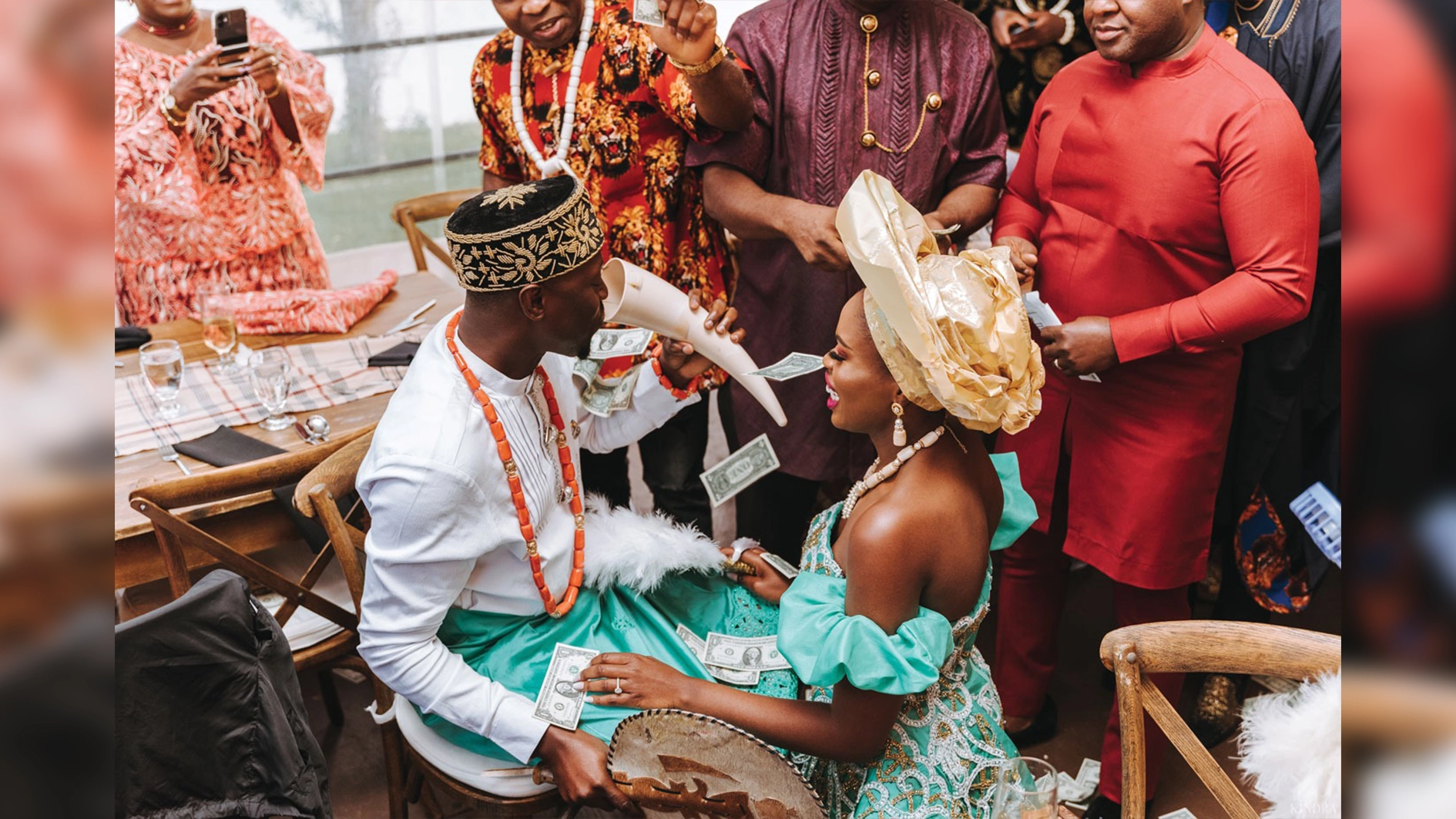
Felicia Okonkwo is a computer scientist. She hails from Ukpor in Anambra State. Last November, she had her traditional marriage, popularly called Igba nkwu, in Ukpor.
“That is the only way my husband will know I have a family and did not fall from a tree,” she said.
According to her, “the white wedding has been scheduled to hold in Lagos so people complaining that I have shut them out will have opportunity to join the celebration.”
Though born and raised in Lagos, she said, “I want to honour my family, especially my uncle who has stood as my father all these years.”
Another lady, who gave her name as Ifeoma Oligbo, said Igba nkwu is best celebrated in the east, “because how many of your family members can you bring to Lagos for your traditional wedding?”
Igba Nkwu is the Igbo traditional wedding ceremony, which involves the bride carrying palm wine to her groom. This traditional ceremony symbolises her acceptance and public identification of him as her husband, officially sealing the union in front of family and community.

Some other features of the ceremony include the couple’s traditional Igbo attire, and involvement of the groom and his family paying a visit to the family of the bribe for introduction known as ikụ aka n’ uzo, and negotiations for dowry are performed.
But this age-long tradition is gradually fading away, as many Igbo families now prefer to hold their traditional marriages in cities.
When The Guardian visited a town hall in Lagos recently, it was discovered that a traditional marriage was holding in the facility. The couple were from a town in Imo State.
Speaking with one of the elderly men at the event, he said insecurity and economic pressure in the country have made many to think out of the box.
The man, who gave his name as Chief John Njoku, said, “the spate of kidnapping in the east is not encouraging. If you invite your in-laws and on the way they are kidnapped will you be happy? Or while you are doing it in the village, suddenly a set of bad boys shows up and whisked your in-laws away and before you know it, they started demanding huge amount of money for ransom.”
Njoku said he would relax and host the traditional marriage anywhere. “It is even better you do your traditional marriage where you are known. How many times have you traveled to the village?” Njoku retorted.
He said: “You can see my village or town people as they gathered here, who else are we going to meet in the village that is greater than the people you’re seeing here today? For me, traditional marriage whether done in Igboland or city, is not fading, rather it is a matter of choice.”
According to a security report by SBM Intelligence, which was released in August 2025, at least 257 people were kidnapped in Nigeria’s Southeast between July 2024 and June 2025.
The figure represents 5.6 per cent of the national total of 4,722 abductions documented within the period.
The report, titled “Locust Business – The Economics of Nigeria’s Kidnap Industry: A 2025 Update”, ranked Enugu as the state with the highest record of kidnapped persons, with 123 in total.
Anambra followed with 63 kidnapped cases; 42 in Imo, 2 in Ebonyi and 27 in Abia State within the period in view.
The report further stated that kidnappers in the Southeast demanded N1.005bn in ransom but only received N157.55m. This accounted for 6.1 per cent of the N2.56bn collected nationwide.
Another elder who spoke to The Guardian, Ahamaefula Jacob, noted that traditional marriage could be hosted anywhere based on agreement.
Highlighting some of the reasons many Igbo families now chose to do it outside of Southeast, Jacob pointed to, “bad roads, distance and the risk involved while traveling.”
For Emeka Emeto, “there is no peace in the Southeast and Igbo families are forced to consider traditional marriage outside Igboland.”
In its editorial of December 3, 202, titled, ‘Curbing violence in South-East’, the Punch noted the persistent violence in Nigeria’s South-
East, comprising Anambra, Enugu, Imo, Abia, and Ebonyi states, continues to raise deep concern.
A recent Amnesty International report revealed that in the past two years, a monarch and approximately 1,800 people have lost their lives in the region. The violence has claimed the lives of members of the Armed Forces, the Nigeria Police Force, the self-styled Department of State Services, and local vigilance groups.
Police stations, courts, local government secretariats, and private properties have been torched or destroyed.
Describing the crisis as “a decade of impunity,” Amnesty’s report one harrowing episode occurred on November 14, 2022, when about 30 gunmen stormed the palace of traditional ruler Ignatius Asor in Obudu Agwa, Imo State.
Witnesses recount how armed men arrived in a convoy of minivans, opened fire in the courtyard, and cold-bloodlessly killed the monarch and two chiefs, pumping over 16 bullets into the ruler’s body before fleeing. No arrests have followed.
Imo State has borne the brunt, recording over 400 deaths between 2019 and 2021, a figure believed to be underreported, followed by Anambra and Ebonyi. Since December 2022 alone, more than 100 fatalities have occurred, many victims of midnight raids, assassinations, and retaliatory attacks.
Mr. Enyinnaya Samuel said, “if you go to your village, you probably won’t see people there, because most of them are in the cities. There are some compounds in the East, you can only see three people but here, you can see that we are complete in this gathering, and sometimes, it’s not so in the village.”
Samuel said insecurity is most dominant reason. He said before December 2025, there were terrible news of innocent citizens being kidnapped. He asked: “Now tell me, if you go to the village with your in-laws who happen to be another tribe, Yoruba or Hausa and in the village they kidnap them, that marriage for me has ended abruptly and I am talking from experience.”
Samuel said traditional marriage is very expensive. So, he would prefer traditional marriage to be hosted anywhere within the city and that would save cost.
He said any marriage done outside Igboland, the kinsmen’s share should be taken to them in the village.
However, Chidi Franklin, who hails from Imo State, believes traditional marriage must be done in the defined manner and place.
Citing the example of the children of Israel in Babylon and their refusal to sing their popular song in a strange land, Franklin said: “Let me tell you, what the Bible recognised is traditional marriage, not white wedding. So, the main marriage is traditional marriage. When you do Igbo custom or tradition in another land it is not complete.
“For instance, when the children of Israel were taken to Babylon and they were asked to sing the song they normally sing when they were in the land of Israel, the children of Israel said, ‘how can we sing the Lord’s song in a strange land’.”
Franklin said he did his traditional marriage in his village and not in Lagos. “For me, I won’t advise my children to do theirs here. When
I married my wife I took her to the village to know her people. I did everything in the village, except white wedding, which we did here in Lagos,” he added.
He recalled one marriage event, he attended here in Lagos and was shocked that some vital requirements such as Igbo kolanut were missing from the table.
Franklin said: “There was one traditional marriage that I attended here in Lagos but I was shocked that the real Igbo kolanut was missing and that’s the problem when you do traditional marriage outside Igboland most of the requirements are completely missing. It is a serious offence and I rejected the kolanut offered to me. The people doing the traditional marriage are purely Igbo and not another tribe.”
For Mr Jude Iheagwam, “if my son wants to marry, he must go to the village to do it, not here in Lagos.”
He said whether he owns a house in Lagos or elsewhere does not take away that age-long tradition and custom in Igboland.
He vehemently condemned those doing it in the city when it should be done in the village where elderly men would oversee the ceremony and also give their wise counsel to the couples involved.
Iheagwam noted that a true son of the soil can never do traditional marriage outside Igboland.
Another Igbo man, Mr Romanus Emeka Ezekwe, a landlord in Ogun State, said a true Igbo man, especially from Anambra, Imo or Abia states would never do his traditional marriage in the city.
To substantiate his claims, Ezekwe noted that every child in Igboland is Nwa oha, meaning that a child is owned by the community.
He said: “Traditional marriage requires the input of elderly men with knowledge and wisdom. They must witness the marriage, give words of encouragement to the couple and prayers. You would love the traditional marriage done in the village. It is strictly adhered to, and cannot be compared with city marriages.”

