 Follow Us on Google News


 Follow Us on Google Discover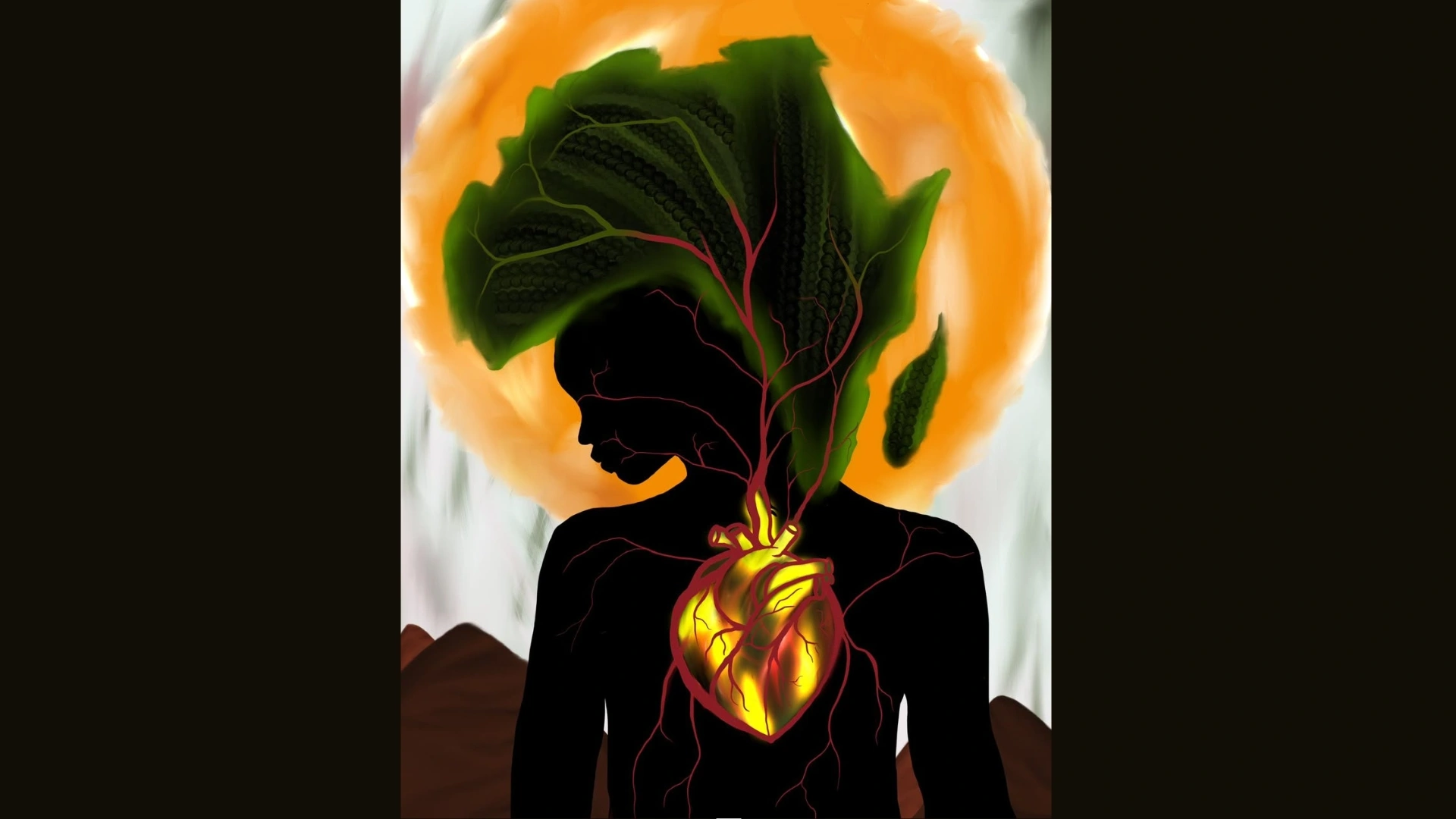
In The Pulse of Progress, Immanuel Obani, professionally known as Immanuel The Artist, presents a compelling challenge to one of modern society’s most unquestioned assumptions: what does progress truly mean? At a time when development is often measured through economic growth, urban expansion, and technological advancement, Immanuel redirects the conversation toward a more fundamental reality. His painting demonstrates that no civilisation can genuinely progress if the natural systems sustaining human life are allowed to deteriorate. Through a striking fusion of anatomy, landscape, and cartography, the work transforms environmental consciousness into an intensely personal and philosophical experience.
At first glance, the painting commands attention through its powerful central image: a silhouetted human figure whose glowing heart nourishes a tree that expands into the unmistakable shape of the African continent. This visual inversion is the conceptual heart of the work. Rather than depicting humanity as separate from nature, Immanuel dissolves the boundary between them, suggesting that the health of ecosystems and the health of human existence are inseparable.
The composition is remarkably economical, yet every symbolic element carries substantial conceptual weight. The anonymous black silhouette removes markers of age, gender, and social identity, allowing the figure to function as a universal human presence while remaining firmly grounded within an African context. This decision shifts attention away from the individual and toward the interconnected systems that sustain all life. The figure becomes less a portrait than a living vessel through which questions of ecology, identity, and responsibility converge.
The glowing anatomical heart is undoubtedly the painting’s emotional centre. Rendered in radiant golds and fiery reds, it pulses with an almost volcanic intensity, immediately drawing the viewer’s gaze. Traditionally, the heart symbolises emotion, vitality, or love. Immanuel expands this symbolism considerably. Here, the heart functions as the engine of ecological continuity. It does not merely circulate blood through the human body; it nourishes the tree that rises into Africa itself. The painting therefore reverses conventional assumptions about humanity’s relationship with the environment. Nature is no longer presented as an external resource supporting civilisation. Instead, civilisation is revealed as entirely dependent upon nature’s continued vitality.
This reversal is among the work’s most intellectually sophisticated achievements. The tree’s branches resemble arteries extending from the heart into the continent, visually collapsing distinctions between biological and environmental systems. Forests become circulatory networks. Rivers become veins. Ecosystems become organs. Immanuel portrays that every act of environmental destruction is not simply an ecological crisis, but a physiological wound inflicted upon us. It is a powerful metaphor that transforms abstract discussions of climate change into deeply human terms.
The depiction of Africa as a living canopy rather than a political map further reinforces this philosophy. The continent appears lush, vibrant, and organically formed, rejecting the rigid borders and geopolitical divisions typically associated with cartographic representation. Immanuel presents Africa not as territory but as consciousness-a living organism composed of memory, biodiversity, history, and future possibility. This conceptual shift is particularly significant within contemporary African art, where questions of identity increasingly intersect with environmental and social concerns.

Visually, the work achieves remarkable harmony through contrast. The intense luminosity of the golden halo behind the African canopy shows an atmosphere of spiritual significance without becoming overtly religious. It elevates the landscape beyond physical geography, suggesting that nature has both ecological and existential importance. Meanwhile, the surrounding muted earth tones and distant mountains ground the composition in physical reality, preventing the symbolism from becoming detached from lived experience.
The artist’s restrained colour palette amplifies the emotional impact of the work. Against the deep black silhouette, the brilliant greens of the African landscape and the incandescent heart become almost sacred presences. Immanuel understands that colour can function conceptually as much as aesthetically. Green here signifies not merely vegetation but renewal, continuity, and hope. Gold suggests life itself, while the crimson vascular network evokes both vulnerability and resilience.
One of the painting’s greatest strengths is its refusal to separate environmental discourse from broader conversations surrounding identity and cultural continuity. The work suggests that climate, memory, heritage, and human health belong to the same living system. This holistic perspective challenges the compartmentalised thinking that often characterises discussions of sustainability. Immanuel suggests that caring for the environment is not simply a scientific or political responsibility; it is an act of cultural preservation and self-preservation simultaneously.
The title, The Pulse of Progress, encapsulates this philosophy with elegant precision. By choosing the word “pulse,” Immanuel replaces static notions of development with an image of continuous rhythm. Progress is no longer imagined as a destination reached through accumulation but as an ongoing balance kept through reciprocity. Like a heartbeat, genuine development depends upon harmony rather than acceleration. It is sustained through relationships rather than extraction.
From a broader critical perspective, The Pulse of Progress marks a significant evolution in Immanuel Obani’s artistic practice. While his earlier works have explored themes of memory, ancestry, and cultural identity, this painting expands those concerns into environmental philosophy without abandoning their human dimension. His distinctive ability to merge symbolic portraiture with conceptual storytelling stays clear, but here it is directed toward one of the defining global conversations of our time: the future relationship between humanity and the natural world.
Importantly, the work avoids moralising. Immanuel does not rely on imagery of environmental catastrophe or despair to communicate urgency. Instead, he presents interdependence itself as beautiful, inviting viewers to recognise their own place within a living ecological network. This optimism gives the painting enduring emotional power. Rather than inspiring guilt, it encourages responsibility rooted in connection.
Ultimately, The Pulse of Progress succeeds because it reframes one of the most important questions of the twenty-first century. Instead of asking how quickly societies can develop, it asks whether development stays meaningful if the living systems that sustain civilisation are allowed to fail. In doing so, Immanuel offers a profound redefinition of progress-one measured not by infrastructure or economic statistics, but by the continued vitality of the earth and the human spirit that depends upon it.
With this work, Immanuel The Artist affirms himself as a thoughtful voice within contemporary African art, showing an ability to unite ecological consciousness, philosophical inquiry, and striking visual symbolism into a cohesive artistic vision. The Pulse of Progress is more than an environmental statement; it is a meditation on interconnected existence, reminding us that the rhythm of humanity has always been inseparable from the rhythm of the natural world.

