 Follow Us on Google News


 Follow Us on Google Discover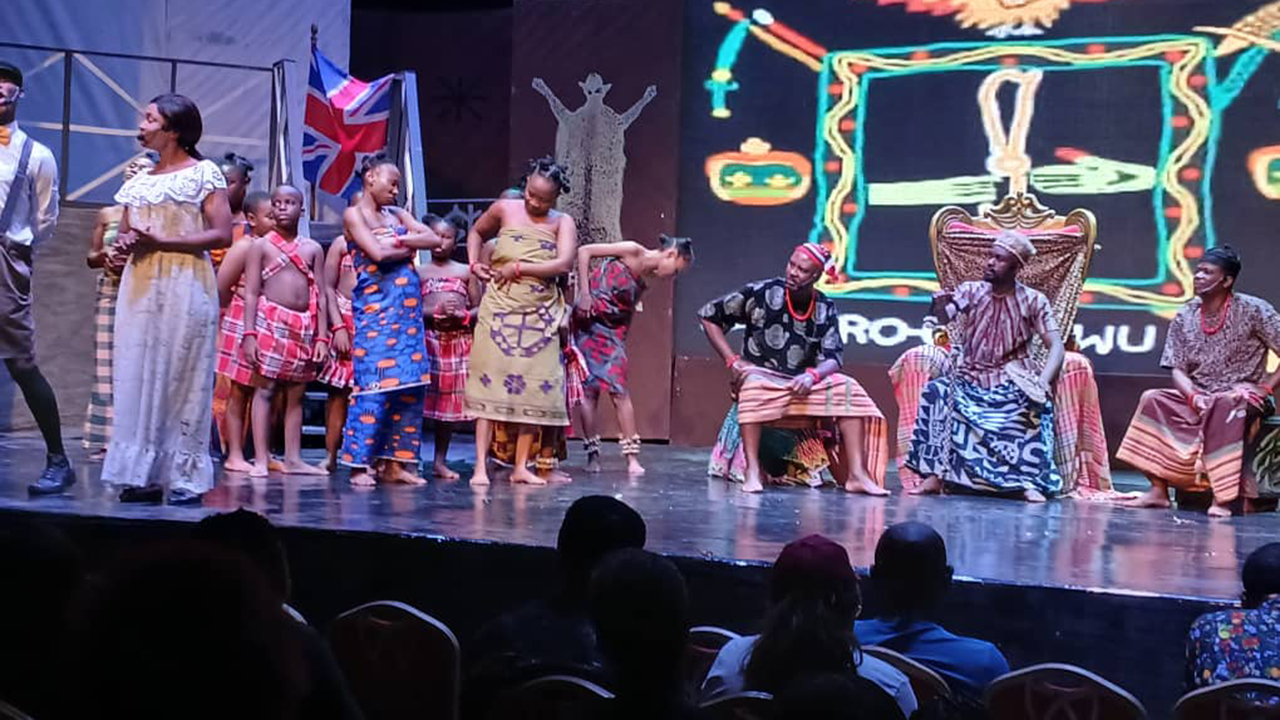

For a very long time, the Ibini Ukpabi, the long juju oracle of the Aros held sway in Igbo land. It was an instrument of justice and served the religious purposes of the people.
[ad]
Arochukwu was a place where Igbo people went to seek justice during disputes over stolen items and other wrongs done by one person to the other. This powerful means of justice made the town strong and bold throughout Igboland and parts of Cross River and Akwa Ibom states.
To fortify the land, Aro warriors were skilled in warfare and unyielding in resolve. These warriors repelled the British attempts at imposing warrant chieftaincy on the kingdom during colonial era. At the end, the kingdom was subdued.
The once-thriving Aro people faced subjugation, their economy and indeed that of the then Eastern region was shattered, their leaders arrested and executed or exiled.
Coming to power at the tender age of 14, the late Eze Kalu Oji of Arochukwu restored Aro’s lost glory, securing its place in the annals of Igbo history. His reign ushered in an era of diplomacy, wisdom, and transformation, balancing tradition and religion with the inevitability of change. He navigated the complex relationship between the Aro people and the British, allowing for progressive reforms while safeguarding Aro’s cultural identity.
This historical trajectory is captured in the play, Uda Nkwa: Echoes from the Drums, by Dr. Ikechukwu Erojikwe, a senior lecturer in the Department of Theatre Arts, University of Nigeria, Nsukka.
Staged recently at the Terra Kulture, Victoria Island, Lagos, it was first performed in Arochukwu, Abia State in December 2004. The play, which lasted for one-and-a-half hours, had over 30 cast and crew members. It was directed by Erojikwe and produced by the Duke of Shomolu Foundation.

It featured notable acts such as Smart Adejumo, Inem Bassey, Chukwu Mark, Micah Chinedum, Praise Abimbola, Chukwuemeka Uba, Patience Dike, Nmeji Aro, and others.
[ad]
A breathtaking tale, Uda Nkwa… tells the story of the late Eze Kalu Oji of Arochukwu, Abia State, who ruled for 73 years. It chronicles, in part, a history that is rich in all fronts.
Erojikwe said, “after the British war during which the long juju oracle was destroyed in the early 1900s, he mounted the throne of his ancestors. He started out in 1921 till 1987. His legacies still live on. His grandson Eze Eberechukwu Oji thought it wise to do a play on his grandfather, hence, this stage play that is produced in his honour. It is full of all the elements of history characterised by a strong and intelligent leader of his people.”
The story is about leadership, what leaders must do to be close to their people. Eze Orji was fond of leaving his palace to visit his subjects at home. People brought cases and disputes from far places for him to settle. He was a peace maker and ensured that people in the Eastern region lived in peace while he was on the throne. In the end, he received two awards from the British and even from the Nigerian government after independence. His tenure served as an embodiment to revisit some of those moments in time when a leader was expected to douse the ugly history of the past, so to say, to embrace changes and carry the people along.
[ad]
Set in Arochukwu, the playwright uses avant-garde narrative to tell the story from the narrator’s perspective. “What we did was a deliberate attempt to use suspension of disbelief in order to carry the audience along and to bring them into the world of Arochukwu,” said Erojikwe, the playwright-cum director.
In the play, a young man, Iheanyi (Praise Abimbola), an anthropologist of Aro descent, embarks on a journey to rediscover his roots. With a mysterious artefact in his hand—retrieved from a clandestine British collection— he arrives at his ancestral homeland, accompanied by his Caribbean companion, Sharone (Eunice).
His arrival raises curiosity, and guided by the wise elder Arukwe (Chukwuemeka Uba), Iheanyi is drawn into a vivid retelling of Aro history, which leads to anagnorisis, as he is a direct descendant of Okoro Nkachu, a revered Aro hunter and warrior, and Eze Kanu Oji, the legendary Aro king.
The staging is innovative, with a set design that seamlessly transitions between the personal and the epic. The use of lighting and sound is particularly noteworthy, creating an immersive experience that pulls the audience into the heart of the story. Most of the songs are chanted within the palace. They dwell on his exploits. They dwell also on his wisdom. The songs say in part, “let us go to the farm, folks. It is time to plant. It is time to harvest. Time to be serious.” Some of the dancers have baskets with them, while other have hoes in their hands. Both men and women are involved in the rigorous dance.
Although Erojikwe says it is not a dance drama per se, the heavy infusions of dances seem to make the play fall fully within the ambit of epic historic play.
[ad]

