 Follow Us on Google News


 Follow Us on Google Discover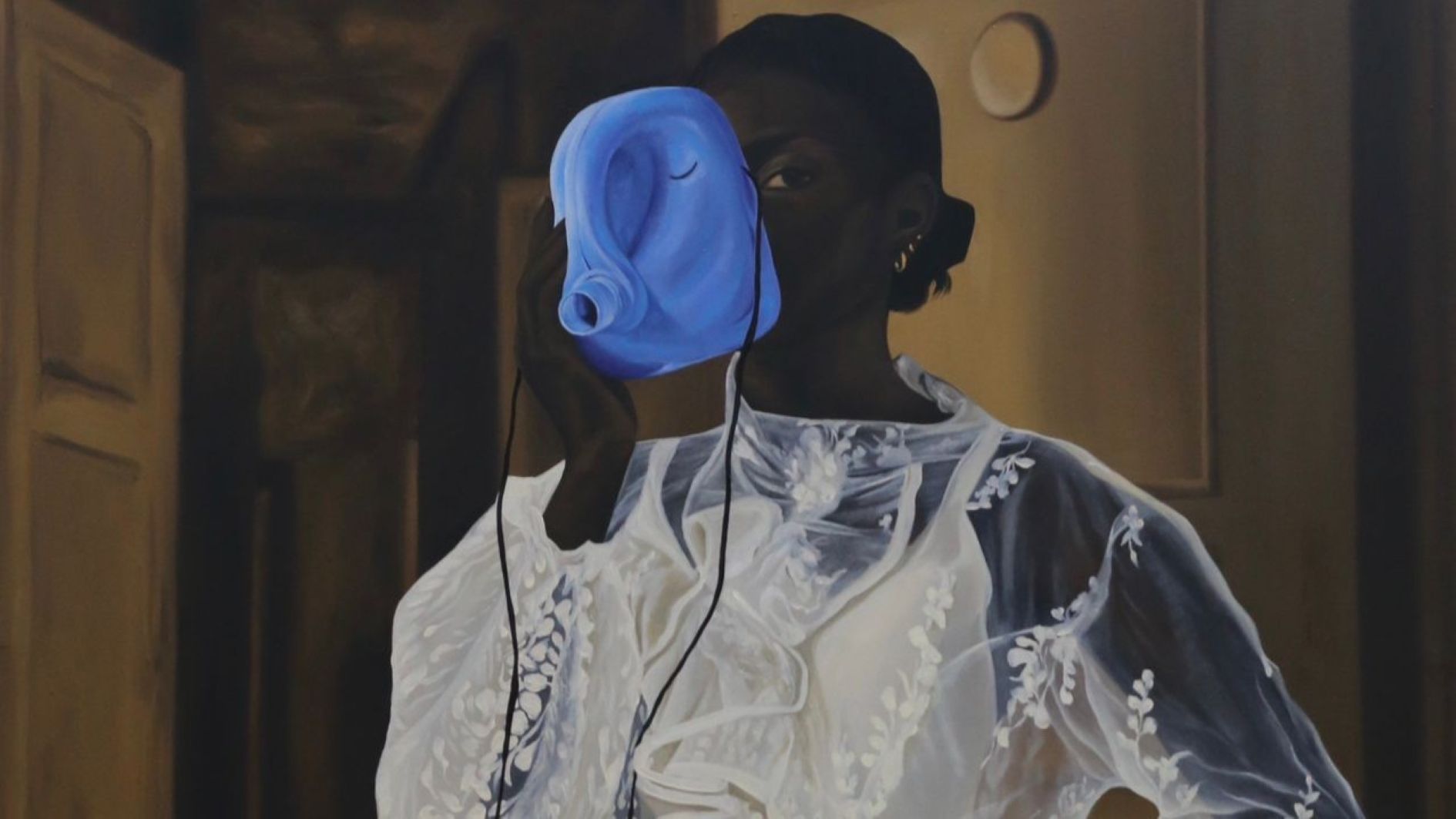
We live in a restless age. Across the world, crises—some born of human error, others of sheer circumstance—continue to puncture the fabric of everyday existence. In Quiet Struggle, a compelling body of work by Lagos-based contemporary visual artist Lawal Habib Olanrewaju, this tension becomes both subject and meditation.
Comprising four paintings—Dona I, Dona II, Dona III, and Still—the series reads like a visual essay on resilience, identity, and the quiet endurance required to navigate life’s uncertainties. Through these works, Olanrewaju poses a subtle but powerful question: in a world that demands constant visibility and performance, how do we hold ourselves together when everything seems to be falling apart?
Executed in oil on canvas and steeped in surrealist aesthetics, the paintings employ plastic kegs as a recurring visual motif. In the Dona series, a young Black maiden dressed in a flowery off-white mesh garment stands with a blue plastic keg masking her face. This unusual symbol becomes central to the narrative of the work. The keg represents concealment—an emblem of hidden identity and the emotional withdrawal that often accompanies moments of personal crisis.
At the same time, the object suggests transformation. In everyday Nigerian life, plastic kegs are vessels of trade, movement and survival. In Olanrewaju’s visual language, they evolve into metaphors for resilience and self-preservation. They reclaim space for those who may feel invisible, reminding viewers that quietness or introspection need not be interpreted as weakness in a society that often rewards outward performance.
In Dona I–III, the figure is positioned within a passageway, reinforcing a sense of transience. The corridor becomes a metaphorical tunnel—an in-between space where uncertainty lingers but hope remains visible at the end. The model’s poised gait suggests quiet defiance, dignity and endurance, embodying the possibility of triumph even in the midst of adversity.
The tonal palette deepens this narrative. Darker, moody hues encourage introspection, while subtle highlights introduce a cathartic glow, hinting at resilience and the promise of emotional renewal.

The series reaches its emotional crescendo in Still. Here, the subject appears again as a young maiden, yet her cultural identity is more visibly pronounced. She is dressed in a flowing boubou fashioned from vibrant wax print fabric and a gele (headscarf), grounding the work in African visual tradition. Despite the keg concealing her face, her posture conveys serenity and quiet confidence—as though she has emerged from turmoil into a space of newfound calm.
Taken together, the paintings offer poignant commentary on mental health and the silent pressures of modern existence. They interrogate the burden of maintaining composure in a world that often demands strength even at the edge of emotional collapse.
The keg motif further enriches this reading. Beyond its psychological symbolism, it evokes commerce, mobility and economic survival. As such, it becomes a layered metaphor for identity itself—raw, dynamic and shaped by both personal and socio-economic realities.
Quiet Struggle resonates strongly with contemporary life, reflecting the silent battles faced by individuals across both urban and rural societies. Through its surrealist symbolism, the series offers not only critique but also solace, reminding viewers that resilience often exists beneath the surface of stillness.
The works stand among Olanrewaju’s most compelling to date, reflecting over a decade of sustained engagement with oil and acrylic painting. Through carefully composed poses, layered symbolism and evocative colour palettes, the artist transforms quiet despair into a dreamlike meditation on endurance and human vulnerability.
In Quiet Struggle, the message is unmistakable: beneath silence often lies strength. The paintings speak in a visual language that feels intimate and direct—like a conversation unfolding within another conversation, one that meets the viewer’s gaze and quietly affirms that their struggles, too, are seen.
Lawal Habib Olanrewaju is a Lagos-based contemporary visual artist whose practice explores identity, vulnerability and transformation through symbolic and figurative painting. He is particularly known for KEGS, a recurring visual character derived from the everyday plastic gallon, used as a metaphor for concealment, emotional restraint and socio-cultural experience in Nigeria. His works are held in private and international collections, and he has exhibited through platforms including The Jade Art Collective, Lianna Foundation and Gallery and the Plus234 Art Fair.

