 Follow Us on Google News


 Follow Us on Google Discover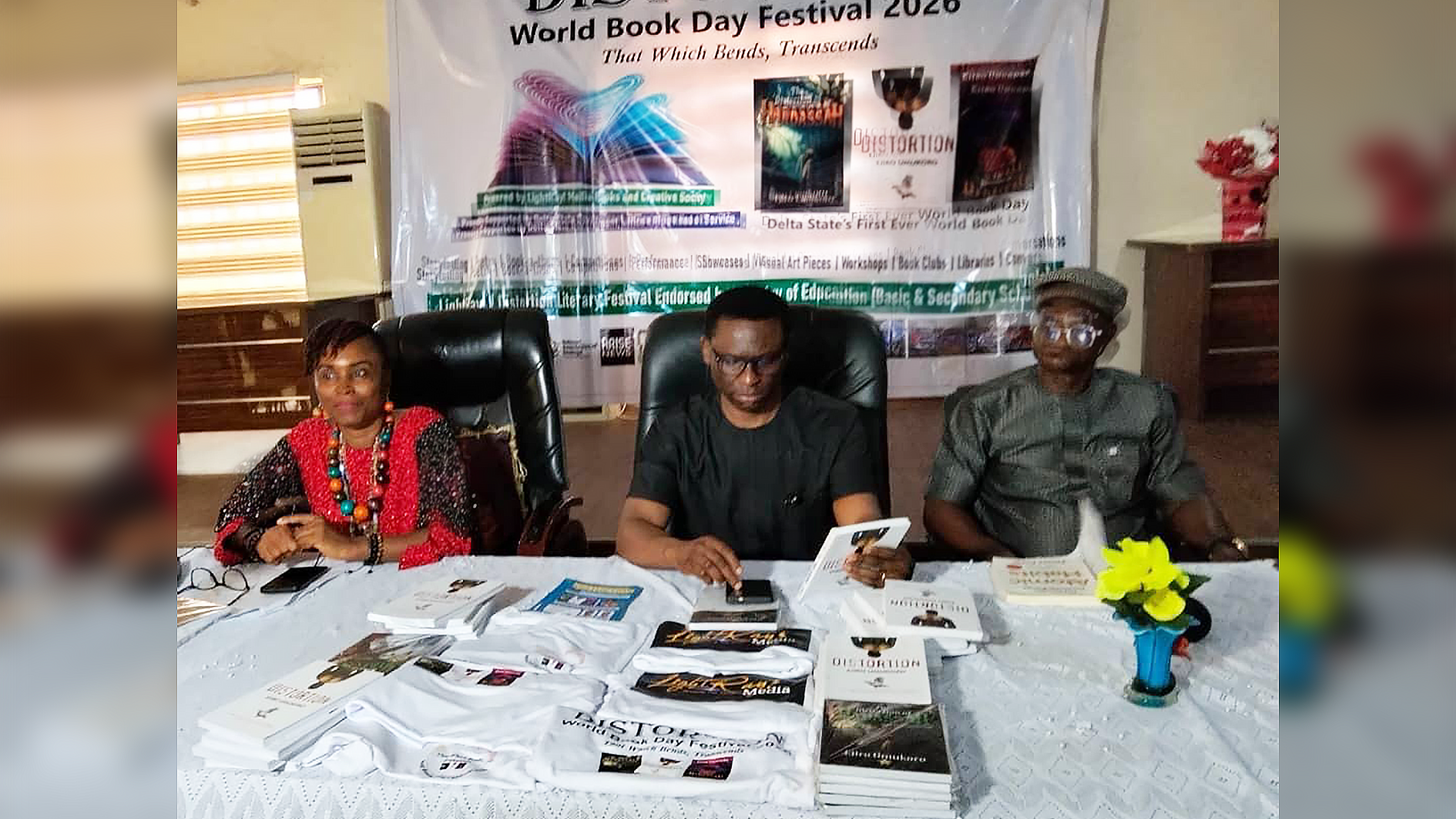
The unveiling of the Distortion World Book Day and LightRay! Festival in Asaba, Delta State, has sparked renewed concern about Nigeria’s weakening reading culture and the deteriorating state of public libraries, with stakeholders warning that the country risks being left behind in the global knowledge economy.
The literary event—described as the first of its kind in the state—featured storytelling sessions, poetry, competitions and performances designed to explore themes of resilience, hope, agency and renewal.
But beyond the celebratory atmosphere, speakers used the platform to highlight what they described as a deepening neglect of literature and reading infrastructure across Nigeria.
Delta State Head of Service, Dr. Mininim Oseji, said literature remains a powerful tool for shaping society, challenging minds and inspiring new ways of thinking.
Represented by his Permanent Secretary, Wilson Chukwuma, Oseji urged Nigerians to cultivate the habit of reading, warning that ignorance thrives where books and knowledge are neglected.
“Literature recognises the role of creativity in shaping society. People must keep reading books so that we do not remain ignorant,” she said, adding that the importance of reading is evident even in everyday life, as people rely on their vision to read signs on the road and in public spaces.

However, the author of The Distortion series, Lady Ejiro Umukoro, lamented Nigeria’s apparent indifference to celebrating literature, noting that countries such as the United Kingdom and the United States treat World Book Day as a national cultural event.
She argued that Nigeria’s failure to prioritise literature and storytelling undermines its place in the global knowledge economy.
“In the knowledge era, we can no longer watch the world pass us by or allow others to tell our stories when we have the capacity, skills and resources to do so,” Umukoro said.
She added that the festival was intended not just as a celebration of books but as the beginning of a broader movement to place storytelling, creativity and knowledge at the centre of community development and economic growth.
The discussions at the festival laid bare structural problems confronting the literary sector, particularly the poor state of libraries across Delta State.
According to her, many public libraries in the state—some more than three decades old—are dilapidated, poorly ventilated and largely non-functional.
Most lack modern information and communication technology facilities, while book collections are outdated and cataloguing systems obsolete, she said.
“In many cases, libraries have reportedly become little more than storage spaces for aging newspapers rather than vibrant centres for research, learning and intellectual engagement.
“The situation is even more troubling in schools, where many primary and secondary institutions reportedly operate without functional libraries.
“Experts also noted a shortage of trained librarians, with more than 89 percent of staff in some library branches said to be non-professionals.
“Limited funding, erratic electricity supply and declining patronage have further weakened the library system, leaving institutions unable to perform their traditional role as knowledge hubs,”she declared.
Officials who attended the event—including Deputy Clerk (Administration) of the Delta State House of Assembly, Smart Edoge; Permanent Secretary in the Ministry of Information, Stella Macaulay; and President of the Asaba Book Literacy and Reading Club, Dr. Gabriel Okonji and others—warned that Nigeria’s reading culture is rapidly eroding.
They described reading as essential to intellectual development, noting that “reading is to the mind what exercise is to the body.”

