 Follow Us on Google News
 Follow Us on Google Discover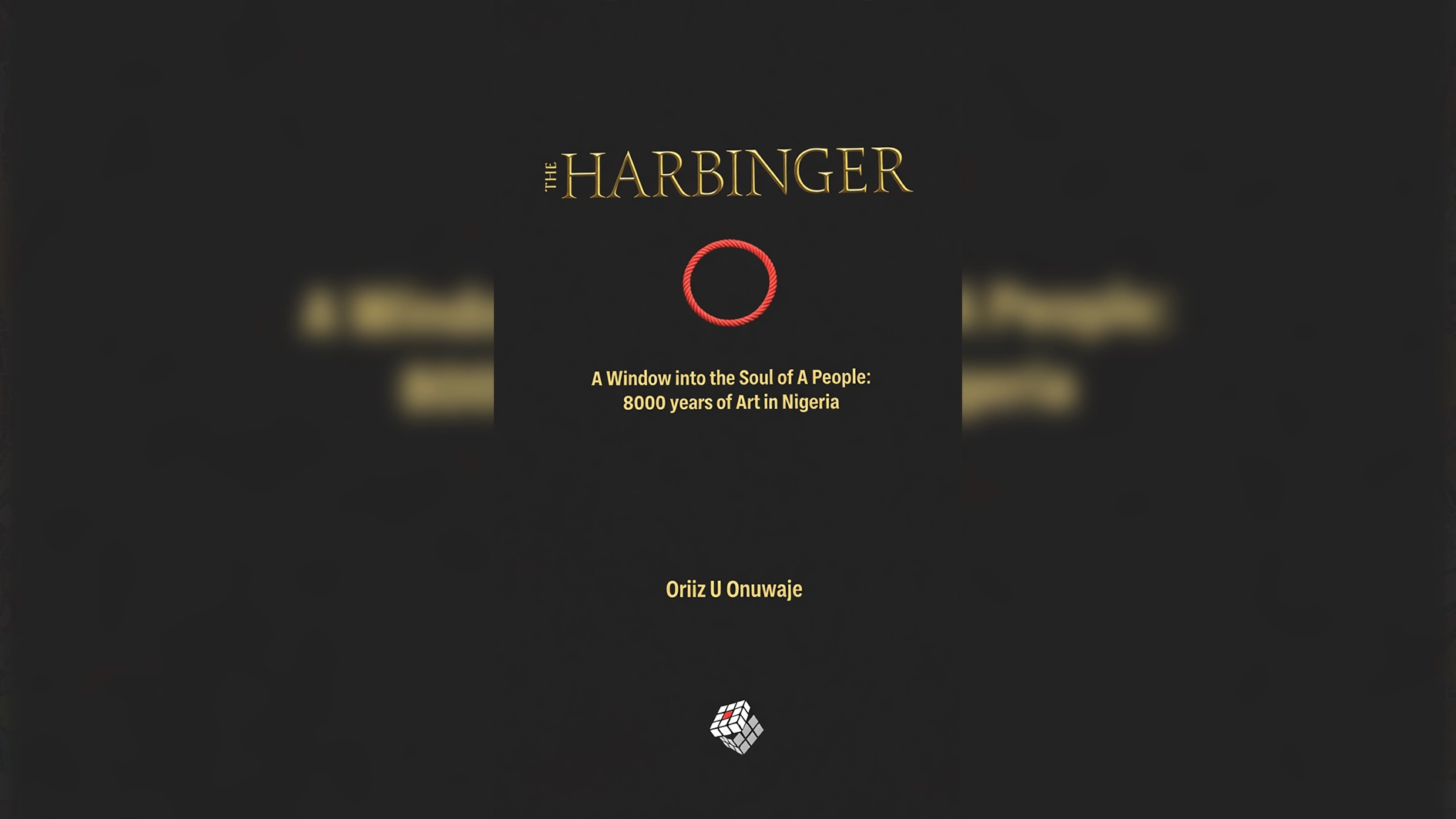
In an era when African art is often presented in fragmented snapshots, Oriiz U. Onuwaje’s The Harbinger emerges as a formidable declaration, a sustained and rigorous effort to restore continuity, clarity, and ownership to Nigeria’s vast artistic heritage.
More than a catalogue of objects, more than an inventory of visual wonders, the book offers a panoramic gaze, a window into the soul of a people whose creative endeavours stretch across eight millennia. This work is audacious in its scope, meticulous in its scholarship, and profoundly poetic in its sensibility, positioning art as both a repository and an active agent of memory, culture, and governance.
From the outset, the book establishes its conceptual stakes in the introduction, ‘The First Glimpse’. Here, Nigeria’s artistic legacy is presented not as sporadic brilliance, but as a continuous, living tradition, with each artefact, structure and motif a testament to deliberate intelligence.
The narrative begins with the Dufuna Canoe, dated over 8,000 years ago, a single tree hollowed into a watercraft, demonstrating not mere utility but conceptual design and engineering foresight.
Long before the Nok Terracottas emerged from the earth, this canoe carried imagination across the Yobe Valley, establishing the earliest known articulation of design thinking in Nigeria. For Onuwaje, the canoe is more than an object, it is a symbolic threshold, where utility converges with beauty and where craft becomes a medium of memory.
From this origin, the narrative expands seamlessly into the consistency of form and philosophical structure spanning 6,000 BCE to the 15th century. The book charts the transition from engineering to sculpture, tracing the development of conceptual precision and moral imagination across successive societies. The Nok tradition, for instance, emerges as a calibrated social and moral canvas.


Terracotta figures illustrate not just physical likeness but the idea of personhood, reflecting societal hierarchies and ethical values embedded in artistic practice. Ife, in turn, elevates these innovations into aesthetic systems, where harmony, symmetry, and physiognomy encode philosophical principles. Concepts of destiny and character become inseparable from form. Across these traditions, whether in Nok, Ife, or Benin, the book asserts that form was never incidental, it was conceptual, deliberate, and culturally resonant.
The narrative then moves into art as a state memory system, highlighting how courtly arts became instruments of governance and historical preservation. In Benin, the lost wax technique reached its apogee through the Sa-Pédiu method, producing bronze plaques, tusks, and ritual figures that doubled as repositories of dynastic memory. The 1897 British punitive expedition is interpreted not simply as looting, but as an assault on living archives, an attempt to dismantle a knowledge system.
Similarly, Igbo-Ukwu bronzes, Hausa-Fulani calligraphic and sartorial arts, and the kinetic masquerades of the Niger Delta demonstrate that Nigerian art historically functioned as an active historical record, a living archive continuously in dialogue with society.
Throughout these chapters, Onuwaje foregrounds both the unbroken thread of continuity and the diversity of practice. The book traces artistic expression from royal courts to local guilds, from sacred objects to daily life, asserting that each artefact embodies both social logic and ethical meaning. Masquerade performance, metalwork, and architectural forms are not mere decorations, they are documents of social organisation, spiritual belief, and cultural knowledge. The meticulous cataloguing of artefacts, including Nok terracotta heads, Ife bronzes, Benin memorials, and ritual objects, serves as evidence of a systematic intelligence that is both aesthetic and civic.
Transitioning into the modern and post-independence era, The Harbinger situates contemporary Nigerian practice within this historical continuum. The Zaria Art Society, the Osogbo School, and other post-1950 movements are shown as responses to and continuations of older traditions while innovating in technique, materials, and social engagement.
Onuwaje demonstrates how contemporary artists expand the “toolkit” of Nigerian creativity, merging technical mastery with conceptual rigour, echoing centuries of unbroken dialogue with form and meaning. Modern metalwork, performance, and even digital experiments are presented as part of a continuum rather than discrete modernist episodes, revealing the persistence of critical thought, civic engagement, and aesthetic discipline across generations.

Significantly, the book does not neglect the imperatives of preservation and stewardship. Onuwaje argues that both physical and digital archives are essential for the survival of Nigeria’s artistic memory. The National Commission for Museums and Monuments, alongside independent curatorial partners, provides frameworks for digitisation, responsible curation, and knowledge circulation. Digital tools are presented not as mere documentation mechanisms, but as active enablers of restitution, education, and accessibility, ensuring that the intellectual legacy of Nigerian art is returned to the people and not confined to climate-controlled vaults. Here, Onuwaje reinforces a recurring theme, memory is civic, not private, and history is not inert, but mobilised through attentive stewardship.
The conclusion, ‘Movement and Meaning’, eloquently synthesises the book’s argument. Nigerian art, Onuwaje asserts, embodies one of humanity’s longest continuous creative traditions, connecting form, spirit, and society. Stewardship, humility, and ambition are essential to sustaining this legacy. The mission is clear, to return heritage from the silence of glass shelves to the pulse of the people. Here, the griot rises again, not merely with drums, but with pixels and code, linking memory to horizon, heritage to global dialogue.
Although the book is an immensely rich and engaging read, the density of the material occasionally challenges the reader. The extensive detail and breadth of scholarship can require careful attention to follow, particularly for those less familiar with Nigerian art history. Minor adjustments such as concise summaries or clearer signposting at the end of chapters would enhance accessibility without diminishing the intellectual rigour of the work. This does not lessen the book’s profound contribution but offers a constructive observation for future editions.
By combining scholarly rigour, curatorial insight, poetic reflection, and visual documentation, Onuwaje produces a book that is both intellectually authoritative and emotionally resonant. Its insistence on continuity, civic memory, and accessible knowledge challenges entrenched narratives and offers a model for understanding African art on its own terms.

