 Follow Us on Google News


 Follow Us on Google Discover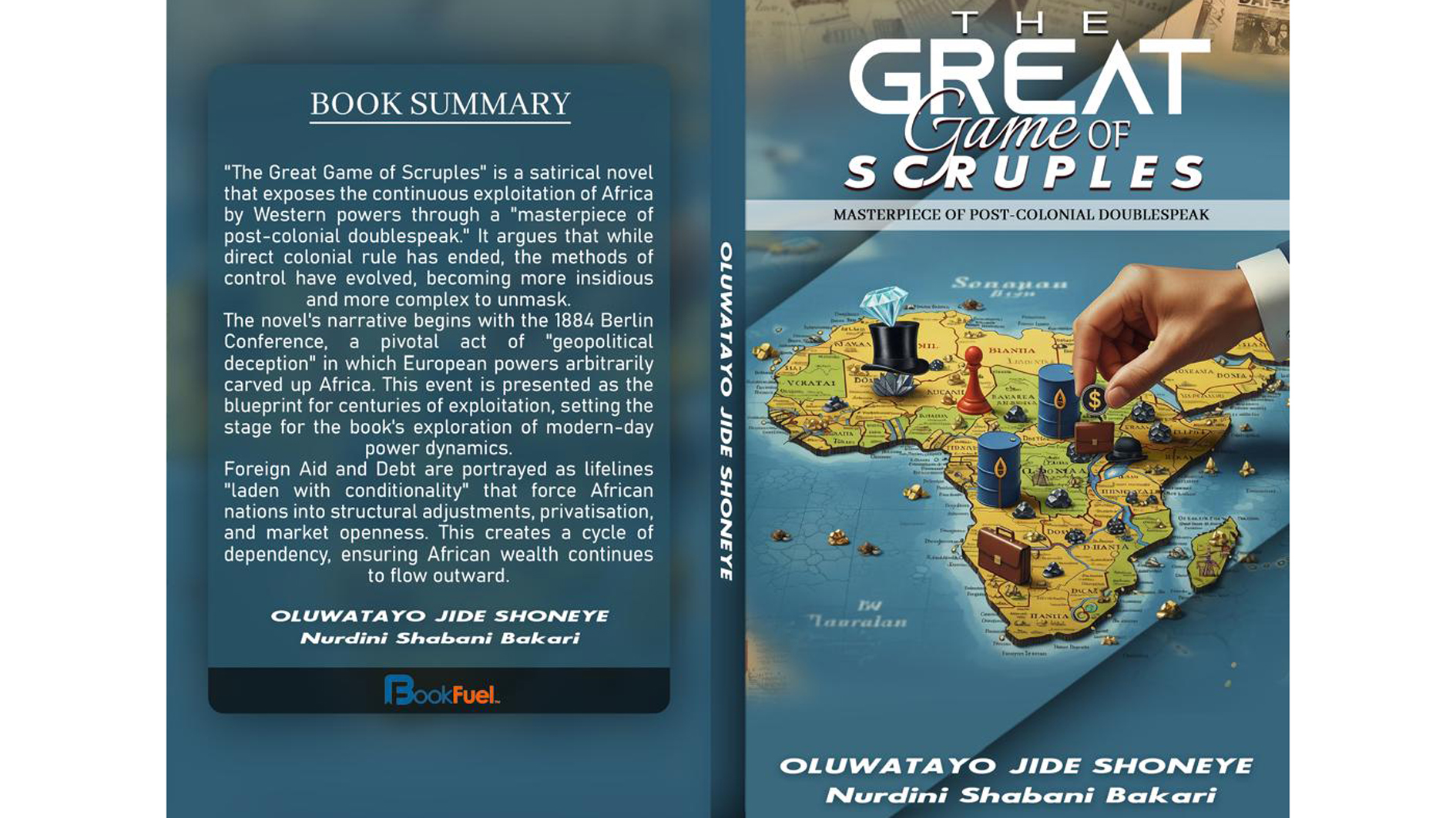
By Princess Obokhale
Few phrases in contemporary political discourse evoke as much collective trauma across the Global South as “Structural Adjustment” and “Sovereign Debt.” For decades, these clinical, antiseptic terms have been treated as fiscal necessities, prescribed by clean-cut technocrats flying into African capitals for forty-eight hours. Yet, underneath the impeccable handshakes and meticulously drafted loan agreements lies a jagged truth: the mechanics of extraction have merely swapped the colonial bayonets of the 19th century for the digital spreadsheets of the 21st.
In their blazing new collaborative novel, The Great Game of Scruples, Nigerian political satirist Oluwatayo Jide Shoneye (author of the acclaimed JAPA: The Great British Migration Lottery) teamed up with historian Nurdini Shabani Bakari to deliver an intellectually violent and searingly funny systemic autopsy of the global financial order. Moving far beyond the local anxieties of migration explored in JAPA, Shoneye and Bakari zoom out to hand the reader a pair of “infrared spectacles” capable of revealing the predatory economics choking our continent.
The Janitor and the Machine
At the narrative heart of this five-part saga is Mamadou Cissé, a senior financial analyst in Dakar who describes himself as a “Janitor of the Labyrinth”. Mamadou’s daily job is to feed and maintain “The Algorithm”, a centuries-old financial software that mathematically translates human life into interest rates, turns sovereign natural resources into conditionalities, and locks developing countries into a perpetual debt treadmill.
The plot thickens swiftly as a looming global crisis in 2026 causes a glitch in this macroeconomic system. Mamadou discovers an uncounted “Variable” buried deep in the code, forcing him to make an existential choice: continue serving as the administrative grease for a system harvesting his people’s future, or risk everything to leak the secrets and join the “Parallel Pulse”, an invisible, decentralised network of “New Architects” fighting to shut down the spreadsheet for good.

A Lineage of Exploitation: From Berlin to the Delta
What makes The Great Game of Scruples exceptional is its brilliant temporal scope. The authors do not view Africa’s current financial distress as a series of isolated structural failures or localised corruption. Instead, they trace a direct, bloody lineage back to the winter of 1884.
In a chillingly satirical opening chapter, “The Berlin Buffet,” we are taken into the grand, smoke-filled Chancellery on Wilhelmstrasse, where European powers carve up a continent like a Thanksgiving turkey on fine bone china. Here, figures such as Britain’s Lord Salisbury and France’s Delacroix skilfully rebrand plunder as “Free Trade Zones” and forced labour as “Capacity Building.” Delacroix notes with wicked triumph: “The greatest game is one in which the victims believe they are playing against themselves.”
For Nigerian readers, the historical parallels feel painfully close to home. The novel smoothly transitions to the Lagos Colony in 1902, highlighting the absurdity of an “Inverted Economy” where the British colonial administration imports processed timber from Liverpool while standing amidst a vast, ancient West African mahogany forest. It reveals the cyclical tragedy of a colony borrowing money from London to buy goods from London, creating a never-ending loop of debt.
Even more striking is the exploration of our own backyard in the Niger Delta. In “Operation Delta Stability,” the novel reveals how corporate interests and state military violence intersect. When local activists block the flow of “Liquid Gold” to prevent their ancestral burial grounds from becoming an oil-contaminated sludge pit, international media outlets sanitise the brutality, framing the military suppression of dying communities as a necessary measure for “Securing the Flow” and protecting “Global Partners”.
The Iron Fist Behind the “Scruples”
The novel’s thematic brilliance lies entirely in its title. The “Scruples” do not represent genuine morality; rather, they are the highly sophisticated ethical masks, “Transparency,” “Good Governance,” and “Sustainability”, worn by the global creditor class.
As Mamadou Cissé meticulously logs in his “Inventory of Deception,” transparency is merely the tool used by foreign banks to monitor a victim’s ongoing capacity to pay debt. In a brilliant comedic paradox, the book highlights how Northern capitals host anti-corruption summits and lecture the South on fiscal discipline, while their own banking systems happily launder the billions stolen from African treasuries. They sell us the compliance software to track the very loot they shelter.
The novel pulls no punches regarding the lethality of this system. It pays direct homage to historical martyrs like Patrice Lumumba, Thomas Sankara, and Muammar Gaddafi, reminding us of the ultimate price paid by leaders who dared to step away from the board. Through Mamadou’s readings of leaked memos, the authors lay bare the NATO intervention in Libya, arguing it was driven not by humanitarian scruples, but by a desperate, panicked move to crush the threat of a gold-backed African Dinar that would have shattered the West’s monetary monopoly. “If you challenge the philosophy, they kill the man,” Mamadou writes. “If you challenge the currency, they kill the country.”
A Blueprint for the New Horizon
Despite its sharp, cynical edge, The Great Game of Scruples refuses to drown in Afro-pessimism. Salvation in this text does not come from begging for foreign debt forgiveness, nor does it come from trying to negotiate with the IMF from within, a trap perfectly illustrated by the tragic character of Dr Adebayo, a brilliant technocrat forced to burn his grandchildren’s inheritance to service old colonial loans.
Instead, true liberation lies in the “Parallel Pulse,” the unrecorded, informal economy of West African market women and grassroots networks who deal in the only currency the Algorithm cannot devalue: communal trust. The book follows a spectacular “Silent Exodus,” where Google engineers, Wall Street analysts, and Global South tech experts leave the metropole and return home to build peer-to-peer energy grids, localised token economies, and sovereign agricultural hubs.
When the Algorithm eventually crashes under its own greed in late 2026, the Western metropolises crumble into food queues because they lack a community grid to rely on, while Africa endures, stabilises, and breathes because it remembered how to speak to the person with the chickens.
The Verdict
Shoneye and Bakari have written something monumental. The Great Game of Scruples is an intellectual Molotov cocktail wrapped in exquisite prose. It is a necessary fiction that functions as a political manifesto for an emerging generation of African architects, economists, and thinkers who are tired of playing a rigged game.
As Nigeria and the wider continent navigate a rocky era of fluctuating fiat currencies and suffocating international credit ratings, this novel offers a profound, defiant thesis: We do not defeat the Great Game by winning it. We defeat it by refusing to play.
This is not just a book to be read; it is a ledger to be studied, a manifesto to be shared across social media, and a roadmap toward reclaiming our own garden. Highly recommended.
The Great Game of Scruples is available globally and is currently being launched across regional hubs, including the London Book Fair.

