 Follow Us on Google News


 Follow Us on Google Discover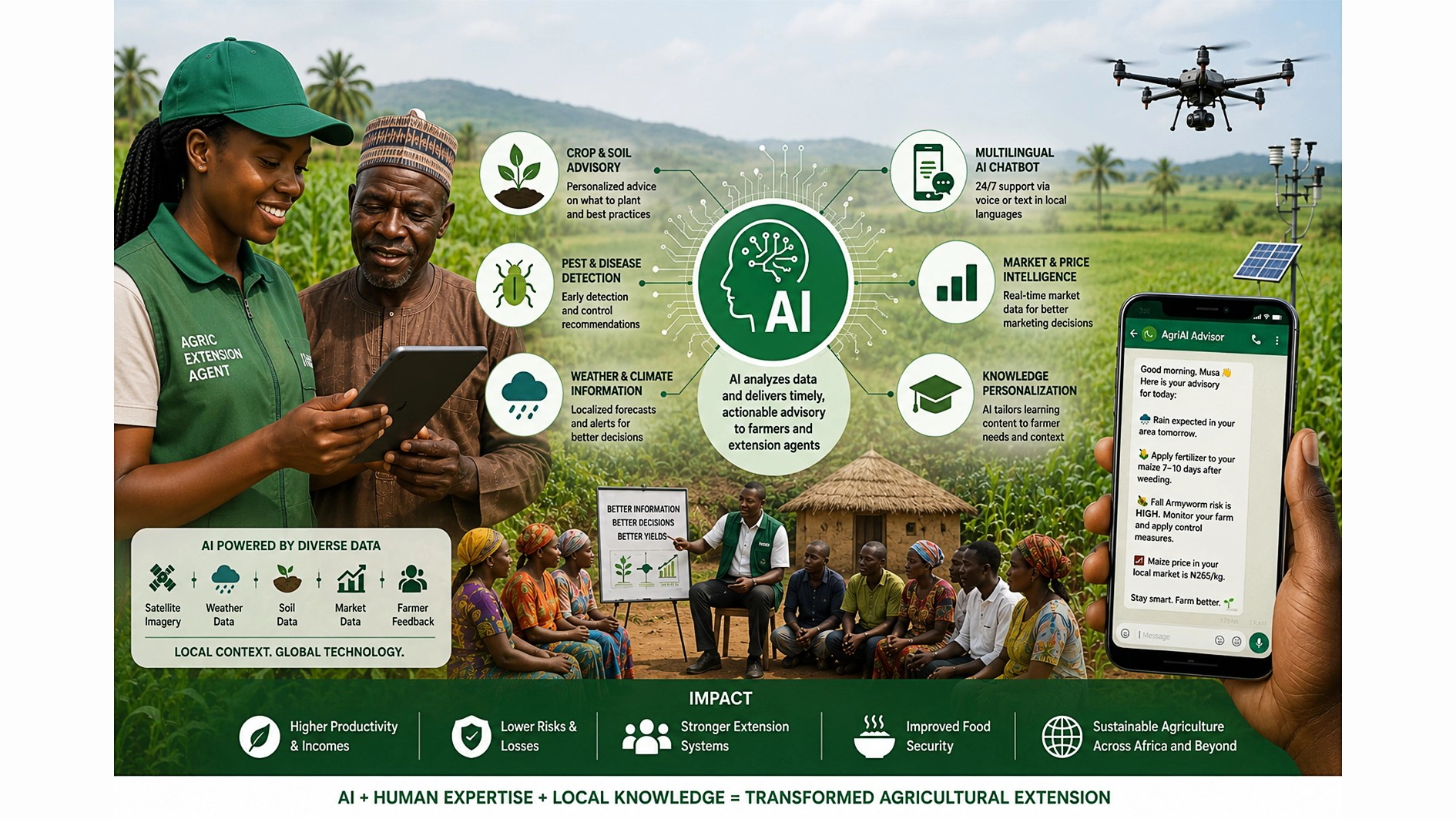
The International Food Policy Research Institute (IFPRI) and the African Forum for Agricultural Advisory Services (AFAAS) have launched a joint effort to explore how generative artificial intelligence (AI) can strengthen agricultural extension systems across Africa.
This initiative, in collaboration with AFAAS national chapters in Kenya (Forum for Agricultural Advisory Services – Kenya (KEFAAS); Liberia – Liberia Forum For Agricultural Advisory Services (LIFAAS); Nigeria – Nigerian Forum for Agricultural Advisory Services (NIFAAS); and Uganda – Uganda Forum for Agricultural Advisory Services (UFAAS) is coming at a time when extension system is in near-comatose across the continent.
The collaboration builds on IFPRI and AFAAS’s shared commitment to evidence-based innovation in agricultural advisory services. Through IFPRI’s Generative AI for Agriculture (GAIA) initiative, the partners are conducting design workshops to inform emerging AI applications that can support farmers and extension agents with timely, localised, and trusted information.
These activities bring together extension professionals, researchers, and policymakers to explore how generative AI can complement human advisory systems and support national digital agriculture strategies.
As the collaboration advances, the partners will convene national stakeholders to identify priority use cases and co-design approaches for testing AI-enabled advisory tools. The collaboration emphasises a participatory process centered on trust, usability, language accessibility, and contextual relevance, ensuring that future AI innovations strengthen human relationships at the heart of agricultural extension.
In Nigeria, NIFAAS/NAERLS Founding Member, Christogonus Daudu, revealed that the IFPRI-AFAAS partnership, working through NIFAAS and the National Agricultural Extension and Research Liaison Services (NAERLS), has brought Nigerian extension professionals into a timely and critical conversation on the role of AI in agricultural advisory services.

He noted that the engagement comes at a moment when public extension systems in Nigeria—and across Africa—are at their lowest ebb, constrained by severe limitations in knowledge, human resources, and infrastructure. “Contextual AI interventions are therefore not optional but are urgently needed, both to strengthen advisory functions that extension systems currently struggle to deliver and to reach farmers and communities that existing structures are unable to serve.”.”
A senior research analyst, GAIA Initiative, IFPRI, Eliot Jones-Garcia, said: “Extension systems across Africa are already evolving through digital innovation. By working with AFAAS and its country networks we are ensuring that AI tools are tested, adapted, and governed in ways that reflect local realities and amplify—not replace—human expertise.”
In Uganda, the Chief Executive Officer, UFAAS, Beatrice Luzobe, said the extension worker-to-farmer ratio remains a major challenge. “From these discussions, it is clear that artificial intelligence presents a valuable opportunity to complement human expertise and strengthen agricultural extension systems. Rather than fearing replacement, extension professionals should embrace AI as a tool that enhances the quality, speed, and effectiveness of extension delivery. This collaboration with IFPRI is timely.”
To the Executive Director, AFAAS, Lilian Lihasi Kidula, Africa’s extension system must not be left behind in the current digital transformation era and AI revolution.
He noted that AFAAS, through its partnership with IFPRI and Country forums, strives to ensure that AI-enabled digital advisory systems adopt a public-private partnership model and are shaped by farmers’ realities, while expanding the reach, relevance, and resilience of extension and advisory services in the continent.”

