As Nigerians are gradually returning to agriculture in response to Nigeria’s food and economic challenges, urban farming is one of the options many are currently adopting.
In cities, this method of farming is emerging as a quiet but measurable answer to the the country’s lingering food crisis, as residents now rely increasingly on small-scale cultivation for household consumption and income.
While urban agriculture has long existed at the margins, recent economic pressures, particularly rising costs, unstable supply chains and limited access to fresh vegetables, have pushed more urban residents to adopt small food-production systems.
From rooftops in Lagos to backyard systems in Abuja, a growing number of Nigerians are experimenting with hydroponics, aquaponics and container gardening as food inflation and supply disruptions continue to shape daily life.
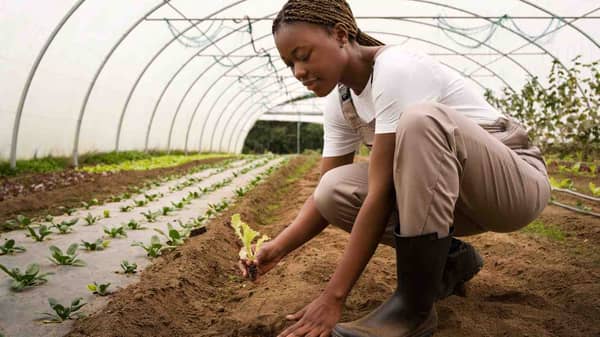
The experience of a 27-year-old fresh graduate, Ifeoluwa Adedayo, who runs a modest hydroponic farm on the rooftop of her family home in Surulere, Lagos State, reflects a broader pattern.
Constructed with recycled plastic bottles, pipes and a small solar pump, the system supports leafy vegetables such as lettuce, spinach and basil. What began as a lockdown project has evolved into an income source.
“I started because food prices kept rising,” she explains. “Later, some restaurants in the area asked if I could supply them regularly.” She now delivers produce to three neighbourhood eateries.
Nigeria’s food inflation hovers around 21 to 22 per cent in mid-2025, according to the National Bureau of Statistics. The sustained rise has continued to squeeze urban households, many of which already dedicate a large share of their income to food.
In Lagos, the dependence on food transported from rural areas remains very high. Logistics challenges, including fuel costs, poor road infrastructure, and security issues along major transport routes, further complicate supply.
Analysts warn that this model is increasingly vulnerable to shocks, with any disruption quickly reflected in market prices.
“Over 75 percent of Lagos’s food supply currently comes from other states,” says the Lagos State Commissioner for Agriculture and Food Systems, Abisola Olusanya. She notes that urban agriculture is becoming an important supplement to the city’s food supply chain.
To address these vulnerabilities, she said the state government has launched initiatives such as the “Produce for Lagos” programme and the Central Food Security Systems and Logistics Hub in Epe, aiming to improve storage, distribution, and local production, while stabilising prices for residents.
With limited space, residents are turning to alternative systems that require minimal land and water. Hydroponics, sack farming, container beds and vertical gardens are now common in several neighbourhoods.
The renewed interest among young people is also driven by accessible technology. Simple smartphone apps now guide planting cycles, nutrient ratios and water management. Social media platforms host large communities where new urban farmers troubleshoot issues, share market information and exchange resources.
In Abuja, 30-year-old urban farmer, Samuel Oche, runs an aquaponics system combining catfish rearing with vegetable production. He monitors water quality through phone-linked sensors and participates actively in online training groups.
“I didn’t study agriculture,” he says. “Most of what I know came from online resources and peer networks. The technology makes it easier to start small.”
Platforms such as FarmEasy, AgroHive and UrbanGrow provide aggregated market places, logistics links and short courses tailored for micro-farming. While small in individual scale, analysts note that these dispersed networks are contributing to urban food availability and entrepreneurship.
Urban farming is also intersecting with waste management efforts. On her part, a secondary school teacher, Chidinma Nwosu operates a household composting service that converts food waste into organic fertiliser. She supplies the compost to individuals running home gardens and small farms.
“Waste is a major challenge in our neighbourhood,” she says. “The composting helps reduce what goes to dumpsites and supports people who are growing vegetables.”
Practices like composting, water recycling and use of renewable energy systems are becoming integral to these farms, aligning with broader circular-economy objectives that environmental experts say cities should prioritise.
However, despite its potential, urban agriculture also has some disadvantages. One of such is the fact that it remains largely unregulated and unsupported in many Nigerian cities. Stakeholders cite issues such as lack of clear land-use policies, limited access to micro-credit, inadequate extension support and absence of official waste-to-compost frameworks.
Some African countries like Kenya, offer examples Nigeria could adopt. Kenya has adopted urban farming bylaws in Nairobi, while Ghana has established designated urban agriculture zones in Accra and Kumasi. These policies create opportunities for structured support, including water access, land regularisation and environmental guidelines.
“Urban farming requires enabling infrastructure,” says Olusanya. “It needs policy attention, training support and basic incentives. Without that, growth will depend solely on individual efforts.”
While urban farming will not replace large-scale rural agriculture, its contribution is becoming increasingly visible. Homegrown vegetables help reduce household expenses, provide slightly more stable access to fresh food and create small revenue streams for residents.
Community gardens in parts of Yaba, Lagos; Gwarinpa, Abuja; Port Harcourt, Rivers State; and Kaduna offer shared spaces for local farming. These sites also serve as informal learning areas where residents exchange knowledge on soil health, irrigation, seed selection and safe chemical use.
Demand for fresh, pesticide-light vegetables is also rising, especially among health-conscious consumers. Small urban farmers say many customers prefer the produce harvested the same day, a factor that gives them an advantage over longer-haul suppliers.
Another issue is the structural challenges – water scarcity, cost of inputs, limited space, pest control and inconsistent power supply affect output. Many rooftop farmers struggle with landlord concerns about structural load, drainage or potential roof damage.
Hydroponic operators report rising costs of imported nutrient solutions. Aquaponics farmers say feed prices remain unstable. Others note the absence of storage facilities or cold chains for perishables.
Yet, many remain optimistic, viewing urban farming as a practical, adaptable response to present realities rather than a comprehensive solution to national food insecurity.
For Ifeoluwa, the rooftop garden is not a dramatic reinvention of agriculture but a functional adjustment to economic conditions. She hopes more young people will adopt similar systems, even at a minimal scale.
“Not everyone needs a big setup,” she says. “Some people start with herbs or a small container garden. It helps with food costs and gives you more control.”