 Follow Us on Google News
 Follow Us on Google Discover
Research reports that your average person doesn’t have a very good understanding of how money works. A 2020 study from Cambridge found that 68.3% of respondents “believe that we still have some sort of gold standard meaning that money is backed by gold” and that “older people are more likely to believe that money is backed by gold.”
Things get even more complicated when you try to figure out how much your average person understands cryptocurrencies like Bitcoin and Ethereum. Phrases like it’s a scam, it’s backed by nothing, it’s a bubble, and more feel like an endless refrain. It makes sense to assume this lack of understanding is holding crypto adoption back.
Luckily, the tables are slowly turning. And thanks to some big educational efforts, a growing number of people are beginning to truly understand how money works, and how crypto represents a realistic way to outpace or even beat inflation and cost of living increases.
What People Need to Know About Money
For those who have spent time studying crypto, questions about the true nature of national currencies like the dollar or the euro feel almost elementary. These systems are not anchored to physical scarcity, but to trust represented by paper notes or digital ledger entries brought into existence by policy decisions. As money is continually issued, the purchasing power of existing currency is diluted, effectively imposing a quiet, often unnoticed cost on holders.
For most people, however, this reality isn’t top of mind. Daily life leaves little room to question how money works beneath the surface. When the effects eventually become visible, through rising prices, shrinking savings, or financial instability, the realization can feel abrupt and deeply unsettling.
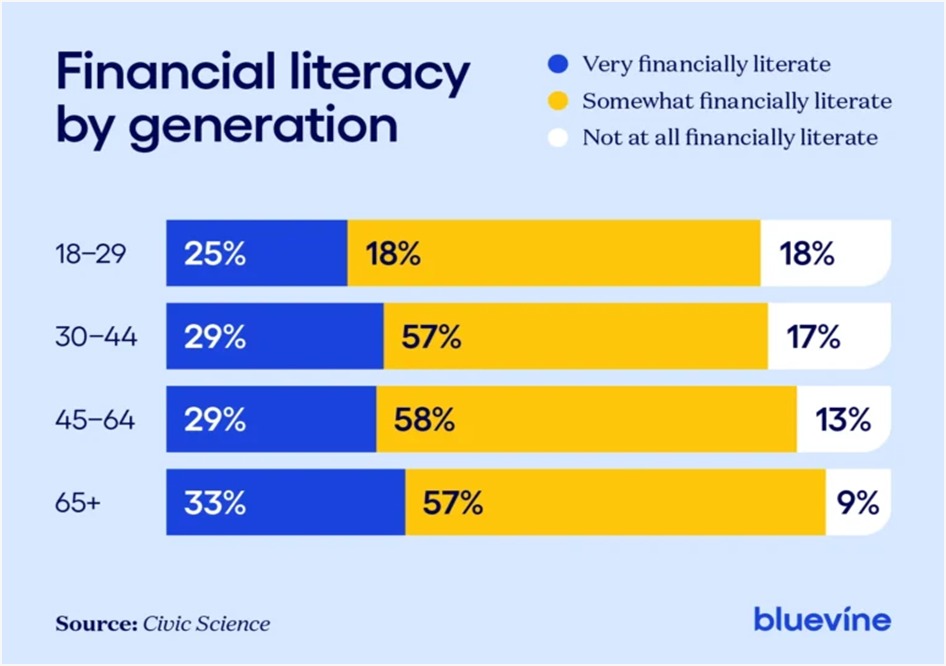

Source: https://www.bluevine.com/blog/financial-literacy-statistics
One thing that has changed this paradigm from the past are the consequences of the covid pandemic. Specifically, the massive increase in cost of living, the rapid rise in inflation, and your average person just feeling like they can’t keep up, much less get ahead. This is leading many to seek out information on alternative solutions, and that’s where crypto education platforms are filling in the gap.
A New Chapter in Digital Financial Literacy
A number of fintech platforms and players in the industry have started to create online educational resources aimed at helping regular people understand not just crypto, but the true nature of money itself. They are using facts and data to illustrate how simply holding cash can gradually erode purchasing power over time.
One such effort is Binance Academy, launched by the popular cryptocurrency exchange and multi-asset platform, Binance. According to Binance CMO Rachel Conlan, the company will “invest heavily in accessible, multilingual educational content”. The reason behind the investment is simple, “If crypto is going to reach the next billion users, education must evolve alongside the product.”
Other popular websites have grown in recent years, such as 99bitcoins and Bitcoin University. Other platforms, however, take a more mixed approach. Robinhood, which primarily deals in stock market assets, does include some training and learning content on crypto.
Common Misconceptions Still Abound, but Won’t Last
Browse social media for a few minutes and you will quickly find a number of misunderstandings and misconceptions about cryptocurrency being thrown about as though they were true. A simple example of this that still persists is that many believe if they want to invest in Bitcoin, they need to purchase an entire bitcoin. This single misconception has likely kept millions of people out of cryptocurrency as they may believe they already missed their opportunity to get in because the price is simply too high.
But thanks to educational platforms and groups like Binance Academy, CashApp, PayPal, and more Fintech platforms, slowly, people are learning that you can buy any amount of bitcoin at a time. That even includes amounts that are worth less than a fraction of one cent in US dollars.
 Source: https://www.chainalysis.com/blog/2025-global-crypto-adoption-index/
Other popular misconceptions that continue are numerous, but a few that stand out more prominently are that bitcoin is supposedly an elaborate scam, that units of bitcoin can be infinitely copied like any digital file, or that bitcoin is simply too difficult to handle for non-experts.
The tides are slowly turning. Each year the number of people that own cryptocurrencies is increasing. There’s still a long way to go, however. Now, the early majority has started to take notice, but we are still a long way from the late majority coming on board, too.

