 Follow Us on Google News
 Follow Us on Google Discover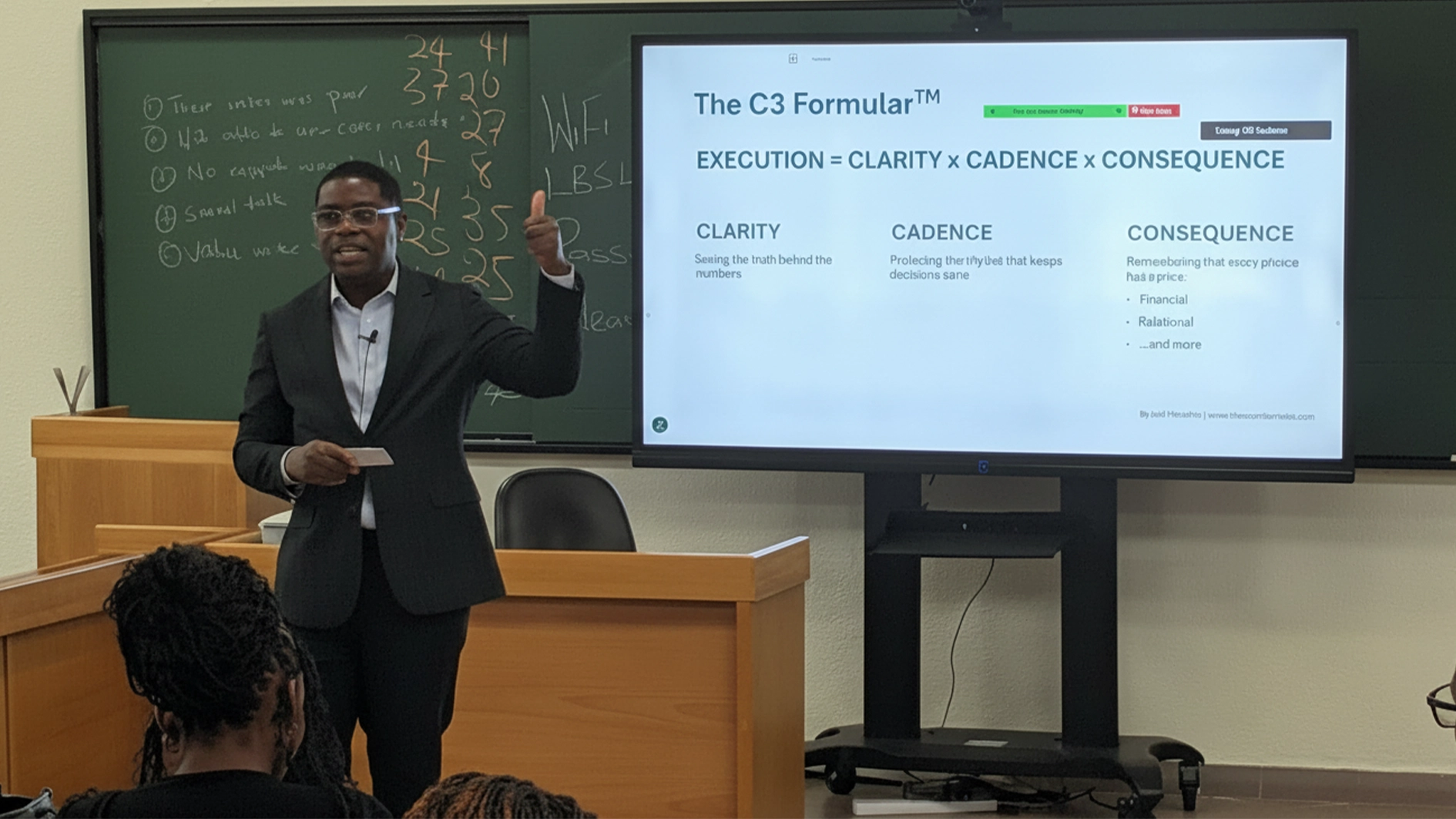
A deceptively simple question brought a Lagos Business School Executive MBA class to a halt on a recent Saturday morning.
What happens to leadership judgment when financial pressure sets in?
The discussion unfolded inside an EMBA classroom at Lagos Business School, where executives had gathered for a session focused on decision-making under stress. The class was facilitated by Akin Monehin, a practitioner whose work examines how leadership systems respond when resources tighten and scrutiny intensifies.
At first, the session followed familiar territory. Financial models were reviewed, scenarios mapped out, and trade-offs debated. But as conversations moved away from textbook assumptions into real constraints such as cash flow pressure, investor expectations and payroll obligations, the atmosphere shifted.
The challenge before the room was no longer technical competence. It was structural honesty.
Participants observed that leadership decisions do not necessarily become more difficult during financial strain. Instead, they become more revealing. Under pressure, organisational weaknesses surface quickly, exposing gaps in systems, accountability and decision design.

That moment reflected a broader evolution taking place within executive education globally. Business schools are increasingly moving away from abstract case studies and towards pressure-tested frameworks that mirror how executives actually decide when conditions deteriorate.
For decades, Executive MBA programmes relied heavily on clean cases with stable variables and rational conclusions. Today, instructors and practitioners are interrogating a different reality. One defined by incomplete information, compressed timelines and uneven consequences.
The Lagos Business School session, part of the EMBA 2025/2026 programme, was structured around this reality. Rather than asking participants to optimise outcomes, the class examined how financial stress alters decision rhythm, ethical judgement and organisational behaviour.
At one point, Monehin offered a simple observation that resonated across the room.
Pressure does not make decisions hard. It makes them honest.
The statement struck a nerve because it reflected an experience many senior executives recognise but rarely articulate. Leadership failures often occur not because leaders lack insight, but because their systems are not designed to hold when stress intensifies.
Central to the session was a framework known as the C3 Formula, which views execution under pressure as a function of three elements: clarity, cadence and consequence.
Clarity, participants noted, extends beyond understanding figures on a spreadsheet. It involves seeing what the numbers conceal as much as what they reveal. Cadence refers to the rhythm of decision-making that prevents organisations from swinging between panic and paralysis. Consequence acknowledges that every decision carries costs beyond the balance sheet, including reputational, relational and cultural impact.
The framework was not presented as doctrine. Instead, it served as a lens through which executives examined familiar leadership dilemmas that surface during financial strain.
As discussions deepened, four recurring tensions dominated the room.
Executives often prioritise image over infrastructure, focusing on reassurance through earnings calls or internal messaging while delaying investment in systems that stabilise performance.
Speed frequently comes at the expense of responsibility, as urgency erodes the psychological safety required for honest communication and leads to rushed decisions with long-term risk.
Leaders grapple with staff welfare versus sustainability, where empathy collides with the arithmetic of organisational survival.
Early success can also mask fragility, creating a temptation to preserve momentum rather than confront underlying weakness.
What stood out was not the novelty of these dilemmas, but their consistency across sectors and geographies. Financial pressure, participants concluded, does not create these tensions. It exposes them.
Rather than separating academic discussion from lived experience, the session deliberately blurred the line between classroom analysis and boardroom reality. Executives were encouraged to test the framework against restructurings that stalled, turnarounds that briefly succeeded before collapsing, and organisations that appeared decisive but lacked resilience.
The result was a classroom dynamic closer to a board review than a lecture. Conversations were probing, uncomfortable at times, and anchored in consequence rather than theory.
Observers of the session say this approach reflects a growing shift in executive education. Business schools are placing greater value on practitioners who can translate complex organisational behaviour into insights shaped by real pressure.
Monehin’s work, which spans corporate transformation, execution design and executive learning, aligns with this movement away from motivational leadership narratives and towards structural realism.
The Lagos Business School session offers a snapshot of how executive education itself is changing. Instead of teaching leaders how to decide in ideal conditions, programmes are increasingly examining how decisions degrade under stress and how organisations can be designed to withstand that degradation.
As global economic volatility persists, the ability to maintain decision discipline under pressure is becoming a defining leadership capability. In response, business schools are functioning less as transmitters of best practice and more as laboratories for understanding failure.
The session ended without tidy solutions. What it offered instead was reflection.
If pressure reveals leadership, the unresolved question remains whether organisations are built to survive what that revelation exposes.

