 Follow Us on Google News
 Follow Us on Google Discover
On May 19, 2021, Bitcoin fell from $43,000 to $30,000 in a single day. The decline did not stop there purely because of sellers who wanted out. It accelerated because of traders who had no choice. Approximately $8.6 billion in leveraged long positions were forced closed across crypto exchanges in 24 hours – each liquidation creating more selling pressure, which triggered more liquidations, which pushed the price lower still. Understanding forced liquidation in crypto is not an academic exercise. It is a prerequisite for using leverage without destroying your account.
How Forced Liquidation Actually Works
Leverage is borrowed exposure. A trader depositing $1,000 with 10x leverage controls $10,000 in Bitcoin. The exchange extends the remaining $9,000 as implicit credit. If the trade moves against the trader by 10%, the entire $1,000 margin is gone – and the exchange is left holding the credit it extended with nothing to recover it from.
Forced liquidation is the mechanism that prevents this outcome. Rather than waiting for losses to reach 100% of margin, the exchange sets a maintenance margin threshold – typically 0.5 to 2% of the position’s notional value – and triggers an automatic closure when the account equity falls to that level. This preserves a small buffer for the exchange to close the position at market before the margin reaches zero.
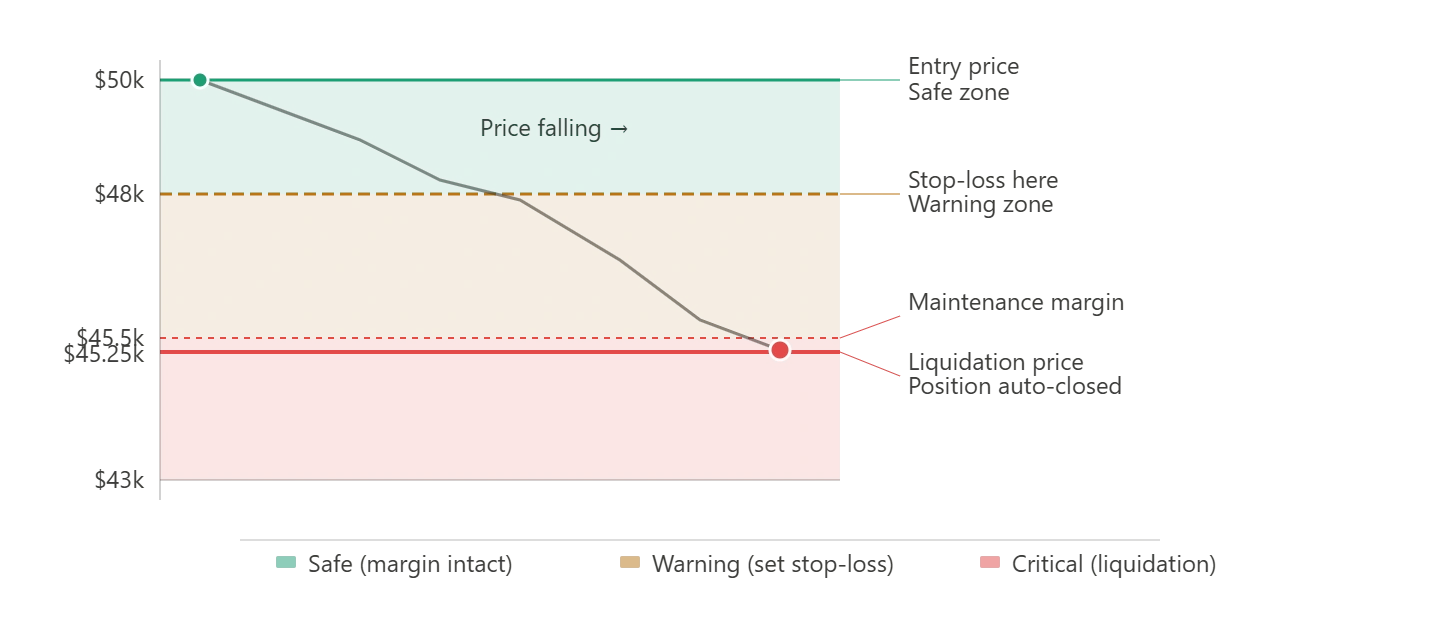
The liquidation price is fully deterministic. For a 10x leveraged long on BTC at $50,000 with $1,000 margin: position size is $10,000 (0.2 BTC). Maintenance margin at 0.5% is $50. The position is liquidated when losses reach $950 – when BTC has fallen approximately 9.5% to around $45,250. That number is calculable at entry and does not change unless the position size or margin changes.
What does change in volatile markets is the fill price. If Bitcoin drops 15% in 60 seconds, the liquidation engine may not execute at $45,250. It executes at the best available market price at the moment it fires – which could be $44,000 or $42,000. Most exchanges maintain an insurance fund to absorb this gap. When the insurance fund is depleted during extreme events, the shortfall is distributed to profitable traders through auto-deleveraging (ADL) – a mechanism that ranks positions by profitability and closes the most profitable ones to cover the deficit.
The Cascade Mechanism
The May 2021 event was not unusual in structure – it was unusual in scale. The cascade logic is always the same.

Price falls. Traders with leveraged long positions near their liquidation thresholds get closed out automatically. Each forced close is a market sell order, adding to downward pressure. The additional selling pushes price further down. New positions that were previously safe reach their liquidation thresholds. They get closed out too. More market sells. More downward pressure. The cycle repeats until either the long liquidation queue is exhausted or buyers absorb the selling at lower prices.
This mechanism amplifies price moves significantly beyond what fundamental selling alone would produce. A 10% decline in spot Bitcoin driven by genuine sellers might trigger a 20-30% total move if open interest in leveraged longs is concentrated at price levels that fall within that range.
The practical implication for traders not using leverage: monitoring the size and concentration of open interest in leveraged positions tells you how much amplification risk exists in the market. High open interest in longs relative to spot volume, combined with elevated funding rates on perpetual swaps, signals a crowded trade where a modest adverse move could self-reinforce into a much larger one.
Liquidation Price by Leverage Level
The leverage ratio determines the distance between entry and liquidation. Lower leverage gives more room. Higher leverage shrinks it.
| Leverage | Margin on $10,000 position | Approximate liquidation distance |
| 2x | $5,000 | ~47% adverse move |
| 5x | $2,000 | ~18% adverse move |
| 10x | $1,000 | ~9% adverse move |
| 20x | $500 | ~4.5% adverse move |
| 50x | $200 | ~1.8% adverse move |
Bitcoin’s average daily volatility runs 3-4%. A liquidation threshold 4.5% from entry at 20x leverage can be reached in a single session under normal conditions – not extreme ones. A liquidation threshold 18% away at 5x leverage requires a move that has happened fewer than a dozen times in Bitcoin’s history. The choice of leverage ratio is the primary decision in liquidation risk management, and the table above makes the stakes explicit.
Forced Liquidation vs. Stop-Loss
The key distinction is control. A stop-loss is a price level the trader selects before entering a position – an instruction to close at a defined loss that preserves the remainder of the margin. A forced liquidation is an automatic closure the exchange executes when the margin is nearly exhausted – after which the trader typically receives little or nothing back.
A stop-loss at $47,000 on a long entered at $50,000 closes the position at a 6% loss, returning approximately $940 of the original $1,000 margin. A forced liquidation at $45,250 closes the position with the account balance at near zero. The difference is $940 versus effectively nothing – and the ability to continue trading versus being wiped out.
Setting a stop-loss before entering any leveraged position is not conservative. It is the mechanics of keeping capital available to trade the next setup.
How to Manage Liquidation Risk
Four levers control the distance between your entry price and the liquidation threshold.
First, leverage selection. This is the most direct control. Halving leverage from 20x to 10x roughly doubles the distance to liquidation. No other single adjustment has the same effect.
Second, position sizing. A smaller position relative to total account equity means a smaller margin commitment and a larger proportional buffer. A trader with $10,000 in their account who uses $1,000 as margin on a 10x position has 90% of their capital untouched by that trade’s liquidation.
Third, manual stop-loss placement. Placing a stop at a level significantly above the liquidation price – not at the liquidation price – means the exchange never gets involved. The trader closes at a chosen loss level, keeps the remaining capital, and retains the ability to re-enter.
Fourth, active margin monitoring. Adding margin to a position that has moved against you reduces the effective leverage and pushes the liquidation price further away. This is a deliberate tactical choice – not the panic response of adding to a losing trade without a plan.
Conclusion
Forced liquidation is not bad luck. It is arithmetic. Enter a leveraged position, calculate the liquidation price, compare that distance to normal daily volatility for the asset, and decide whether the margin you are committing can survive normal market noise. If the liquidation price is closer than a typical daily range, the position is oversized for the leverage used. The exchange’s liquidation engine is impartial – it fires at the threshold regardless of conviction, news, or expectation. Your stop-loss should always fire first.

