 Follow Us on Google News


 Follow Us on Google Discover
Industry experts have called for urgent, coordinated infrastructure development to unlock growth in Nigeria’s industrial sector, citing persistent gaps in financing, professionalism and intergovernmental collaboration.
They lamented that overlaps between federal, state and sub-national projects continue to stall progress.
They made this statement at the inaugural West Africa Infrastructure Expo, co-located with HVACR Nigeria and organised by dmg events, which aimed to advance investment, collaboration and project delivery in key sectors of the economy.
The exhibition brought together over 35 exhibitors from different countries, showcasing solutions across infrastructure, smart cities, and water management, among other areas.
Deputy President of the Nigerian Society of Engineers (NSE), Valerie Agberagba, identified critical challenges hindering progress. She noted a financing gap, alongside concerns about professionalism, ethics, transparency, and weak communication across ministries and tiers of government. According to her, overlaps between federal, state and sub-national projects continue to stall progress, and she warns that failure to close these gaps would impede the achievement of infrastructure goals.
Agberagba also urged stakeholders to look inward for funding, stressing that domestic resources could be harnessed to drive development. On capacity building, she stressed the need for continuous training to keep pace with evolving technologies.
Highlighting the growing impact of Artificial Intelligence (AI) and automation, she said that engineers must remain relevant by staying current with new tools and systems.
She disclosed that the NSE, in collaboration with the Council for the Regulation of Engineering in Nigeria (COREN), has introduced initiatives to bridge the skills gap, including a mandatory one-year post-graduation residency programme for young engineers.
Addressing infrastructural deficits, Agberagba pointed to inefficiencies in road networks, ports, and rail systems that continue to slow the movement of goods and services across the country.
Senior Vice President at dmg events, Josine Heijmans, said the event brings together public- and private-sector players to explore solutions and address challenges in infrastructure development and building services across Nigeria and the wider West African region.
She noted that the expo features a range of activities, including a summit and ongoing talk programmes that examine opportunities and constraints in sectors such as transport, water and energy.
Heijmans explained that hosting the inaugural edition in Nigeria underscores the country’s strategic importance as Africa’s largest economy, with over 200 million people in need of critical infrastructure, housing and cooling solutions. According to her, discussions at the expo extend beyond attracting investment to ensuring the timely execution and completion of projects.
She said the inclusion of HVAC-R Nigeria highlights the growing importance of climate control, cold chain infrastructure and cooling systems in meeting Nigeria’s development needs. Describing the platform as critical for industry growth, Heijmans said it fosters partnerships, encourages collaboration and supports knowledge exchange among stakeholders.
Regarding market potential, she disclosed that Africa’s HVAC sector was valued at about $2.6 billion in 2023 and is projected to reach $5.6 billion within the next decade, with Nigeria leading in import value.
Experts advocate infrastructure devt to boost industrial growth
Date: 15 April 2026 4:32am WAT
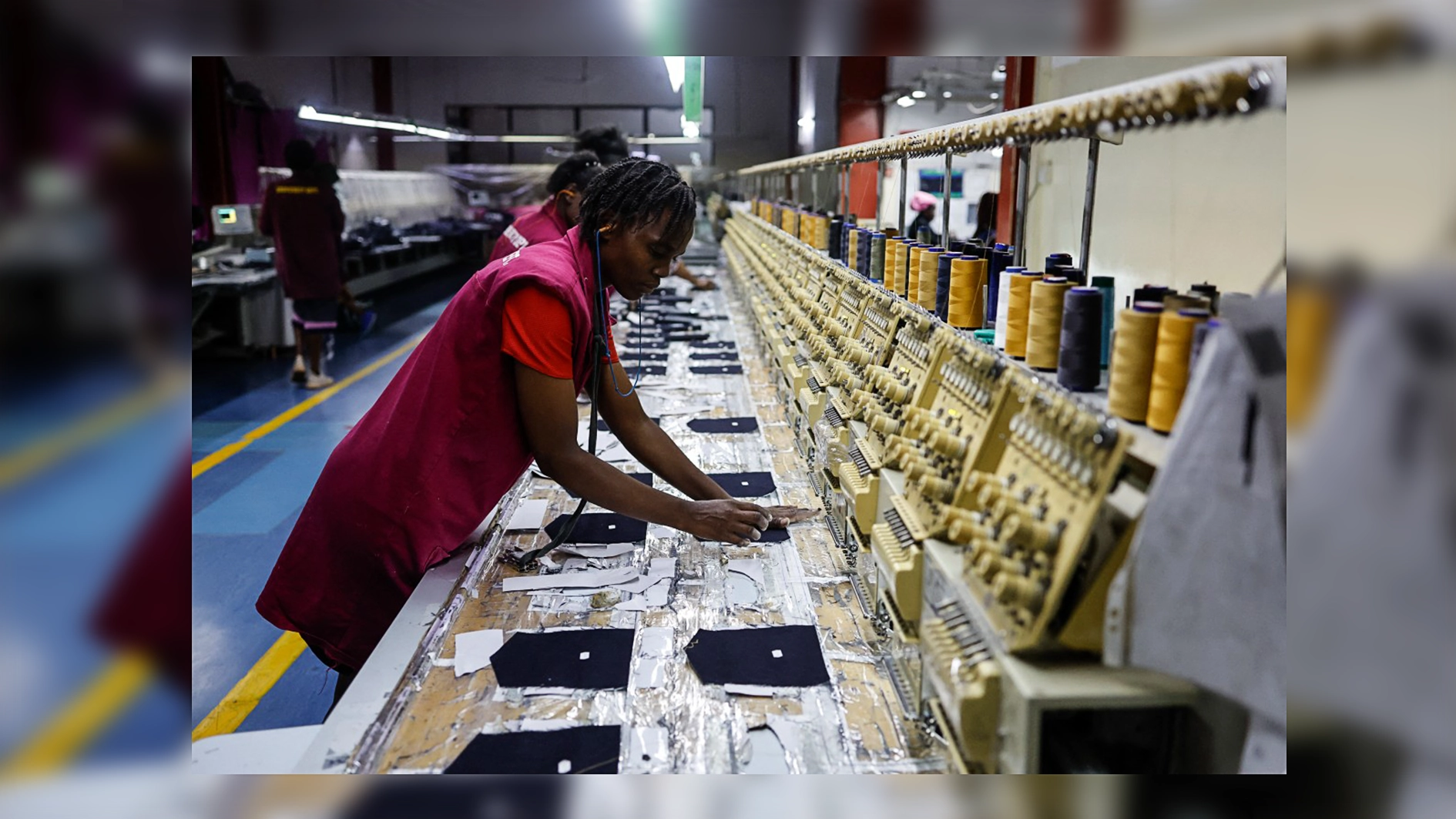
A worker operates an industrial embroidery machine inside a textile factory. PHOTO: AFP
A worker operates an industrial embroidery machine inside a textile factory. PHOTO: AFP

