 Follow Us on Google News


 Follow Us on Google Discover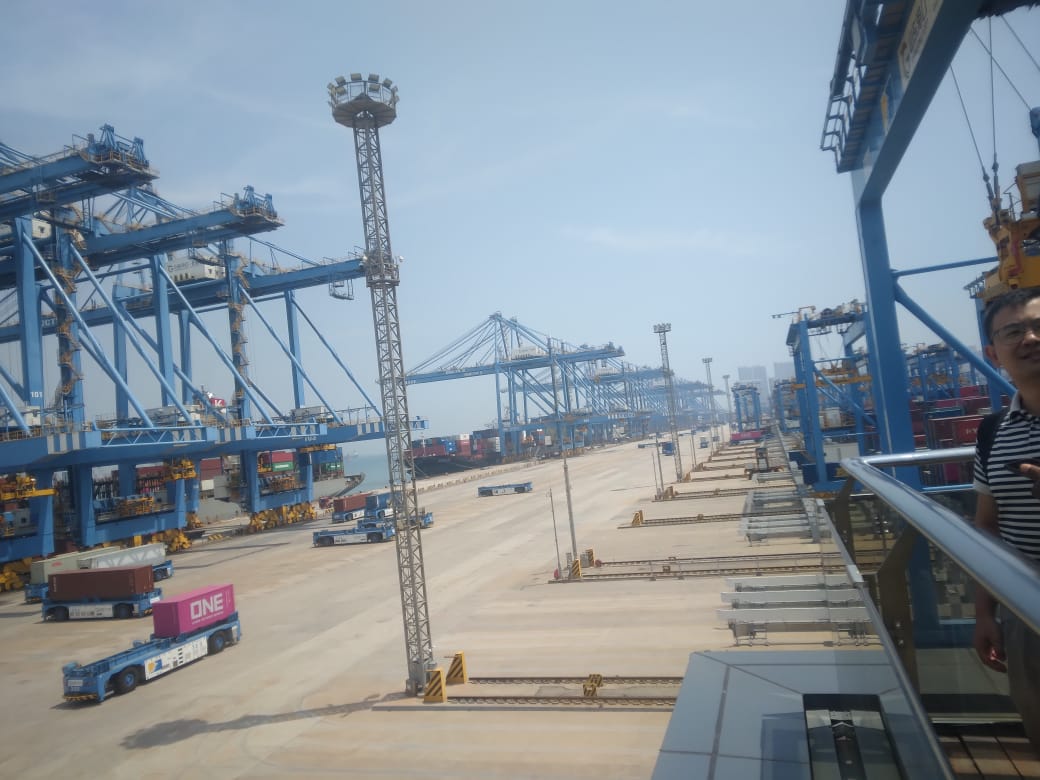
The Pavilion Coordinator of Qingdao Automated Port, Shandong Port Group, China, Steven Chan, has highlighted the port’s cutting-edge automation and charging system, emphasising its development in container handling efficiency, sustainability and battery longevity.
Speaking during an interactive session with a group of Nigerian journalists at the automated container terminal pavilion, Chan explained the innovative discharging process at the port.
According to him, once containers are offloaded from vessels, a spreader places them on heavy electric vehicles (HEVs), which transport them to the yard. A stacker crane then moves them into designated slots. He stated that HEVs are charged automatically along their fixed path via an overhead electricity slide wire and collector system, an idea inspired by a general manager’s observation of buses recharging during passenger loading at bus stops.
“The HEV must pass through this point for transportation, and during the two-minute stop, it charges automatically. This time-efficient charging system allows us to maintain battery levels without downtime,” he said.
According to him, the innovation ensures each vehicle gains sufficient charge, 4.5 kilowatt hours in two minutes, enough to complete one full operational cycle. He emphasised that the port strategically maintains the battery charge between 75 per cent to 80 per cent, only topping up by about five per cent per charge.
This method, Chan revealed, has significantly extended battery life.

“After eight years in operation, 96 per cent of our lithium batteries are still functioning optimally. Unlike Tesla or BYD batteries, which may degrade after seven to eight years, we believe ours can last up to 10 years without replacement,” he said.
Chan noted that Qingdao’s automated terminal, built entirely by Chinese developers, began in 2013 and was fully operational by 2017.
Despite early use of Toshiba lithium batteries in Phase 1, subsequent development transitioned fully to domestically-produced battery systems. Addressing the operational scope, Chan confirmed the port processed over three million containers in 2024, averaging about 10,000 containers daily on its 2-kilometre stretch of automated infrastructure.
When asked about technical reliability since operations began, Chen stated: “We’ve had zero shutdowns due to system errors since 2017.”The port, owned by Shandong Province under the Shandong Port Group, also includes a rural terminal zone designed for vehicle logistics.
Chan emphasised that although automation has drastically reduced the workforce from 1,300 to 300, it reflects a broader move toward smart and efficient port management.

