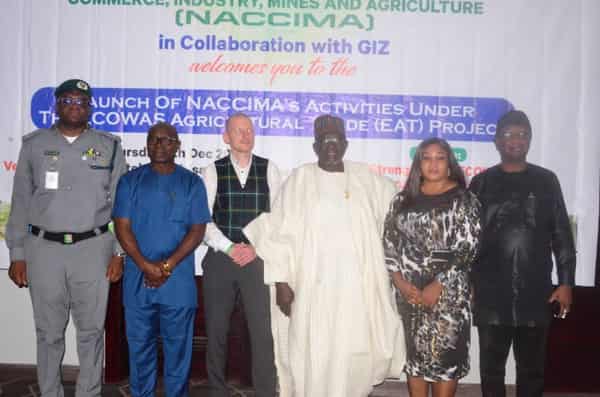
The National Chamber of Commerce Industry Mines and Agriculture (NACCIMA), has partnered with the German Agency for International Cooperation (GIZ) to strengthen regional integration, facilitate cross-border agricultural trade, and expand opportunities for micro-small and medium-sized enterprises (MSMEs),
At the launch of NACCIMA activities under the ECOWAS Agricultural Trade Programme themed: “Strengthening ECOWAs Agricultural Market to Drive Food Security and Regional Prosperity,” NACCIMA President, Jani Ibrahim, noted that agriculture continues to play a critical role in Nigeria’s economy, adding that in Q4 2024, the sector contributed about 24.64% to GDP.
He said with the recent GDP rebasing, the share of agriculture in national output has risen. Early 2025 estimates show agriculture’s share of GDP at around 27.8 per cent.
Ibrahim, however, noted that despite its large role in the economy and its sustenance of livelihoods, Nigeria’s agricultural exports remain modest.
He disclosed that it is against this backdrop that the EAT Project and NACCIMA’s role take on special relevance.
He said for NACCIMA, this initiative aligns perfectly with the association’s mandate to empower the private sector, promote enabling policies, and strengthen export competitiveness.
“Through this Project, we intend to address longstanding bottlenecks that hinder trade through the capacity building of traders and SMEs within the agribusiness value chain, enabling them to meet requirements for regional markets,” he said.
The NACCIMA boss applauded GIZ and ECOWAS, its development partners, for entrusting NACCIMA with the responsibility.
He noted that the partnership promises stronger agricultural value chains, better market access, enhanced trade in food and agro-products, and a more vibrant role for the private sector in shaping regional trade in West Africa.
For the Director General, NACCIMA, Sola Obadimu, agriculture remains a major pillar of Nigeria’s economy, contributing about one-quarter of its GDP and supporting millions of livelihoods.
Obadimu noted that despite the vast potential, the nation’s agricultural export earnings remain below expectation, even as the wider ECOWAS region with a population of over 400 million people continues to offer huge untapped market opportunities.
The DG pointed out that the EAT Project is therefore timely, as it strengthens the collective effort to boost intra-regional agricultural trade, improve standards, remove non-tariff barriers, and support SMEs to participate more competitively in regional value chains.
Program Lead, GIZ- EAT, Arne Schuffenhauver, said the programme is funded by the German government, implemented in partnership with the ECOWAS Commission, and with many other partners in five countries of which Nigeria is one of them.
Schuffenhauver said ECOWAS trade is one of the biggest markets for food products in West Africa.
He noted that the GIZ partnered NACCIMA because the association gives services to members and non-members on how to better access markets, how to trade, how to go through inspections and customs in an efficient way.
“We just have to channel funds, credits, into these directions so that we can invest more into these businesses for the benefit of traders and also consumers,” he said.
Principal Trade Promotion Officer, Nigerian Export Promotion Council (NEPC), Nancy Okpa,noted that the launch marks a significant milestone in regional economic cooperation by creating a structural platform for producers, processors, exporters, policy makers and development partners.
Okpa said through this collaboration, barriers to trade are reduced, opportunities for inclusive growth are expanded.
She noted that the framework for agricultural trade facilitation lies strongly with the council’s mandate to support exporters, improve competitiveness and help Nigerian producers meet regional and global demands.