 Follow Us on Google News
 Follow Us on Google Discover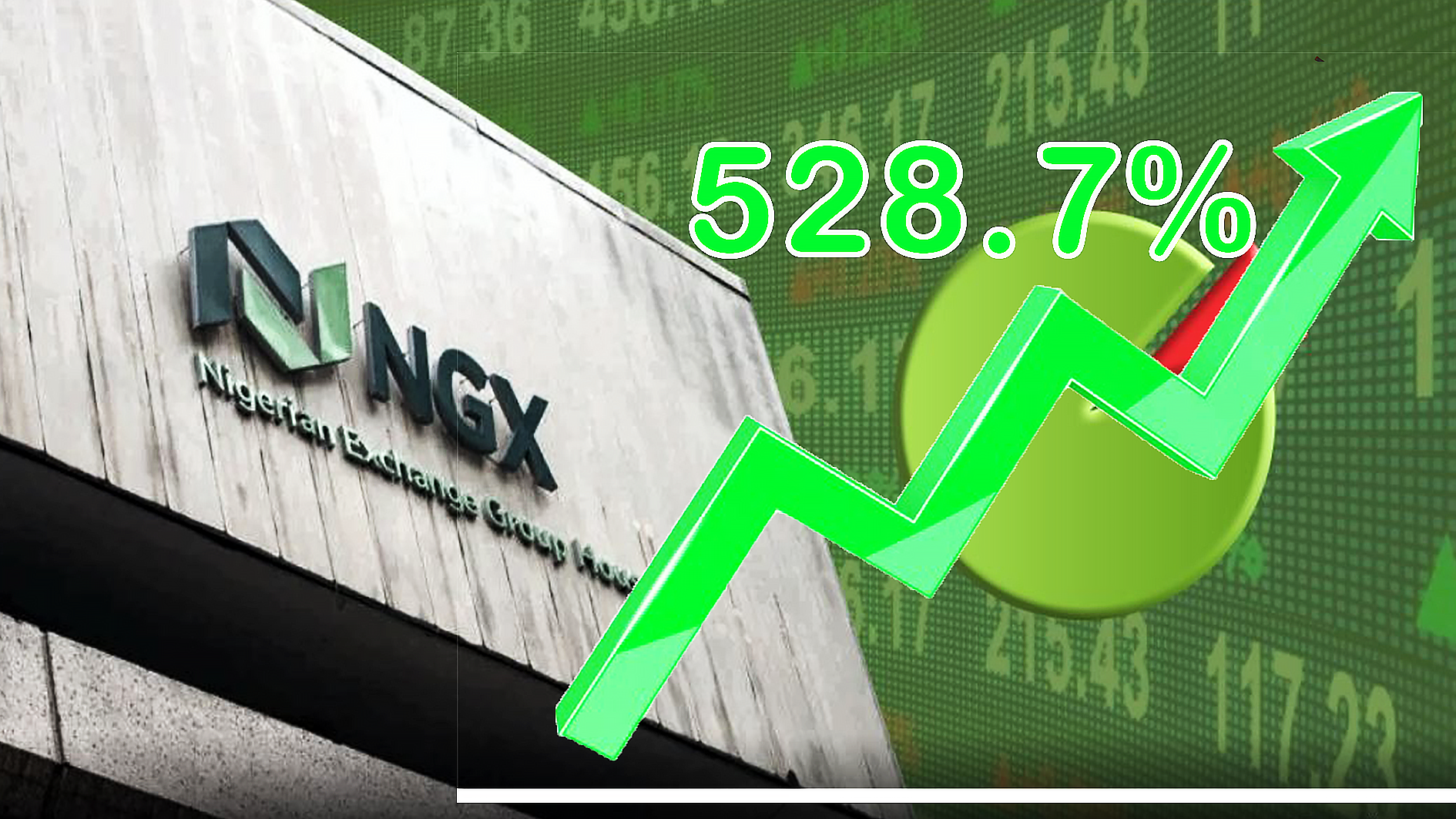
The Nigerian Exchange Limited (NGX) has achieved a historic surge in value five years after its demutualisation, with market capitalization rising by N108 trillion, or 528.7 percent, to N129 trillion as of the end of March. The rise represents one of the strongest expansions in the exchange’s history.
Data by the NGX showed that from a market capitalisation of about N20 trillion in 2021, when the exchange transitioned from a mutual structure to a shareholder-owned entity, the equities market has surged to N128.693 trillion as at March 2026, representing a N109 trillion increase in value.
Similarly, the all-share index (ASI), which measures the performance of listed equities, rose from 39,216.2 points on March 30, 2021 to 200,484.43 points as at March 30, 2026, represents an increase of roughly 161,268.23 points, translating to a growth of more than 400 per cent and representing one of the strongest bull runs in the exchange’s history.
With the growth, the NGX is at least six times larger than it was in 2021 with every N1 in the market in 2021 growing to about N6.45.
The post-demutualisation era has been pivotal in repositioning the NGX as a profit-driven and globally competitive exchange.
The restructuring, improved governance and enhanced transparency have enabled the exchange to attract new listings and deepen market participation with a structural shift, laying the foundation for accelerated growth in market value and trading activity over time.

A review at the five-year performance of some stocks across sectors between 2021 and 2026 in the banking, industrial and consumer goods sectors show strong returns.
In banking, Stanbic IBTC Holdings Plc rose by 156 per cent from N52 in 2021 to N133.10, Sterling Bank Plc was up by 352.7 per cent from N1.69 to N7.65, Jaiz Bank Plc increased from 59 kobo to N10.40, representing 1,662.7 per cent growth.
Industrial stocks were led by Julius Berger Nigeria Plc at 1,301.2 per cent from N20.55 to N288, and Lafarge Africa Plc at 907.9 per cent from N21.50 to N216.70 kobo.
Consumer goods saw Guinness Nigeria Plc gain 1,310.7 per cent, rising from N30 to N423.20 kobo, Champion Breweries Plc appreciated from N2.12 to N16 kobo, indicating a growth of 654.7 per cent and Dangote Sugar Refinery Plc advanced by 315.6 per cent from N16.40 to N68.05 kobo.
Among mid- and small-caps, John Holt Plc surged 3,344.3 per cent from 53 kobo to N18.25 kobo.
Chams Plc rose from 21 kobo to N4.05 kobo, representing an increase of 1,828.6 per cent and Japaul Gold & Ventures Plc appreciated from 43 kobo to N3.41, marking a 693 per cent increase, while UPDC Real Estate Investment Trust posted a modest 28.6 per cent gain from N5.60 to N7.20 kobo.
Operators argued that the trajectory reflects not only structural reforms in the exchange but also broader macroeconomic adjustments that have reshaped Nigeria’s investment landscape, positioning the bourse as one of the best-performing markets globally in recent years.
They argued that the rally became more pronounced in 2023 following the inauguration of the current administration under Bola Ahmed Tinubu.
An independent investor, Amaechi Egbo, said a series of macroeconomic reforms, including foreign exchange (FX) market liberalisation, subsidy removal and fiscal adjustments, helped to restore a measure of stability and improve investor sentiment.
He pointed out that the reforms, alongside stronger corporate earnings, were identified as key drivers of the equity market rally, with policy changes boosting confidence and supporting significant gains in market capitalisation.
“Improved macroeconomic conditions also triggered a shift in asset allocation among domestic investors. With inflationary pressures eroding fixed-income returns, equities increasingly became an attractive hedge, leading to a surge in retail participation.
“The administration itself acknowledged the milestone as the NGX crossed the N100 trillion mark, describing the development as a reflection of renewed confidence in the Nigerian economy and the capital market’s growing role in wealth creation,” he said.
In addition, he pointed out that foreign investor interest, which had been subdued in earlier years due to currency illiquidity and policy uncertainty, began to recover.
Egbo noted that exchange rate flexibility and reforms aimed at improving market transparency contributed to a gradual return of offshore capital, further boosting liquidity and valuations on the exchange.
President of the Independent Shareholders Association of Nigeria, Moses Igbrude, attributed the strong growth recorded by the Nigerian Exchange Limited over the past five years to improved planning and effective execution of the exchange’s demutualisation objectives.
According to him, the process enhanced transparency, accountability and broadened ownership structure within the exchange, which helped to strengthen confidence in the capital market.
He also noted that the structural improvements, combined with strong performance by listed companies, played a key role in attracting investors back to the market and deepening participation across the Nigerian capital market.

