 Follow Us on Google News
 Follow Us on Google Discover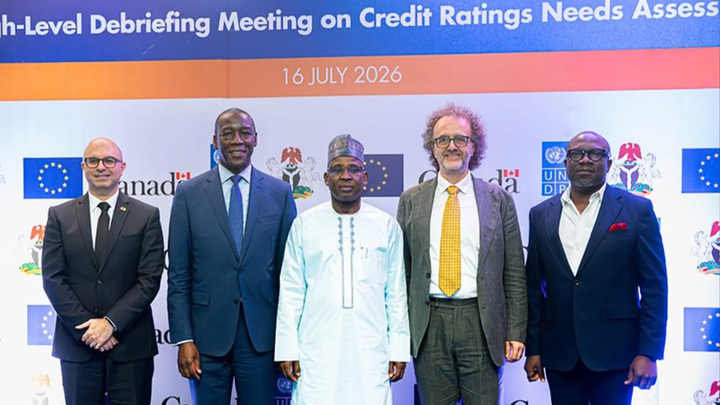
The United Nations Development Programme (UNDP) has urged Nigeria to adopt a whole-of-government approach to improve its sovereign credit rating.
Chief Economist, Africa Bureau, UNDP, Raymond Gilpin, made this call on Thursday in Abuja at a high-level debriefing meeting on credit ratings needs assessment mission for Nigeria.
The meeting organised by the Federal Government in collaboration with the United Nations Development Programme (UNDP) through the Africa Credit Ratings Initiative (ACRI) and strategic partners – the European Union Delegation to Nigeria and ECOWAS, and the Government of Canada, is part of effort of the government to strengthen macroeconomic stability, deepen reforms, improve fiscal credibility, and reinforce investor confidence.
Gilpin said Nigeria’s recent ratings upgrades have placed it firmly on the path toward achieving investment-grade status.
He said attaining investment grade should become a national development priority, stressing that the responsibility extends beyond the Central Bank of Nigeria (CBN) and the Federal Ministry of Finance to all government institutions. He noted that stronger policy coordination, credible economic data, and sustained reforms would be critical to securing higher ratings that could unlock cheaper international financing and attract long-term investments.
According to him, sustained collaboration among fiscal authorities, regulators and government agencies would be essential to translating recent rating gains into stronger investor confidence, lower borrowing costs and faster economic development.

He disclosed that the Africa Credit Ratings Initiative (ACRI) has strengthened the capacity of nearly 400 government officials from about 20 African countries through technical assistance, workshops, executive study tours and an online training programme developed in partnership with the United Nations Staff College System.
According to him, “22 senior African officials from 11 countries recently visited the Philippines to study the reforms that helped the country transition from non-investment grade to investment grade.
The UNDP Chief Economist said one of the major obstacles facing many African countries is the lack of timely, accurate and transparent data, which often increases subjectivity in sovereign credit assessments.
“To address this, ACRI is prioritising capacity building in data management while also creating a continental network of more than 1,000 public officials to encourage peer learning and the exchange of best practices”, he said, adding that Nigeria’s recent improvements in its sovereign ratings and outlook present a rare opportunity to accelerate reforms capable of delivering investment-grade status.
Earlier in his address, the Minister of Finance and Coordinating Minister of the Economy, Taiwo Oyedele, said for too long, African countries have borne what is often described as the “African Premium” a perception gap that is estimated to cost the continent over $74.5 billion annually in additional borrowing costs.
He said the focus of the meeting is not on the shortcomings, but on strengthening institutions, improving engagement with international credit rating agencies, and ensuring that Nigeria’s sovereign ratings accurately reflect the resilience and potential of the economy.
“Over the past three years, the Federal Government has implemented one of the most ambitious economic reform programmes in Nigeria’s history”, he said. “Bold measures have been taken to restore macroeconomic stability, strengthen fiscal sustainability, improve foreign exchange market efficiency, enhance domestic revenue mobilisation, and rebuild investor confidence.”
The Minister said sovereign credit ratings are influenced not only by macroeconomic performance but also by the quality of data, institutional coordination, policy credibility, effective communication, and sustained engagement with rating agencies. “This is precisely why today’s meeting is so important”, he said, adding, “Our objective is not merely to secure higher ratings but to ensure that Nigeria’s credit profile accurately reflects the progress of our reforms and the vast opportunities within our economy.
“Achieving Investment Grade status is a strategic economic imperative. Expert analysis suggests that doing so could reduce borrowing costs by 100 to 150 basis points, generating estimated savings of about N5.84 trillion resources that can be redirected to infrastructure, healthcare, education, social protection, and other critical development priorities,”
Other speakers at the event include the Head of Cooperation, European Union Delegation to Nigeria and ECOWAS Massimo De Luca, and the Counsellor and Head of Development Cooperation, High Commission of Canada, Arash Irantalab.
The mission forms part of the Government’s broader efforts to strengthen institutional co-ordination, strategic market engagement, and sovereign credit ratings preparedness. Through consultations with key public institutions, development partners, financial sector actors, and market stakeholders, the mission will assess institutional readiness, identify priority gaps, and support the development of a forward-looking roadmap to strengthen sovereign creditworthiness, investor confidence, and access to affordable long-term capital.

