 Follow Us on Google News
 Follow Us on Google Discover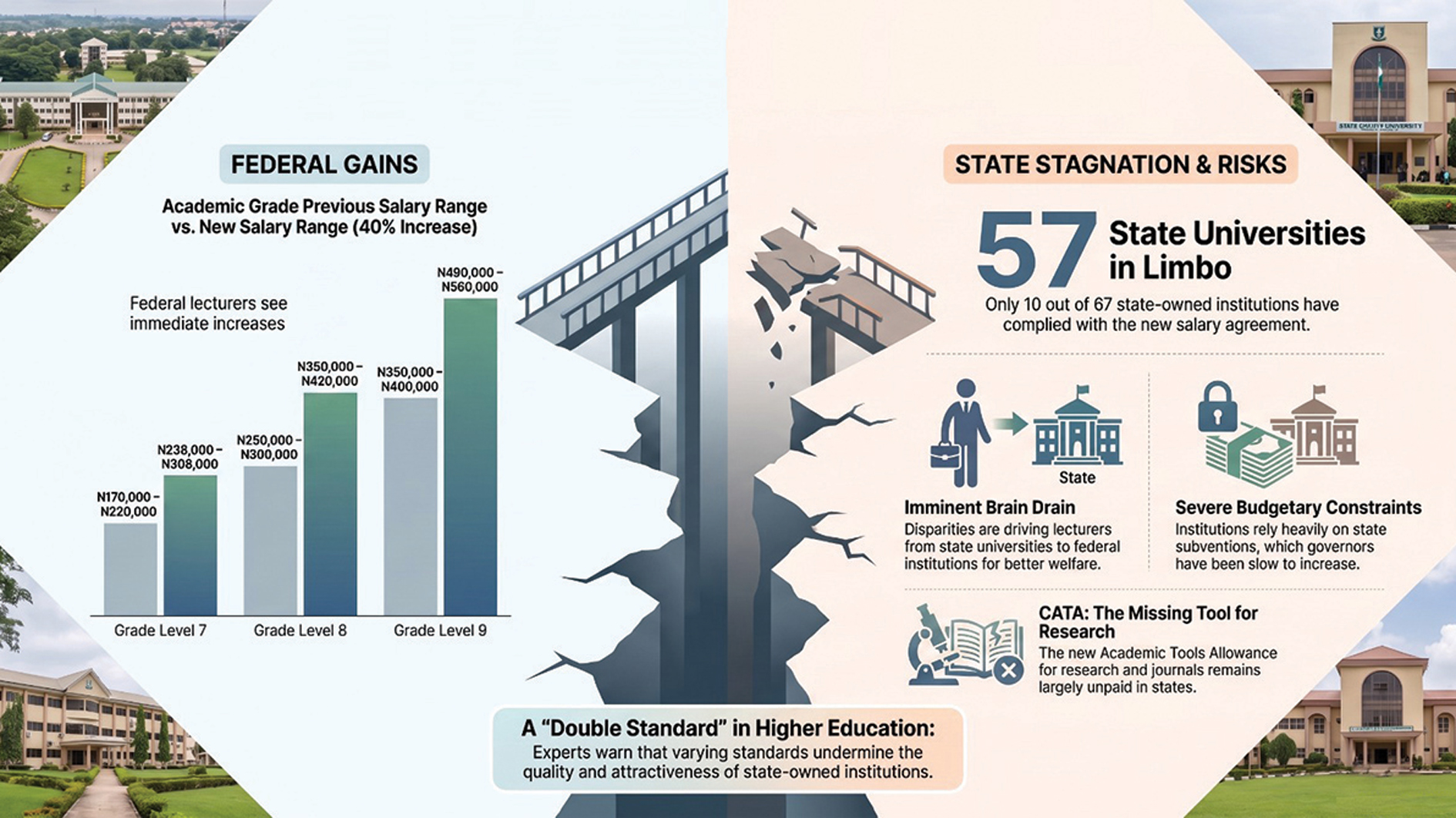
• Only 10 state-owned institutions have complied
• Rivers, Lagos, Nasarawa state varsity lecturers among highest earners
• Stakeholders seek uniform standard for federal, state institutions
• Double standard making state varsities unattractive to lecturers, experts warn
As implementation of the Federal Government-Academic Staff Union of Universities (ASUU) agreement kicks off on a shaky note, there are concerns over the fate of some federal schools and 57 state-owned universities nationwide.
Some federal-owned universities, such as the University of Lagos (UNILAG), the University of Ibadan (UI), the University of Ilorin (UNILORIN), Nnamdi Azikiwe University (NAU), Awka; Obafemi Awolowo University (OAU), Ife, and the University of Port Harcourt, are already reaping the benefits of the implementation. Others, like the University of Abuja, Bayero University, Kano (BUK), and Ahmadu Bello University (ABU), have yet to see implementation and are warming up for another round of protests.
The story is oddly different in the state-owned universities. At the signing ceremony in Abuja earlier this year, the absence of state governors and heads of 67 state-owned universities forewarned their lack of readiness and capacity to implement the agreement.
Stakeholders are just as concerned about some states’ capacity to meet the financial and structural obligations, particularly regarding staff remuneration, academic programme funding, and infrastructure upgrades.
While federal universities will benefit directly from the revised terms, many state institutions may struggle to align with the new benchmarks, given existing budgetary constraints and rising operational costs, with attendant risk of disruption, if not properly managed by state governments.

According to recent updates from ASUU zonal leadership regarding compliance and implementation of the Consolidated Academic and Tools Allowance (CATA) and related arrears, 10 state universities have so far complied, although ASUU has not published an official national register that comprehensively lists the institutions.
Recall that federal universities recently released funds for the payment of five months’ CATA in accordance with the provisions of the signed agreement, while findings showed that many state institutions are struggling to align with the new benchmarks.
One academic, mixed fortunes
Highlights of the Federal Government–ASUU agreement include a 40 per cent upward review of lecturers’ salaries, improved conditions of service, and the introduction of a new Professorial Cadre Allowance for full-time Professors and Readers.
Under the arrangement, professors will receive N1.74 million per annum, equivalent to a monthly increment of N140, 000, while Readers will earn an additional N840,000 per annum, or N70,000 per month.
With the agreement, federal university lecturers on grade level seven, whose total earnings prior to the signing were between N170,000 and N220,000, will now receive between N238,000 and N308,000.
At Grade level eight, academics earning between N250,000 and N300,000 will now earn between N350,000 and N420,000.
In the same vein, Grade level nine academics, who drew between N350,000 and N400,000, will get a take-home pay between N490,000 and N560,000.
However, the increment has yet to be implemented in state universities, as some ASUU leaders contacted by The Guardian said they are still being paid under the old structure.
It was gathered that aside from Rivers State University (RSU), Lagos State University (LASU) and Nasarawa State University, where academic staff are paid significantly more than their counterparts in federal universities, other state institutions pay extremely low salaries and allowances.
The average monthly salaries of state university lecturers range from N120,000 to N150,000 for graduate assistants; N150,000 to N180,000 for assistant lecturers; N200,000 to N240,000 for lecturer II; N250,000 to N280,000 for lecturer I; N300,000–N360,000 for senior lecturers; N380,000 to N550,000 for Associate Professors/Readers; and N580,000–N700,000 for Professors.
Investigations revealed that most state universities are awaiting approval from their respective governing councils.
At the Adekunle Ajasin University, Akungba-Akoko (AAUA), it was gathered that the Council would meet to approve the agreement.
Confirming the development to The Guardian, the ASUU Chairman, AAUA Chapter, Dr Bolu Oshodi, disclosed that the university management must first present the agreement to the Council for consideration and approval at its scheduled meeting later this month.
Oshodi said the union has formally written to the university management and the Chairman of Council, attaching copies of the agreement to facilitate deliberations.
He explained that even if the Council approves, the process does not end there. It would still require the endorsement of the Visitor to the university — the Governor of Ondo State — before implementation can begin.
“It is not an easy ride,” Oshodi said, noting that the university relies heavily on monthly subventions from the state government for its operations.
He pointed out that the institution is currently facing significant subvention challenges, stressing that funding would need to be substantially increased to enable the agreement’s effective implementation.
“Once the Council approves, it will get across to the Visitor – that is, the state governor. Once the management takes it to Council and it’s approved, the university will have to seek the nod of the Visitor,” Oshodi said.
On his part, the Chairman of the Academic Staff Union of Universities at Enugu State University of Science and Technology, Andrew Apeh, expressed reservations about the South-East governors’ implementation of the new agreement.
Apeh, who lamented that lecturers in the South-East states of Abia, Anambra, Ebonyi, Enugu and Imo are the least paid nationwide, said governments in the region deliberately do not implement agreements the federal government reaches with ASUU.
“Even the 25 and 35 per cent being paid by other universities across the federation are not being implemented in universities owned by the South-East states. Even earned academic allowances, which other state universities pay, are not paid in the South-East,” Apeh lamented.
Experts have expressed concerns that the disparity could further deepen inequality within the tertiary education sub-sector.
According to them, wide variations in salaries, allowances, and welfare packages have continued to fuel staff migration, thereby weakening academic capacity and undermining the quality of teaching and research in many states.
FG-ASUU agreement
The new structure includes two components: Consolidated University Academic Staff Salary (CONUASS) and Consolidated Academic Tools Allowance (CATA).
CATA, a university-specific allowance, is intended to cover the cost of teaching and research tools and to enhance the global competitiveness of Nigerian academics.
The CATA is designed to support the professional expenses of university teaching and research. It covers various expenses such as journal publications, conference participation, internet access, membership of learned societies, and books and other academic materials.
Other components of the agreement include a comprehensive review of academic staff remuneration through the renegotiated Earned Academic Allowance (EAA), the phased release of outstanding arrears, and a commitment to periodic salary adjustments in line with prevailing economic realities.
There are also group life insurance, research leave, sabbatical leave, annual leave, sick leave and deferred leave or compensation for denial.
Additional provisions cover injury pensions as well as office accommodation and facilities, which are to be managed by the governing councils of individual universities.
Under the deal, the Federal Government is to provide N30 billion to stabilise and restore universities.
Tagged ‘Stabilisation and restoration fund,’ the money would be paid in three equal instalments of N10 billion yearly from 2026 to 2028.
Another highlight of the settlement is the National Research Council (NRC) bill, which will be forwarded to the National Assembly for consideration. The proposed bill will provide for at least one per cent equivalent of Gross Domestic Product (GDP) for research, innovation and development funding.
The pact also provides that the five laws that impede university autonomy and academic freedom would be reviewed and amended by the Federal Ministry of Education in collaboration with ASUU and other relevant stakeholders.
They include the Joint Admission and Matriculation Board (JAMB) Act; the National Universities Commission (NUC) Act; the Education (National Minimum Standards and Establishment of Institutions) Act; the Universities Miscellaneous Provisions Act; and the Tertiary Education Trust Fund Act.
Under the agreement, the Federal Government is responsible for allowances related to undergraduate activities, including industrial training supervision, field trips, teaching practice and external moderation, while university governing councils are to fund postgraduate supervision and postgraduate external moderation from Internally Generated Revenue (IGR).
Findings revealed that although the agreement is binding on the Federal Government and the 77 federal universities, challenges are envisaged at the sub-national level, as state governments and heads of state universities were conspicuously absent from the presentation ceremony in Abuja.
This has fueled speculations that the pact is not legally binding on them and that they are consequently not obligated to implement its provisions.
Concerns over selective implementation in federal institutions
Already, ASUU has started mobilising its members for possible industrial action over what it described as the poor and unsatisfactory implementation of agreements previously reached with the government.
The Benin Zone of ASUU has threatened to embark on an indefinite strike across seven state-owned universities in Edo, Delta and Ondo states if the Federal Government-ASUU Agreement is not implemented in members’ July salaries.
The union said the strike would affect Ambrose Alli University, Ekpoma; Adekunle Ajasin University, Akungba-Akoko; Olusegun Agagu University of Science and Technology, Okitipupa; Delta State University, Abraka; University of Delta, Agbor; Dennis Osadebay University, Asaba; and Southern Delta University, Ozoro.
The ASUU Benin Zonal Coordinator, Prof. Monday Igbafen, said while all federal universities and 10 state universities had partially implemented the FGN/ASUU Agreement, including the payment of arrears, the affected institutions were yet to comply.
Igbafen lamented that the union had exhausted dialogue with the governors of the affected states without success.
Similarly, the union’s Kano Zone has warned that it may resort to industrial action against the governments of Kano, Kaduna and Jigawa states if they continue to delay the implementation of the agreement in their state-owned universities.
ASUU Kano Zonal Coordinator, Abdulrazaq Ibrahim, warned that unless urgent steps are taken to address the outstanding issues, it may have no option but a nationwide shutdown to press home its demands.
The Kano Zone comprises Ahmadu Bello University (ABU), Zaria; Bayero University, Kano (BUK); Kaduna State University (KASU); Kano University of Science and Technology (KUST), Wudil; Federal University Dutse (FUD); Northwest University (NWU), Kano; Sule Lamido University (SLU), Kafin Hausa; and the Federal University of Technology, Babura.
A human rights activist and lawyer, Frank Tietie, implored state governments to domesticate the agreement, arguing that there can be no double standards within the university system.
He further explained that Nigeria operates a single university system regulated by the National Universities Commission (NUC), arguing that being on the concurrent list does not permit variations in standards.
He noted that any operational benchmark approved by the NUC must be applied uniformly across all universities in the country.
Experts noted that unless state governments prioritise sustainable funding models for their universities, the gap in standards and staff welfare will continue to widen.
They urged states to explore innovative financing options, strengthen budgetary commitments to education and engage constructively with academic unions to ensure stability, equity and long-term growth in the university system.
In his reaction, public affairs analyst, Ekun Femi, feared that the situation could trigger a significant migration of academic staff from state-owned universities to federal institutions in search of better working conditions and improved welfare packages.
He warned that such a trend would further weaken state universities, many of which are already grappling with inadequate funding, poor infrastructure and irregular payment of salaries and allowances.
He added that if the imbalance is not urgently addressed, the resulting brain drain could adversely affect the quality of teaching, research and academic stability in state universities.
On his part, Ifeanyi Nwoko, also a public affairs analyst, expressed concerns over a growing contradiction in the actions of many state governments.
He observed that while states are often eager to announce the establishment of new universities as political achievements, they frequently lack the long-term financial and administrative capacity to sustain such institutions effectively.
He noted that the situation has serious implications for the quality of education and the stability of the university system, as persistent underfunding often leads to industrial disputes and academic disruptions.
“ASUU must also protect lecturers in state universities. What we need is a national minimum benchmark. Let there be uniform expectations for pay and allowances for lecturers across the country, while states or federal institutions that can afford more should pay. The pay should be reviewed regularly, and everyone should be carried along”, he said.
Reacting, ASUU national leadership said it has communicated with state universities, urging them to begin immediate implementation of the agreement.
ASUU President, Prof Chris Piwuna, said NUC has also written to state governments, urging them to commence enforcement of the accord’s terms.

