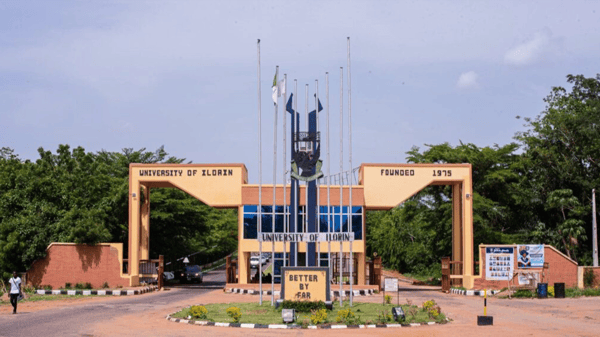
A Professor of Political Science at the University of Ilorin, Gbade Ojo, has expressed concern over the ‘indigene’ and ‘non-indigene’ distinctions across various sectors, saying it has created social and political divisions that undermine national unity and cripple federal efficiency.
Ojo, who stated this while delivering his inaugural lecture titled: ‘The worship of an unknown deity,’ noted that the indigene and non-indigene practice has led to discrimination against many Nigerians when seeking admission, employment, promotion, school fees payment, state government scholarships and bursaries, postings, and opportunities outside their states of origin.
He lamented the hijack of federal institutions by local interests, particularly in university appointments, saying it has made a nonsense of the notion of universality in most federal institutions across the country.
“Local potentates have virtually hijacked federal tertiary institutions in their domains, thus making a nonsense of the notion of universality in most federal universities across the country. Those who venture to pick up a job, both teaching and non-teaching, with these federal universities seem to have mortgaged their future. They experience terrible marginalisation or stagnation, which is a constant reminder of the absurdities of Nigerian federalism.”
He stressed that Nigeria’s concept of citizenship is flawed and is one of the major reasons the country’s federal system continues to falter.
Ojo explained: “The Nigerian citizenship is problematic and has, in no small measure, undermined the efficacy of the federal architecture. To be employed outside one’s ethnic enclave in Nigeria, especially at the state level, is a very big risk, career-wise, in the sense that such a person will bear the burden or toga of a non-indigene.”
Ojo further stated that the notion of “my state” or “my home” afflicts every Nigerian who lives outside his/her state of origin, making them go home to get married to a wife or husband, build a house, or vote. He noted that even the dead are rarely buried outside their states of origin, implying that citizens’ allegiance to the federation is truncated because of the respective state’s preferential treatment of its citizens.
The scholar argued that this weakens national loyalty and integration, citing the National Youth Service Corps (NYSC) scheme as an example of a programme that has failed to promote genuine integration.
Ojo criticised a system where Nigerians have dual identity, inclusive of their state citizenship, saying it is ‘absurd’ that children of federal civil servants working outside their states are made to pay higher school fees in state-owned tertiary institutions, despite their parents paying taxes and levies in those states.
“A state that cannot effectively address the problem of citizenship negates the tenets of federalism,” he stressed. Calling for reform, Ojo said Nigeria must redefine citizenship to restore fairness and cohesion in the federation.
He added: “The problematic citizenship in Nigeria must be addressed once and for all. While statism may not be completely abolished, citizenship should be properly conceptualised both legally and sociologically. Anyone who has resided in a place for at least 10 years should not be discriminated against in any guise.”