 Follow Us on Google News
 Follow Us on Google Discover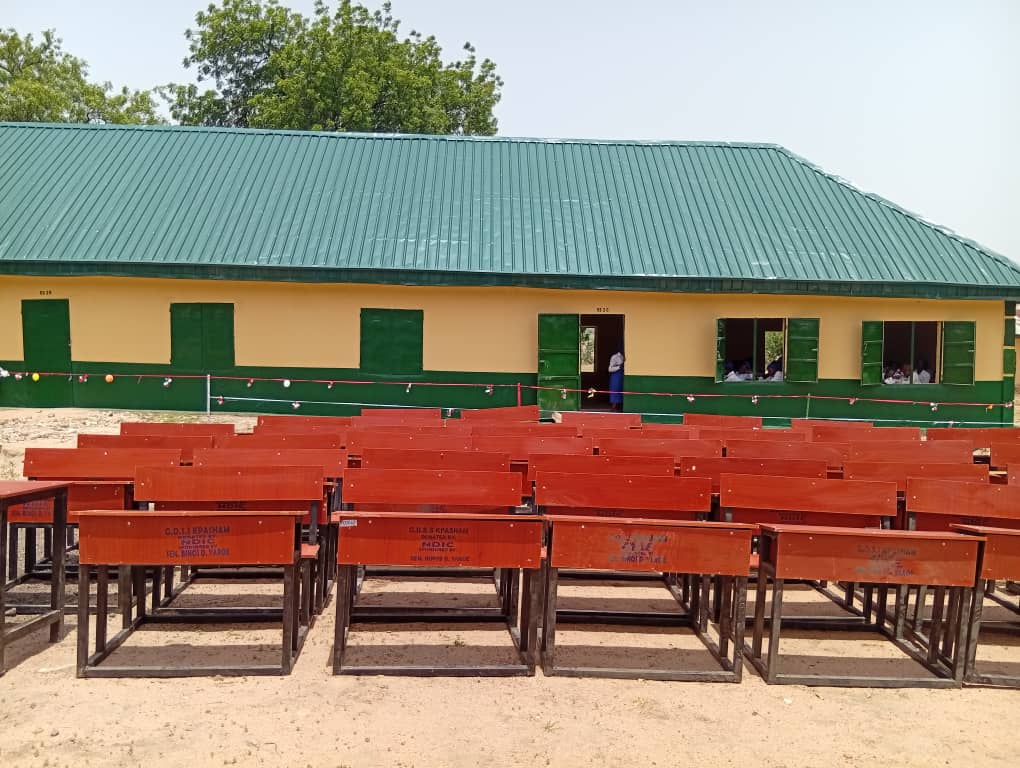
The Executive Chairman of the Oyo State Universal Basic Education Board (SUBEB), Dr Nureni Adeniran, has stated that the policies of the Seyi Makinde-led administration in the basic education sector, covering primary and junior secondary schools, have significantly reduced the infrastructure deficit and improved the quality of education in the state.
Adeniran maintained that the administration has been able to improve the quality of education through the massive training of teaching and non-teaching staff members, the recruitment of thousands of teachers, the construction/renovation of classrooms, and the procurement of school furniture, among other initiatives.
He maintained that quality improvement resulted in increased school enrolment, with thousands of parents even withdrawing their wards from private schools to enrol them in public schools in the state.
The SUBEB chairman stated this on Wednesday, during the Omituntun 2.0 Inter-Ministerial Briefing held at the Governor’s Office Briefing Room, Secretariat, Agodi, Ibadan.
According to him, the governor began the task of repositioning the basic education sector in the state in 2019, noting that in his first four years of office, the government promptly paid UBEC counterpart funds for 2019, 2020, and 2021, which enabled SUBEB to undertake various physical and human development programmes, thereby uplifting the basic education sector in the state.
He asserted that the board conducted training programmes for 13,859 teaching and non-teaching staff members, built 289 classroom blocks, established 60 model schools, and renovated an additional 229 classrooms. Additionally, it procured 22,962 desks and benches, 1,189 pieces of teachers’ furniture, sank 138 boreholes, and also acquired 33 motorcycles, 30 desktop computers, and 33 digital tablets, among other initiatives.
The SUBEB chairman also lauded the administration’s effort in the area of reducing the number of out-of-school children in the state, as, according to him, about 60,000 out-of-school children have been returned to the classrooms.

“There is no gainsaying that the vision of the Governor Seyi Makinde administration on the Basic Education sub-sector to have a very negligible number of out-of-school children in the state, is gaining momentum daily,” he said.
Speaking on how the government’s efforts have improved education during Omituntun 2.0, Dr Adeniran stated that “the state government has also graciously paid the counterpart funds for 2022 and 2023 to complement the released matching grants from the Federal Government through UBEC for the two years, which amounted to the sum of Two Billion, Six Hundred Million, Two Hundred Thirty-Seven thousand, Three Hundred and Fourteen Naira, Twenty-Nine Kobo (N2,600,237,314.29) only.”
He explained that the Board has received approval to implement projects in public primary schools across the 33 Local Government Areas of the state, including the construction of 41 classroom blocks, seven perimeter fences, 30 boreholes, the procurement of 5,828 pupils’ desks and benches, 473 teachers’ tables and chairs, 910 sports equipment items, as well as the renovation of 60 classroom blocks. The SUBEB chairman added that, in addition to the SUBEB interventions, the state would also undertake another extensive programme of construction and renovation of classrooms using a reward fund it received for its participation in the Better Education Service Delivery for All (BESDA) Programme, which aims to reduce the number of out-of-school children.
He said, “All the states that benefited in the BESDA Programme were rewarded with funds and His Excellency, the Executive Governor, Engr. Seyi Makinde FNSE, decided and insisted that the reward should be utilised for the provision of infrastructure in public primary schools in the state.
“To this end, the board has rolled out infrastructural projects which will soon be executed in the public primary schools in all the thirty-three (33) Local Government Areas of the State and this will go a long way to improve both infrastructure and academic activities of these benefiting schools.”
Adeniran said these projects would include the construction of 28 blocks of classrooms, renovation of 29 blocks of classrooms, construction of 4-compartment toilet with deep-well, sinking of 16 boreholes with tank and tank-stands and the procurement of 2,922 desks and benches and 182 teachers’ tables and chairs.
Dr Adeniran also noted that the administration recruited 5,600 teachers and 80 caregivers to address the shortage of teachers in the 2,508 public primary schools in the state, saying “I wish to reiterate that the recruitment has gone a long way to improve the learning outcome in all the public primary schools across the state through academic performances and other extra-curricular activities.”
He maintained that the recruitment of new teachers has led to improved standards of education, saying “the situation is changing because we have newly-recruited teachers that have better orientation, that dress very well, that are more accustomed to the digital world, and so on and so forth.”
He added that the government has also introduced various policies to enhance teaching and learning, as well as training and capacity-building for teachers, and other forms of training.
Fielding questions from newsmen, Dr Adeniran said that the issue of infrastructure deficit in the education sector has been quite worrisome, but the government of Engr. Makinde has been making efforts to address the issue, a development which he noted has led to a significant reduction in the deficit.
He noted that some other efforts have also been planned to further reduce the education infrastructure deficit, saying:
He said, “When Engr. Makinde became the governor, we were talking about the infrastructure deficit in education. So, we all agreed that we had to deal with it. The governor is of the opinion that the peanuts that we pay as cash-off funds are not going anywhere.
“I have mentioned all the schools that SUBEB did. If you provide a book of the schools we have done, you say, ah, this governor has tried. But if you go out and see some dilapidated structures, you will say, what is this governor doing? When you consider the number I have given and if you remember that we have 2,506 schools, then it is an issue that will continue to recur.
“In the real sense of it, we have done very well, because if other governments have been fixing this number of schools, the situation would have changed. If you want to look at the pace of the UBEC/SUBEB, it won’t go anywhere. So, at the end of the day, our government decided to take a decisive step and that was the reason the government established the office of the Special Adviser on Education Intervention, which is saddled with special intervention in education. AT UBEC/SUBEB, we will also continue with our own regular interventions.
“At present, a lot of work is going on in the area of special intervention. Before you know it, a lot of things are going to be fixed, because the government intends to approve N10 billion on a yearly basis for special intervention on education infrastructure. If that is done on a yearly basis, by 2027, we would have had a successful result.”

