 Follow Us on Google News


 Follow Us on Google Discover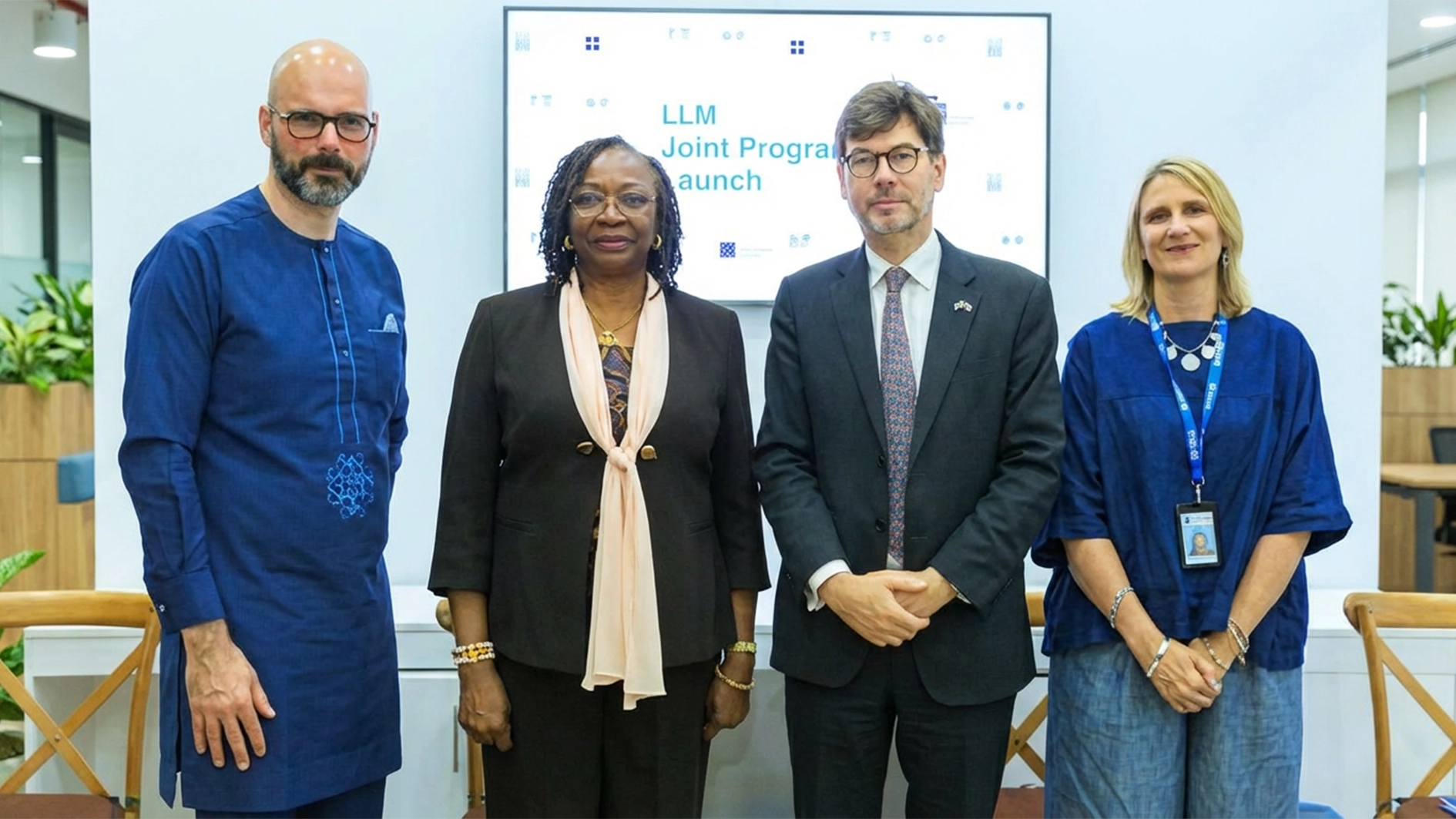
The University of Lagos has taken a decisive step onto the global stage with the launch of a pioneering joint Master of Laws programme in partnership with the University of Dundee in the United Kingdom, creating what education leaders have described as a transformative model for advanced legal training in Nigeria.
The joint LLM initiative, the first of its kind between a Nigerian university and a UK institution of comparable standing, represents a major shift in how international postgraduate education is structured and delivered. It offers Nigerian students direct access to global legal scholarship without severing their academic and professional ties to home, while also deepening long-term academic collaboration between Africa and Europe.
At its core, the programme allows students to earn two LLM degrees through a single integrated academic pathway. Admitted candidates begin their studies at the University of Lagos, where they complete the first six months of coursework. They then proceed to Dundee for the final six months, after which they graduate with certificates awarded by both universities. The structure is designed to blend international exposure with local relevance, a balance increasingly seen as essential in a globalised legal environment.
University officials say the initiative responds to a growing demand for legal professionals who are able to navigate complex cross-border issues while remaining grounded in the social, economic and regulatory realities of their home countries. Rather than encouraging permanent academic migration, the joint LLM seeks to create what educators describe as a fair and reciprocal model of internationalisation.
The programme was formally launched at the British Council in Lagos on 14 October 2025, an event that marked a milestone in UK Nigeria academic relations and highlighted the growing emphasis on equitable partnerships in higher education. Senior academics from both institutions described the collaboration as a template for future global engagement built on mutual respect, shared knowledge production and institutional trust.
Speaking at the launch, the Vice Chancellor of the University of Lagos, Professor Folasade Ogunsola, framed the programme as a turning point for legal education in the country.

“The joint LLM between the University of Lagos and the University of Dundee creates a pathway for our students to engage with complex legal and ethical issues from diverse perspectives while remaining grounded in African realities,” she said, adding, “This partnership strengthens our commitment to producing lawyers who are globally competent yet deeply attuned to the needs of their societies.
“It reflects UNILAG’s broader vision of reimagining partnerships built on mutual respect, co creation and shared responsibility. The future of learning lies in collaboration rather than competition, and through this initiative our students and faculty gain access to new research frontiers and global networks.”
Her remarks underscored a strategic shift within Nigerian higher education towards deliberate international engagement, not as a symbolic gesture, but as a structural reform aimed at raising academic standards and research capacity.
From the perspective of the University of Dundee, the collaboration is equally significant. Professor Nigel Seaton, Interim Principal and Vice Chancellor of Dundee, described the joint LLM as a landmark in the institution’s relationship with Africa.
“The joint LLM is a milestone not only in the University of Dundee’s commitment to Africa but also in advancing equitable educational partnerships that expand access to high quality education,” he said. “Partnering with the University of Lagos for our first joint master’s programme in Africa was a natural choice, given our strong academic ties and the presence of Dundee alumni within UNILAG’s Faculty of Law.
“Students will benefit from advanced legal instruction informed by perspectives from both the Global South and Global North, before joining our vibrant community of over 2,000 alumni in Nigeria, many of whom are leaders in key sectors, particularly energy.”
Education analysts note that Dundee’s established strengths in energy law, international commercial law and global governance make it a strategic partner for Nigerian students seeking specialisation in areas central to the country’s economic future. Nigeria’s legal sector is increasingly shaped by international investment, cross-border energy transactions and complex regulatory frameworks, areas in which globally informed expertise is essential.
The intellectual foundation of the joint LLM is built on the idea that legal education must reflect the interconnected nature of modern economies. Students are exposed to comparative legal systems, international regulatory standards and transnational dispute resolution mechanisms while retaining a strong grounding in Nigerian jurisprudence.
To mark the completion of the first six months of study at UNILAG and ahead of the students’ transition to Dundee, a send-off dinner was held on 15 January 2026 at the Radisson Blu Hotel in Victoria Island, Lagos. The ceremony brought together senior academics, university officials and members of the legal community, symbolising both celebration and institutional endorsement of the programme’s early success.
Dayo Ayoade, Professor of Energy Law and Coordinator of the joint LLM, traced the origins of the initiative to a professional training programme organised in 2019.
“The joint LLM between the Faculty of Law, University of Lagos and University of Dundee started in 2019 when some of my colleagues and I organised a training on oil and gas law in Abuja,” he explained. “It was a successful event and from there conversations began about developing an international partnership on a joint LLM programme. COVID 19 interrupted that momentum, but from 2021 and 2022 we resumed serious engagement with our collaborator, Professor Peter McEleavy of the University of Dundee, and we started working out how to deliver this programme.
“Happily, there was already a memorandum of understanding between both universities. Leveraging that framework, we reached a further agreement on the joint LLM and that is where it truly began.”
Professor Ayoade emphasised that the programme is the result of sustained institutional effort involving multiple academic leaders across successive administrations. Former deans of the Faculty of Law, including Professor Ayodele Atsenuwa and Professor Ige Bolodeoku, as well as the current dean, Professor Abiola Sanni, played central roles in bringing the project to fruition.
Professor Bolodeoku described the structure as a genuine partnership in teaching and assessment.
“This joint LLM means that the Faculty of Law, University of Lagos, is a stakeholder in terms of teaching, and our sister institution in Dundee is equally a stakeholder,” he said. “Students begin here for one semester, which is half of the LLM programme. After completing the equivalent of the second semester in Dundee, they will have satisfied the academic requirements of both institutions.”
The Office of Global Engagement and Strategic Partnerships at UNILAG sees the programme as part of a broader institutional strategy. Professor Ismail Ibraheem, Director of the office, said the university has deliberately prioritised internationalisation as a survival strategy in an increasingly competitive academic environment.
“We were intentional about internationalisation because we realised that the university’s future relevance will be determined by its commitment to research, innovation, entrepreneurship and global engagement,” he said. “We are determined to produce students trained in Nigeria who can work anywhere in the world as global citizens. Our curriculum must be relevant not only locally but internationally.”
For the Faculty of Law, the initiative represents both prestige and responsibility. Professor Abiola Sanni, Senior Advocate of Nigeria and current Dean, expressed pride in the collaborative achievement.
“I am excited that we have come this far and I give credit to everyone who worked on this project,” he said. “It is a good development and I am extremely glad that it is happening in my time as dean. This is a collective victory for the faculty and the university.”
Clarifying the nature of the dual certification, Professor Sanni explained that students must complete the full academic cycle before receiving either qualification.
“They will receive two certificates, one from UNILAG and one from the University of Dundee, but only after they complete the entire programme,” he said. “We lay the foundation here and Dundee builds on it. The two certificates are separate, but they represent a single integrated programme.”
For students, the attraction of the joint LLM lies in its efficiency and accessibility. Traditional foreign postgraduate programmes often require extended relocation and significant financial strain. By dividing the academic year between Nigeria and the United Kingdom, the joint model reduces disruption while preserving international credibility.
One of the pioneer students, Blessing, described the opportunity as life changing.
“The joint LLM is a dream come true for me,” she said. “Within a short period, I have gained so much. I am able to experience Nigeria and the UK within a year. The idea of spending six months at home and six months abroad makes advanced study more realistic. It is a privilege to learn from distinguished professors and to earn two master’s degrees from prestigious universities at the same time.”
Her experience reflects a wider shift in student expectations. Increasingly, postgraduate candidates are seeking programmes that combine global mobility with practical relevance and financial sustainability. Education experts argue that joint degrees may become a defining feature of the next phase of international higher education.
The UNILAG Dundee collaboration also signals a changing narrative about African universities. Rather than serving merely as sending institutions for talent migration, universities like UNILAG are positioning themselves as equal partners in global knowledge production. This model challenges older hierarchies in which expertise flowed in one direction and instead promotes reciprocal exchange.
Legal practitioners have welcomed the initiative, noting that Nigeria’s evolving economic landscape requires lawyers trained to operate across jurisdictions. From energy and infrastructure to technology and international arbitration, the demand for globally literate legal professionals continues to grow.
By embedding international study within a Nigerian institutional framework, the joint LLM offers a template that other disciplines may eventually follow. University administrators suggest that similar partnerships in engineering, public health, business and digital technology could emerge if the model proves sustainable.
For now, the programme stands as a bold experiment in academic diplomacy, one that blends institutional ambition with student opportunity.

