 Follow Us on Google News


 Follow Us on Google Discover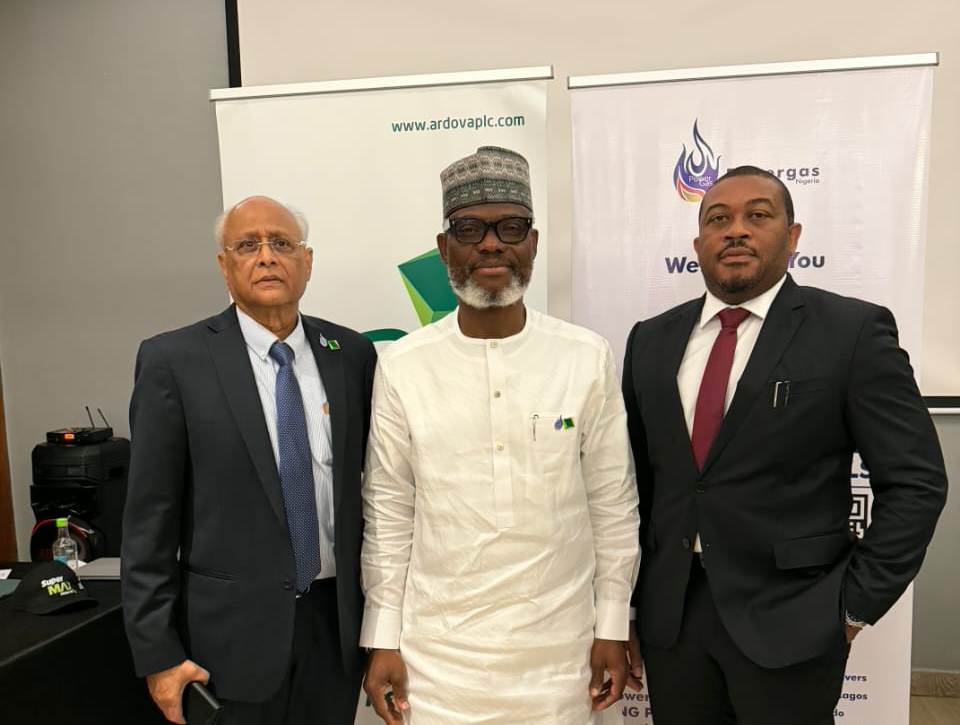
…Ardova–Diadem Consortium targets wider distribution, 100 CNG sites as stakeholders stress continuity, safety and execution
The proposed acquisition of Powergas by the Ardova Plc–Diadem Energy consortium is set to open a new phase in Nigeria’s compressed natural gas (CNG) market, with the investors outlining plans to expand gas infrastructure, widen access to customers and deepen the use of domestic gas across transportation, industry and power.
At a staff townhall meeting held at the Radisson Blu Hotel, Ikeja, Lagos, following the announcement of the transaction, stakeholders placed emphasis not only on the commercial value of Powergas but also on the infrastructure and human capital that have enabled the company to take natural gas beyond the reach of Nigeria’s conventional pipeline network.
The consortium has agreed to acquire 100 per cent of Powergas Global Investments Nigeria Limited and Powergas Ebedei Limited from Africa Infrastructure Fund I, managed by A.P. Moller Capital, through Impala Energy Holdings. Completion is expected around the end of 2026, subject to regulatory and other third-party approvals.
The transaction comes at a time when Nigeria is seeking to increase domestic gas utilisation and expand CNG infrastructure as part of efforts to reduce dependence on petrol and diesel for transportation and provide industries with more reliable domestic energy.
The Federal Government has also expanded its Presidential Initiative on Compressed Natural Gas to include electric vehicles, with the initiative mandated to support the deployment of CNG infrastructure, conversion programmes and mobile refuelling units nationwide.

From virtual pipeline to wider gas network
For Diadem Group Chairman, Dr George Eluwa, the acquisition represents a continuation of a relationship that has already demonstrated the potential of a “virtual pipeline” model.
Eluwa recalled that Diadem had worked with Powergas since 2022, deploying CNG trucks and supporting the movement of compressed gas by road to customers beyond the conventional pipeline network.
He said that in 2025 alone, Diadem’s fleet completed more than 6,500 trips, covering over 2.7 million kilometres and delivering more than 51 million standard cubic metres of gas.
According to him, the logistics operation also resulted in the avoidance of more than 500 tonnes of carbon dioxide emissions compared with diesel-based transportation.
But Eluwa stressed that the figures should not be attributed to Diadem alone, describing them as the product of collaboration between Powergas’ compression and operations teams and its logistics partners.
“Those numbers do not belong to Diadem,” he said, stressing that they reflected Powergas’ compression infrastructure, operational systems, planning and commitment.
The significance of that model, he suggested, lies in its ability to move gas to customers where fixed pipelines are either unavailable or economically impractical.
Powergas was founded in 2013 around this model of taking natural gas beyond the conventional pipeline grid. Its operations have since expanded to include four mother stations and more than 250 tube skids, according to information released on the transaction.
Ardova: acquisition goes beyond assets
For Ardova Plc Chairman, Dr AbdulWasiu Sowami, the attraction of Powergas goes beyond the physical assets being acquired.
He said the consortium was particularly interested in the people, operational culture and reputation developed by Powergas over the years.
“What drew us to Powergas was not only its assets, it was its people and the reputation you have built,” Sowami told employees at the townhall.
He noted that customers had come to depend on Powergas for the safe and timely delivery of gas, describing the company’s ability to build a virtual pipeline where a conventional physical pipeline does not reach as an achievement rooted in its operational culture.
Sowami said Ardova’s interest was therefore to build on the platform rather than simply take over its existing operations.
The transaction brings together three complementary components: Powergas’ gas sourcing relationships and compression infrastructure, Diadem’s virtual-pipeline logistics capabilities, and Ardova’s nationwide retail, logistics and distribution network.
That combination is expected to provide a broader platform for supplying natural gas to industries, commercial fleets and motorists.
100 CNG sites targeted within 24 months
One of the clearest targets emerging from the transaction is Ardova’s plan to deploy CNG infrastructure across its retail network.
The company says it is targeting 100 CNG refuelling sites nationwide within 24 months, potentially giving commercial fleets and motorists wider access to CNG.
The plan comes as government-backed CNG infrastructure is also expanding. In May 2026, four CNG projects were commissioned across Lagos, Abuja and Owerri under the Midstream and Downstream Gas Infrastructure Fund, while the Federal Government said it was pursuing measures to reduce the cost barrier to vehicle conversion and improve access to CNG.
The private-sector expansion, however, places greater emphasis on execution—particularly the availability of gas, compression capacity, transportation infrastructure, refuelling facilities and conversion capacity required to turn the growing policy interest in CNG into sustained consumer use.
Dr Abiola Babatunde-Ojo, Managing Director of Ardova Plc, said the focus following the transaction would be on execution, including expanding compression capacity, introducing CNG into Ardova’s retail network and connecting more industries and fleets to domestic gas.
Beyond transportation: tackling Nigeria’s gas utilisation gap
The proposed combination also has implications beyond the automotive market.
The consortium says it intends to expand Powergas’ compression capacity across viable gas-producing corridors, creating additional offtake opportunities for associated and non-associated gas.
Such expansion could provide a commercial route for gas that might otherwise remain stranded or be flared, while supporting investment across the gas value chain.
This is particularly relevant to Nigeria’s wider push to convert its substantial gas resources into productive economic activity. The Federal Government has recently highlighted a renewed drive to unlock gas resources for industrialisation, power generation, investment and job creation, including the September 2026 Final Investment Decision on the $800 million Ima Gas Project.
For Powergas, the next phase therefore presents a question larger than ownership: how effectively can existing infrastructure be scaled to connect more of Nigeria’s gas resources with businesses and consumers that need dependable energy?
Continuity and safety remain critical
While the acquisition promises expansion, Eluwa used the townhall to reassure employees that the immediate priority would be continuity.
He stressed that the transaction was still subject to regulatory approvals and closing requirements and that operations would continue under the existing arrangements until completion.
His second message was safety.
“Gas is our business and safety is our licence to operate,” he said, emphasising the need to maintain the safety of drivers, operators and other personnel as the business enters its next phase.
That emphasis is significant for an industry in which the expansion of road-based gas distribution will require sustained attention to transportation, compression, storage, loading, handling and refuelling standards.
Powergas itself highlights safety and reliability as central to its operating model, reporting more than 100,000 deliveries and a near-100 per cent safety record on its website.
From acquisition to national gas access
Eluwa framed the longer-term ambition around making Nigerian gas more accessible to ordinary consumers and businesses.
He said the consortium’s ambition was for clean and affordable Nigerian gas to be brought “within an arm’s reach” of Nigerians—through vehicles, electricity generation, homes, businesses and communities.
The ambition reflects the broader challenge facing Nigeria’s gas sector: the country possesses substantial gas resources, but infrastructure limitations have historically constrained the ability to convert those resources into reliable energy for households, industries and transportation.
The Ardova–Diadem consortium is consequently betting that combining production-side compression, road-based logistics and downstream distribution can help close part of that infrastructure gap.
Ardova Executive Chairman Sowami said the consortium intended to connect Nigeria’s gas resources to industry, power and transportation while supporting the Federal Government’s CNG and broader gas-development programmes.
Yet the ultimate measure of the acquisition will depend on implementation—whether new compression capacity is delivered, whether CNG stations become operational at the projected scale, whether supply remains reliable, and whether the resulting infrastructure can provide commercially viable energy for customers.
A new chapter, but the old foundation remains
At the townhall, Sowami paid tribute to Powergas founder and visionary D.P. Kidani and to A.P. Moller Capital, which invested in Powergas Ebedei through Impala in 2019 and supported the company through development, construction, commissioning and operational scale-up.
The acknowledgement underscored the fact that the proposed acquisition is not the beginning of Powergas’ story, but a transition into another phase of an infrastructure model that has already been developed and tested.
Powergas began with the idea of moving gas beyond the pipeline. Diadem subsequently became part of the logistics chain, while Ardova now seeks to bring its national distribution footprint into the equation.
The challenge ahead is therefore to turn those separate capabilities into a larger and functioning gas ecosystem—one capable of expanding access without compromising safety, reliability or affordability.
As Nigeria continues to pursue greater domestic gas utilisation, the Powergas transaction places a new spotlight on whether private investment and integrated infrastructure can help move the country from having gas resources in the ground to having dependable gas within reach of the industries, transport operators and communities that need it.

