 Follow Us on Google News


 Follow Us on Google Discover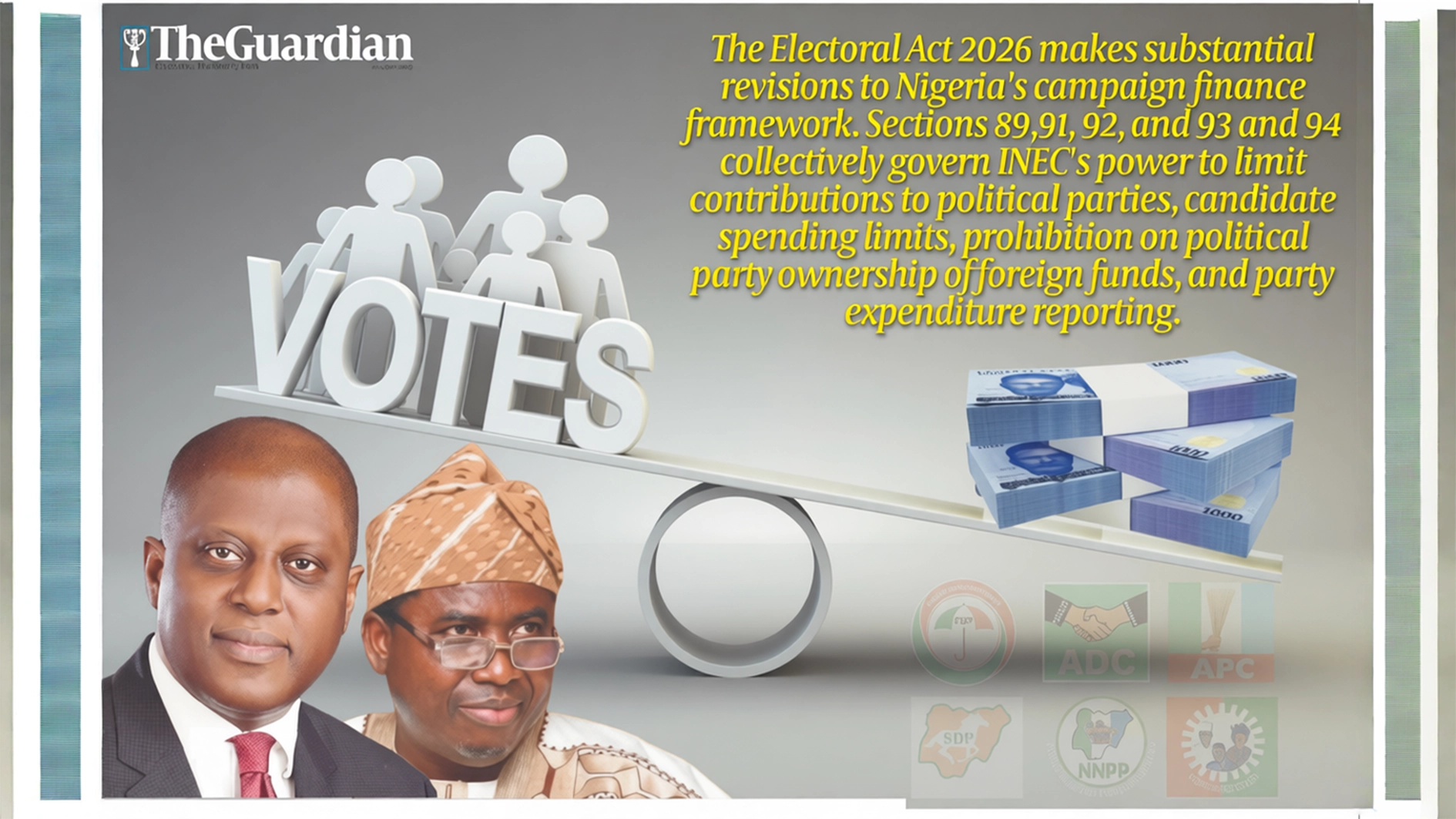
• Spending complicates policy choice for monetary authority
• Excessive spending, dollarisation may recreate 2022 FX crisis
• Edun, Cardoso warn about election money distortion
• Politicians insist funding limit below reality
With pre-election activities fully activated, rising politically-induced liquidity may have thrown spanners into efforts to sustain the modest price stability recorded since last year and prevent the economy from regressing into 2023/2024 volatility.
At a press briefing on the outcome of this year’s maiden Monetary Policy Committee (MPC) meeting this afternoon, the CBN Governor, Yemi Cardoso, is expected to make a statement on how the monetary authority intends to manage possible excessive market distortion that could result from political spending, which the new electoral guideline has increased.
It is immaterial whether the CBN Governor dismisses the fact that the expected excessive election spending is a major variable outside his team’s control. The market already has a default expectation that a pre-election year comes with an uptick in the demand for foreign exchange (FX), which often puts pressure on the exchange rate and general prices.
Unlike economic decisions, election-related expenditures are hard to fit into forecast models. First, they do not follow any strict rules. Secondly, the figures and forms are extremely impulsive, making it difficult for policymakers to adequately control market distortion.
Most importantly, the historical unholy alliance between monetary regulators and politicians could create a confidence challenge that makes the market unresponsive to policy interventions.
Already, the Minister of Finance, Wale Edun, recently expressed dismay that the incremental naira appreciation could be defrayed by political activities in a pre-election year.
Edun’s concern aligns with a historical trend dating back to the 2003 general election, when the Abuja parallel FX market was mopped up by delegates, who were faced with limited choices in travelling back to their states after the PDP primaries.
As part of the aftermath of the election, where millions of naira were shared among the party faithful, currency trading shops in the Federal Capital Territory (FCT) were flooded with requests by delegates who had to convert the proceeds of the primaries to hard currencies for easy movement of the funds to the abodes of the politicians.
In the run-up to the 2023 election, politicians ransacked Lagos, Abuja and other major cities in Nigeria, mopping up dollars, which became the currency of trade in the highly competitive nomination exercise.

With the scarcity that resulted, the dollar soared to about N900/$ at the black market, stretching the spread between official and unofficial markets to about 100 per cent. At the time, naira traded at about N460/$ at the regulated official market.
The rigidity caused by the wide arbitrage robbed the country of the much-needed FX inflow as the foreign capital importation dried up and the official market was only accessible to politicians and their cronies.
There are fears that 2027 could bring back the hell days of the FX market and turn the logic of reform upside down once again.
Cardoso had also urged state governors to maintain fiscal discipline and avoid frivolous spending; as such, excessive spending could destabilise the impacts of reforms that have successfully restored economic stability.
From 2025 to this week, the naira has gained approximately N200 against the dollar. The pass-through effect of relatively cheaper imports has eased price pressure. Hence, inflation has eased from over 30 per cent to a little above 15 per cent in January.
On the back of the restrictive monetary run, aggregate money supply slowed to a 9.8 per cent year-on-year growth as of January. The slow growth reflects the negative growth in credit to the private sector, from N78 trillion in December 2024 to N75.83 trillion at the close of last year.
The moderations – of inflation, naira depreciation and money balances – have enhanced policy headroom in the restrictive monetary policy that has run since 2022. But politicians may turn on the liquidity tap, following the recent release of the 2027 timetable.
Even in a tightened market, politicians have always had their ways. For instance, while credit to the private sector rose by three per cent last year, that of the government rose from N27.14 trillion to N34.22 trillion or a significant 26 per cent, highlighting the significant influence of the political system on market trends.
The Electoral Act 2026, signed into law by President Bola Ahmed Tinubu, may have increased the impact as it increased campaign funding for certain categories of elective offices and raised the limit for donors.
In the revised Electoral Act, the lawmakers generously increased the campaign finance ceiling for all elective offices, particularly federal legislators, governors and the president, by 100 to 400 percentage points.
The Policy and Legal Advocacy Centre (PLAC), a non-governmental organisation committed to strengthening democratic governance and citizens’ participation, noted that by stretching the spending limits for all elective offices by as much as 400 per cent, the Electoral Act indulged the candidates and political parties beyond mere inflationary rate, particularly given that individual donations are also increased by as much as 900 per cent.
By raising campaign finance limits across the board, the newly enacted Electoral Act 2026 has altered Nigeria’s political spending landscape ahead of the 2027 general elections, effectively doubling, and in some cases tripling, the ceilings contained in the repealed Electoral Act 2022.
What the Electoral Act says
Under Section 92 (1–8) of the new law, presidential candidates may now spend up to N10 billion, up from N5 billion under the 2022 regime. Governorship candidates are permitted to expend N3 billion, compared with N1 billion previously. The spending threshold for senatorial candidates increased from N100 million to N500 million, while House of Representatives aspirants may now spend N250 million, up from N70 million previously allowed.
Similarly, state house of assembly candidates are allowed to spend N100 million, compared with N30 million under the old law. Area council chairmanship candidates can spend N60 million, a double of the former N30 million limit, while councillorship candidates may now spend N10 million, up from N5 million.
Beyond expenditure ceilings, the Act also revises donation limits. While the 2022 law capped individual or corporate donations to a candidate at N50 million, the 2026 legislation raises the ceiling to N500 million per donor, representing a tenfold increase.
Lawmakers justified the upward review as a reflection of inflationary pressures, escalating logistics costs and the financial demands of nationwide campaigns. They argued that previous limits had become unrealistic, leading to widespread non-compliance and rendering enforcement largely symbolic.
Electoral Act’s recommendation symbolic
Even with the new law, critical stakeholders described the Electoral Act 2026 as merely symbolic in Nigeria’s heavily monetised political system.
President Bola Tinubu of the All Progressives Congress (APC) and Alhaji Atiku Abubakar of the Peoples’ Democratic Party (PDP) at the last election allegedly spent between N500 billion and N1 trillion. To date, neither of the candidates has made public what was expended to prosecute their campaigns in the last general election.
Gubernatorial contenders in commercially strategic states like Lagos, Rivers, Anambra, Kano, and Kaduna reportedly spent between N15 billion and N20 billion. Senatorial hopefuls in the states allegedly spent between N700 million and N1 billion, while House of Representatives and state assembly candidates also routinely breached spending limits, with estimated expenditures of N400 million and N200 million, respectively.
With the new law, there are concerns that higher thresholds could entrench money politics and narrow the field against less financially endowed aspirants while causing significant distortion to the monetary space.
Stakeholders express concern
Stakeholders are worried that the increase in campaign funding cap by the Electoral Act 2026 at this point, when Nigerians are calling for less emphasis on money politics, compounds the challenges of inclusivity and transparency, as INEC’s ability to oversee political parties’ excesses has become a subject of national anxiety.
According to PLAC, the tenfold donation cap increase has the capacity to enable elite capture of electoral financing, such that one individual or organisation can validly provide a candidate with N500 million.
While noting that penalties for breach of the provisions are clearer on paper, PLAC said the sole determinant of the effective policing of the stipulations is the enforcement credibility, stressing that “Section 93’s disclosure and publication requirements for party expenditure are a genuine transparency opportunity, contingent on consistent INEC and judicial enforcement.”
Like PLAC, Nigerians are worried that the development would warrant the takeover of the electoral process and outcomes by the monied class, even as it gives full impetus to vote-buying and its associated corrupt tendencies.
Concerns about the emphasis on huge funding latitude for aspirants to various elective offices are limited to its overarching implications on electoral fidelity, but also to the possible stress on the economy that is already burdened by steep naira to Dollar parity in the exchange market.
Even in the face of the rising concern on the possible liquidity surge this could cause, Election expert Fouad Oki, who served as Campaign Director-General for former Babatunde Fashola and Akinwunmi Ambode in Lagos, said the N10 billion spending limit for presidential campaigns is unrealistic, given the scale of activities required.
He said that in the current state of the economy, an aspirant must tour all 36 states to declare interest, hold meetings with governors and stakeholders across party lines, and reach out to party delegates—often involving financial inducements running into billions.
Stakeholder outreach engagements with leaders across 109 senatorial districts, 360 federal constituencies, 774 local governments, and 8,809 wards are standard. Aspirants are also expected to visit at least 500 first-class traditional rulers nationwide.
Visits to religious leaders and groups such as the Christian Association of Nigeria (CAN) and the Pentecostal Fellowship of Nigeria (PFN), with a combined following of over 65 million, are crucial and usually involve financial commitments.
Expenses at this stage include transport, fuel, vehicle maintenance, accommodation, protocol, staff salaries, and security—all of which may easily surpass the N10 billion cap.
Other stakeholders also noted that the cost of campaign promotions—posters, fliers, branded materials, media placements, and billboards—consumes billions. These are aimed at shaping public perception and building name recognition.
Oki further posited that candidates must re-engage party leaders and delegates. Party nomination forms alone cost millions—N100 million in APC and N40 million in PDP during the 2023 cycle.
The South-South stakeholders also toed that line of argument over the enforcement of the Electoral Act, regretting that the stipulations would no doubt lead to further increases in the cost of expression of interest and nomination forms by political parties.
According to the Pan Niger Delta Forum (PANDEF) and the Ijaw National Congress (INC), there is no justification for the huge increase, arguing that that aspect of the Electoral law failed to address critical issues surrounding the cost of expression of interest and nomination forms, while prioritising a 400 per cent increase in campaign spending.
National Publicity Secretary of PANDEF, Obiuwevbi Ominimini, said the omission has grave implications for Nigeria’s political and economic systems. However, the National Publicity Secretary of the INC, Ezonebi Oyakemeagbegha, warned that it could inject excessive liquidity into the political system and deepen corruption in the electoral process.
Oyakemeagbegha said that the significant rise in campaign expenditure would pose serious economic challenges, including further depreciation of the nation’s exchange rate and increased borrowing, remarking that the policy could escalate Nigeria’s debt burden.
On his part, the PANDEF spokesman lamented the high cost of the expression of interest forms. He pointed out that major political parties currently charge exorbitant fees for expression of interest and nomination forms, thereby disenfranchising capable but less privileged aspirants.
He cited the 2020 election cycle, noting that the cost of expression of interest and nomination forms for Senate seats ranged between N10 million and N20 million, while forms for the House of Representatives and state Houses of Assembly were also priced in millions of naira. In some states, he said, assembly forms cost about N2 million.
Ominimini questioned why a country with a minimum wage of N70,000 would allow political parties to fix nomination fees far beyond the reach of ordinary citizens.
“We are saying that the law should make provision for the maximum amount any political party can charge for expression of interest and nomination forms. It should not be more than the nation’s minimum wage,” he said.
On the 400 per cent increase in campaign spending, Ominimini warned that the development could further entrench money politics and strengthen the influence of so-called political “godfathers.”
He expressed concern that the increase could worsen corruption and exert additional pressure on the naira, especially in the face of weak enforcement of existing campaign finance regulations.
While criticising anti-corruption agencies for failing to effectively monitor political donations, noting that the Electoral Act places limits on individual contributions to campaigns, Ominimini stated:
“You have seen situations where an individual publicly announces a donation of hundreds of millions of naira on behalf of himself and unnamed associates. Anti-corruption agencies should investigate such claims to determine the true sources of the funds.”
He maintained that while the hike in campaign spending is troubling, the more pressing issue is the exclusion of ordinary Nigerians from the political process through prohibitive nomination fees.
Godfatherism, he added, has remained a persistent challenge in Nigeria’s politics, alleging that in some cases, candidates’ names are decided behind closed doors by powerful political actors.
According to him, such practices would be further strengthened by increased campaign spending limits unless strict regulatory oversight is enforced.
Speaking further, the INC spokesman accused politicians of insincerity and greed, adding that the increase in campaign spending would widen the gap between the political class and ordinary Nigerians, particularly poor workers and vulnerable electorates.
He cautioned that, unless properly regulated, the policy could undermine transparency and accountability in the electoral process.
Questioning how INEC will effectively monitor campaign spending, the Centre for Anti-Corruption and Open Leadership (CACOL) and the Human and Environmental Development Agenda (HEDA) lamented that despite repeated demands for INEC to publish details of campaign spending by major parties in 2023, the commission has yet to do so.
According to CACOL’s Debo Adeniran, “Secrecy pervades the system. Banks rarely flag campaign-related transactions, and there is no real-time transparency. Even the EFCC, which ought to monitor political funding, has done little in this regard.”
Former Senate Minority Leader, Olorunnimbe Mamora, also questioned the wisdom of saddling INEC with the responsibility of monitoring campaign finance. He argued that the commission is already overburdened and lacks the capacity for such oversight.
“In my view, another agency, such as the Nigerian Financial Intelligence Unit, should handle this responsibility. INEC is not equipped to monitor financial flows during the three electoral phases—pre-election, election day and post-election. We must define exactly what should be monitored and who should do it,” he said.

