 Follow Us on Google News


 Follow Us on Google Discover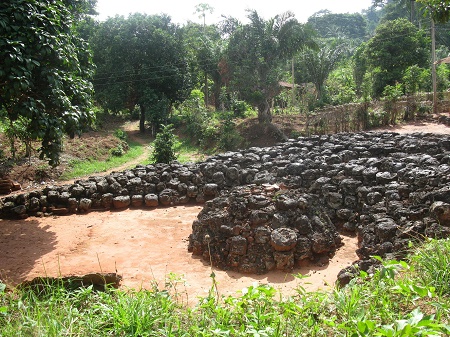
 A few days ago, I changed the image on my computer screen, from one depicting night-traffic along a foreign mountainside, to a stunning view of Otobo-Ugwu–an ancient iron-smelting ruin and community shrine in Lejja, near Nsukka, Enugu State.
I have been to the site several times. The new image is a photograph, taken during one of those visits. Still, each time the computer lights up, I am enraptured: Both by the enthralling aesthetics and the intriguing geometry of this remarkable structure.
Otobo-Ugwu is situated near the crest of a hillock in Dunoka village, the cultural hub of Lejja’s 33 communities. Built with massive blocks of iron slag, it is a huge crescent-shaped configuration, with a circular mound (constructed from similar masses) positioned in its cusp.
The hillock–nestled in a rich verdure of palm, mango, mlina and oil bean trees–harbours a complex of shrines. The rituals and traditions of each one, is a variation on the same general theme: That being the efficacy of iron-smelting and, inferentially, astronomical cycles.
No one knows who erected Otobo-Ugwu, when or exactly why. One thing is clear, though: The builders possessed a highly evolved aesthetic and, not incidentally, a vision of the future. Whatever may have been their motives, communicating with the unborn was manifestly among them.
This is implied, by the structure’s expansiveness, as well as the engineering that went into it. Otobo-Ogwu is laid out in a near-perfect crescent, whose creation involved transporting and positioning thousands of dark metallic masses, some weighing up to a metric tonne.

“Slag,” I should explain, is the waste material generated when iron (or other metal) is heated and separated from its ore. Iron-smelting throve in Lejja (and elsewhere in Nigeria) hundreds, possibly thousands, of years before colonization; and these hunks of slag are the surviving residue.
My first visit to Lejja, was in 2009, on invitation from Drs. Johnson Urama, a radio astronomer, and Pamela Eze-Uzomaka, an archaeologist—both professors at the University of Nigeria, Nsukka (UNN). I watched an international team of archaeologists excavate, just outside the shrine complex.
Professor Felix Chami, of Dar es Salaam University (Tanzania), headed the team, while Eze-Uzomaka was the local coordinator. Urama and Dr. Chukwuma Opata, a lecturer at UNN and a local authority on Otobo-Ugwu, carried me to the ruins.
That sparked my interest; and the five of us later co-authored a paper, emphasizing the astronomical angle. (Urama, who is also an archaeoastronomist, read the monograph at an International Astronomical Union seminar in Lima, Peru).
A panoramic view of the mound-in-cusp configuration, suggests strongly that its creators had astronomical symbolism in mind. The two structures are, in all likelihood, replications of the planet Venus and its periodic alignment with the crescent Moon.
My interviews with village Elders, support the celestial hypothesis. The old men could shed little light on Otobo-Ugwu origins. Yet Lejja’s customs and traditions are keyed to the lunar cycle. The crescent Moon in particular, they said, once figured in a dramatic (but now discarded) monthly ritual.
The anchor of this time-keeping system, was “Oyaogwoo”–an aged evergreen tree (“ogbu”) with slag-masses at its base. A trail approaching the shrine complex, forks into a “Y” shape; and Oyaogwoo stands between the northern and southern prongs.
Formerly, tradition required villagers to use the north trail, until the crescent Moon appeared, then switch over. When the new Moon was announced, one Elder recalled, cries of “Ogughi banyi oh!” (“No evil is in our compound!”), erupted from every house.
To be continued.
J.K. Obatala

