 Follow Us on Google News
 Follow Us on Google Discover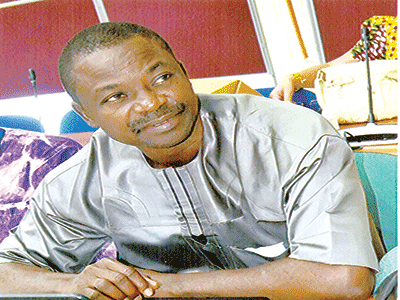

A mycotoxicologist and Dean, School of Basic and Applied Sciences Babcock University, Ilishan Ogun state, Prof. Dele Fapohunda, has tasked the Agriculture Minister, Audu Ogbe, on how to ensure local wholesome food consumption, enhanced export value in 2016.
Fapohunda, in a blueprint made available to The Guardian noted: “Nigerians expect the year 2016 to witness an upscale in the standards in the agricultural sector in a manner that will rub off positively on the human health and export. In 2015, the Nigerian agriculture export suffered a set back as the European Union (EU) placed a one year ban on the importation of beans, sesame seeds, melon seeds, dried fish and meat, peanut chips and palm oil from Nigeria. The ban, which ends in June 2016, was due to the continuous detection of pesticides and aflatoxins at levels higher than acceptable. Aflatoxins are poisons produced by molds on these and other susceptible crops when exposed to conducive environment. These favourable conditions are present in Nigeria and sub Saharan Africa.

One aflatoxin called aflatoxin B1, which is common in Nigeria, is a group 1 carcinogen, confirming it is being a human carcinogen. A 2013 report released by Partnership for Aflatoxin Control in Africa, PACA, sponsored by the Bill and Melinda gates Foundation and British Department for International Development (DFID) stated that more than 70 percent of all liver cancer cases in Nigeria were attributable to aflatoxin ingestion. PACA, is a continental but country-led initiative.
Stakeholders expect that food production and food safety should be on same front page in the policy road map of the Federal Ministry of Agriculture in 2016.
As we approach June 2016, what steps and feedback evaluation mechanisms are being put in place to launch Nigeria back to the EU and global agricultural platforms?
Capacity building and holistic solution provision measures must be attained and sustained. It will be a disaster if, after June, Nigeria is once again caught in another embarrassing ban web. In every four Africans there is one Nigerian; and for every two West Africans, there is also one Nigerian. This demographic advantage should naturally confer leadership on Nigeria in every department including meeting standards in aflatoxin –free local food consumption and global agricultural trade. It is a challenge the Hon Minister of Agriculture is competent to address.

