 Follow Us on Google News
 Follow Us on Google Discover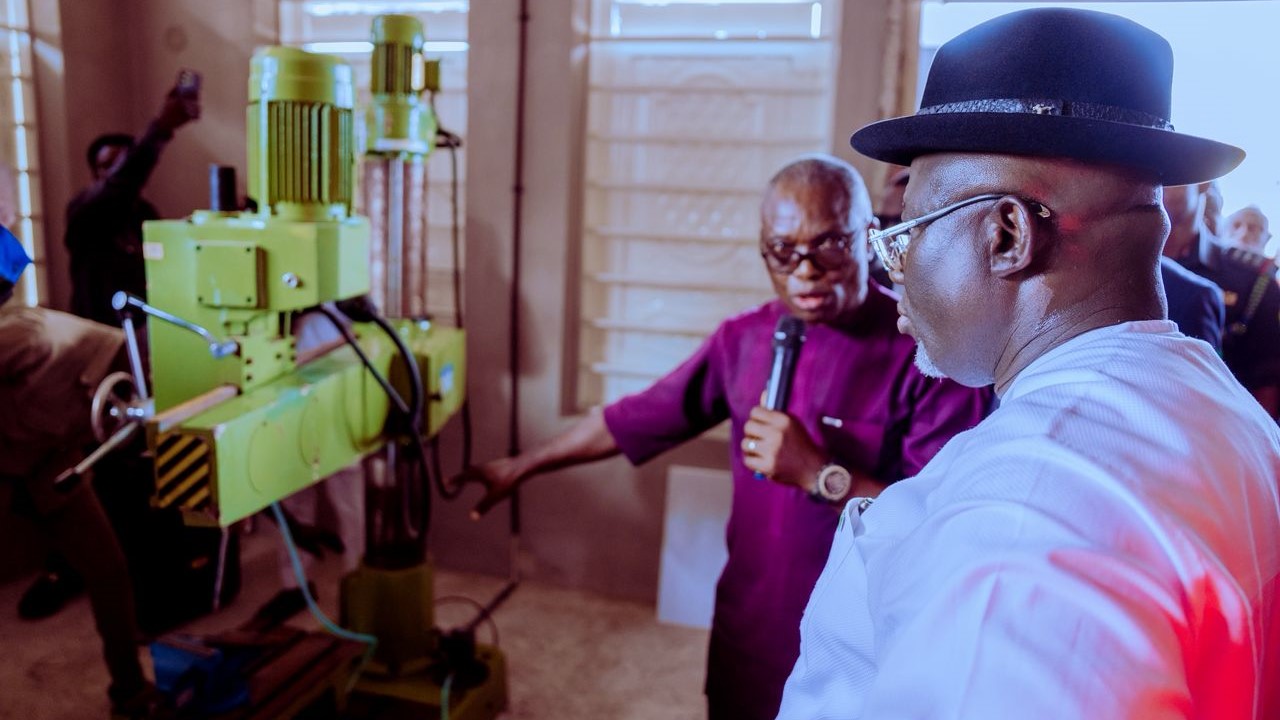
On a humid Monday in Omadino, a riverine community in Warri South Local Government Area, jubilation filled the air as Delta State Governor, Rt. Hon. Sheriff Oborevwori, inaugurated the Model Technical College that now stands as a symbol of promise for young people and a testament to an administration determined to deliver results rather than rhetoric.
The college, already alive with academic activity months before its official commissioning, represents more than bricks, workshops and laboratories: It reflects a governance philosophy anchored on prudent management, inclusive development and a firm belief that effective technical education, skills and infrastructure are the surest pathways to sustainable prosperity.
Standing before a cross-section of students, traditional rulers, lawmakers and community leaders at the epochal event in Omadino, Governor Oborevwori described technical and vocational education as one of the most effective tools for tackling youth unemployment in Nigeria. He stressed that the aim was to raise skilled professionals, entrepreneurs and employers of labour, not graduates searching for jobs endlessly.
“Some achievements are better appreciated when seen rather than spoken about,” the governor said, pointing to the sprawling campus with its internal road network, modern classrooms, workshops and laboratories. He noted that within just two years, his administration had delivered landmark projects without borrowing or imposing additional burdens on Deltans, a feat he attributed to fiscal discipline, transparency and prompt payment of contractors.
The Omadino Model Technical College, initiated by the previous administration of Senator Ifeanyi Okowa and completed under Oborevwori, has quickly become a flagship investment in technical education. Its fully equipped workshops, hostels, staff quarters, clinics, recreational facilities and support infrastructure underline a commitment to quality and functionality.
To the governor, the confidence and eloquence of a student who spoke at the event was living proof that effective teaching and learning were already taking root in the college.

For the Commissioner for Technical Education, Mr. Smart Ufoh, the college is “far more than a modern technical school:” it is a bold statement of purpose and a symbol of transformation. He revealed that academic activities began in September 2025 with the admission of Junior Technical One students, ensuring that the sophisticated facilities did not lie idle or fall into disrepair. The response from Omadino and neighbouring communities, he added, had been overwhelming. Beyond education, the Omadino event became a broader conversation about equity, access and development in Delta State’s often-neglected riverine areas. Responding to remarks by the Olu of Warri, His Royal Majesty Ogiame Atuwatse III, the governor reaffirmed his administration’s commitment to inclusive development that leaves no part of the state behind. He reeled out a long list of completed and ongoing projects across riverine and coastal communities: over 15 bridges, kilometres of roads linking previously isolated settlements, the Burutu Technical College, major road projects in Ogidigben, Torugbene, Ogulagha, Okunti, in Bomadi and Warri South-West, as well as the completed Trans-Warri Road and ongoing works at Akugbene Technical College.
Even within the Olu of Warri’s kingdom alone, the governor disclosed, no fewer than 15 bridges and extensive road networks had been delivered. “We have truly done a lot for Deltans,” Oborevwori said, noting that the sheer volume of completed projects sometimes made it difficult to commission all of them before elections. His message was clear: development, not politics, remains the focus. Traditional authority lent weight to that assessment. The Olu of Warri, at the event, thanked the governor for personally inaugurating the Omadino College, describing his presence in the riverine area as a blessing.
While urging him to do more particularly in schools, roads, bridges and jetties, the monarch acknowledged that the past two- and -a- half years had transformed projects once considered impossible to reality. Yet, this factual narrative of steady progress extends beyond education and roads to security, peace and governance.
At Government House, Asaba, where Governor Oborevwori received newly trained police cadets of Delta State origin, Wednesday, he charged them to uphold integrity, professionalism and respect for the rule of law. Congratulating them on completing the rigorous Police Academy training, he described policing as a noble but demanding profession that requires discipline and selfless service.
Reaffirming his administration’s commitment to security, the governor noted significant improvements in safety across the state over the past two years and announced the approval of monthly allowances for the cadets, effective from January. To the young officers, he said: “You are special to this state, and we are proud of you.”
That message of pride and partnership resonated with the Urhobo Christian Ministers Association International, which paid a prayer visit to the governor and lauded his leadership for promoting peace, inclusive governance and massive infrastructure development. The association’s president, Archbishop Solomon Gbakara, praised the administration for maintaining harmony between arms of government and for ensuring that development projects are spread equitably across all parts of the state.
To him, the visible calm and balanced growth in Delta State reflect wisdom in leadership and a clear sense of direction. Infrastructure delivery, another cornerstone of the Oborevwori administration, is also being driven by a deliberate policy of prompt payment to contractors. During an inspection of the N29.2 billion bridge across the Orere River in Ughelli South, the Commissioner for Works (Highways and Urban Roads), Comrade Reuben Izeze, disclosed that the project had reached 77.67 per cent completion. He attributed the steady progress to the state government’s policy of settling certified works without delay, stressing that the contractor was not owed any outstanding certificates.
The bridge project, which includes a 500-metre reinforced concrete bridge, nearly six kilometres of access and arterial roads, and an extensive drainage, is already changing the landscape. “The last time we came here, we couldn’t drive onto the bridge. Today, we were able to pass through”, Izeze recalled. It was, according to him, a clear indication that consistent support and accountability yield results.
Across education, infrastructure, security and community engagement, a common thread runs through these stories: a governance approach that prioritizes diligent planning, faithful execution and equitable spread. From the classrooms of Omadino to the bridges of Orere, from riverine roads to police cadets stepping into service, Delta State’s development narrative is being rewritten with a focus on sustainability and shared progress. As Governor Oborevwori continues to urge communities to protect public assets and stakeholders to play their part, the emerging picture is one of a state steadily building the foundations for opportunity.

