 Follow Us on Google News


 Follow Us on Google Discover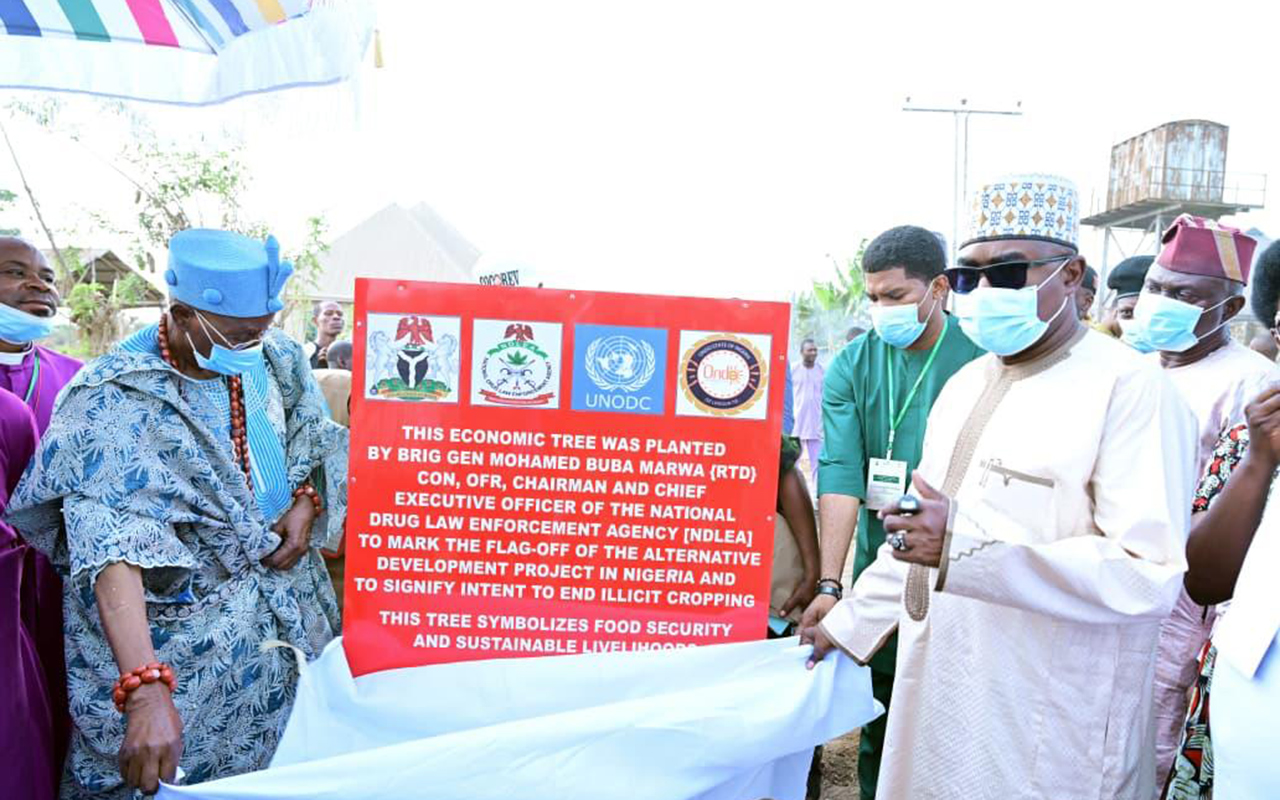
For decades, Nigeria’s response to illicit drug cultivation has been largely enforcement driven, centred on arrests, seizures and the destruction of illegal farms. While these measures have yielded notable successes, they have also revealed a persistent challenge – without viable economic alternatives, affected communities often return to the same illicit activities enforcement seeks to dismantle. This reality, particularly evident in cannabis producing regions of the country, has increasingly framed drug control not only as a law enforcement concern, but as a development, public health and national security issue.
It is within this context that the National Drug Law Enforcement Agency has begun to reimagine its approach. Under the leadership of its Chairman and Chief Executive Officer, Brig. Gen. Mohamed Buba Marwa (rtd), the agency has launched an Alternative Development initiative that seeks to address the structural drivers of illicit drug cultivation through lawful livelihoods, agricultural diversification and community centred interventions. The pilot phase of the programme, recently launched in three cannabis growing communities in Ondo State, represents the first structured application of alternative development in Africa’s drug control framework.
Marwa formally outlined the rationale behind the initiative at a press conference in Abuja on February 3, 2026, where he called for a strong national response and sustained support for the programme. According to him, alternative development goes far beyond crop substitution, encompassing the strengthening of rural economies through value chain development, the reduction of pressure on law enforcement and the justice system, the promotion of peace and social cohesion in crime prone areas, and the improvement of Nigeria’s standing in global drug control and development cooperation.
He described the early outcomes of the Ondo pilot as evidence that alternative development works when communities are genuinely engaged and empowered. The initiative, he stressed, offers a shared benefit for communities, government and national security, provided it receives consistent backing from all levels of government, traditional institutions, development partners, the private sector, civil society and the media.
The urgency of this shift is underscored by the scale of Nigeria’s drug challenge. Data from the 2018 National Drug Use Survey conducted by the National Bureau of Statistics with technical support from the United Nations Office on Drugs and Crime shows that an estimated 14.4 per cent of Nigerians aged between 15 and 64 years, approximately 14.3 million people, reported using at least one psychoactive substance in the preceding year.
This prevalence rate is more than twice the global average and places Nigeria among the countries facing one of the most complex drug control environments in the developing world.
Cannabis remains at the centre of this challenge. With an estimated 10.6 million adult users, it is the most frequently used and widely available illicit drug in the country. Its impact extends beyond consumption into organised cultivation and trafficking networks that exploit remote forests, weak rural infrastructure and limited state presence. Field assessments in high risk areas of the South West indicate that nearly 8,900 hectares of land are under cannabis cultivation, often clustered in ways that suggest coordinated production and supply chains serving both domestic and cross border markets.
The social and public health implications are severe. Habitual use, often initiated in late adolescence, contributes to dependency, diminished educational outcomes and long term health challenges, while placing additional strain on already overstretched healthcare systems. Families and communities bear the cost through lost productivity, increased crime and weakened social cohesion. From a security perspective, the illicit drug economy has been linked to criminal networks that thrive on instability and exploit young people with limited economic options.

These realities informed the agency’s decision to look beyond enforcement and adopt a United Nations endorsed alternative development model. Rather than treating symptoms through repeated raids and seizures, the strategy seeks to dismantle the economic foundations of illicit cultivation by offering sustainable alternatives rooted in local realities. In doing so, it aligns drug control with broader national priorities around food security, rural development and youth employment.
It was gathered that Ondo State was selected for the pilot phase because of its unique position within Nigeria’s agricultural and drug control landscape. While it is the country’s leading cocoa producer, it is also widely recognised as its highest producer of cannabis. This dual identity made it both a strategic and symbolic choice for testing a new approach, demonstrating that illicit cultivation can coexist with legitimate agricultural excellence, and that one can be replaced by the other with the right support.
Marwa’s four-day official visit to the state marked a significant moment in the programme’s rollout. Combining high level policy engagements with direct community interaction, the visit was widely described by residents as a signal of renewed government attention to long marginalised rural areas. His arrival in Akure aboard a commercial flight, rather than a chartered aircraft, was noted by observers as consistent with his reputation for modesty and public service, subtly reinforcing the people-centred ethos of the initiative.
At the Government House, Governor Lucky Orimisan Aiyedatiwa received Marwa and his delegation, affirming the state government’s commitment to the initiative. Subsequent engagements with traditional rulers, Christian and Muslim leaders, and other stakeholders reinforced the emphasis on collective responsibility in addressing drug abuse and illicit cultivation. These meetings also highlighted the influential role of community institutions in shaping behaviour and sustaining long term change.
During a town hall meeting organised under the Renewed Hope Alternative Development Advocacy Mission, Governor Aiyedatiwa described the NDLEA’s initiative as timely and visionary. He noted that drug abuse poses a serious threat to public health, social stability and economic productivity, often fuelling crime and youth restiveness.
According to him, tackling the root causes of drug abuse, including poverty, unemployment and lack of opportunity, is far more effective than relying solely on punitive measures.
He highlighted his administration’s investments in agriculture, vocational training, skills acquisition and youth focused grants, stressing that productive engagement reduces vulnerability to drug abuse and illicit activity. The governor assured the NDLEA of full state support, pledging collaboration with traditional institutions, religious bodies, civil society organisations and the private sector to strengthen prevention, rehabilitation and reintegration efforts.
At the formal launch of the Alternative Development Pilot Project, Marwa articulated the philosophical shift that underpins the initiative. He described it as a decisive move from a purely enforcement driven approach to one rooted in empowerment and partnership. The programme, he explained, is designed to help communities voluntarily abandon illicit crops such as cannabis and transition to lawful alternatives including cocoa, cassava, yam and beans, supported by technical guidance, access to inputs and market linkages.
He emphasised that the initiative is not a pretext for arrests, but a collaborative effort supported by the Federal Government, the United Nations and international partners, with strong emphasis on community ownership and sustainability. In Ondo State, where drug use prevalence is estimated at about 17 per cent, translating to roughly 400,000 users, this assurance proved critical in building trust and encouraging voluntary participation.
As the visit progressed to the pilot communities of Ifon in Ose Local Council, Ilu Abo in Akure North and Eleyeowo, policy discussions gave way to lived realities.
In Ilu Abo, residents welcomed the NDLEA chairman during a courtesy visit to the monarch, Oba Samuel Oluyemisi, who praised the initiative as the result of deep and creative thinking. He noted that while traditional measures had reduced illicit cultivation in the past, economic hardship had continued to push some youths into crime and drug production.
Representatives of international partners were also present at the community engagements. Mr. Noel Mulinganya of the International Institute of Tropical Agriculture, who participated in planting exercises alongside the NDLEA, state officials and residents, expressed admiration for the agency’s effort to attract youths away from illegal activities through agriculture. He noted that IITA’s youth engagement programmes focus on wealth creation and job opportunities, and pledged continued support through the transfer of relevant technologies, knowledge and skills.
The pilot scheme has drawn broad national and international backing. The Minister of Agriculture and Food Security, Senator Abubakar Kyari, represented by the ministry’s South West Regional Director, Mrs. Temitayo Alao, commended the initiative as a direct response to hunger, poverty and unemployment among vulnerable populations. She noted that the programme aligns with President Bola Ahmed Tinubu’s Renewed Hope Agenda by promoting food security, job creation and agricultural diversification.
International institutions, including the United Nations Office on Drugs and Crime, the Global Partnership on Drug Policies and Development based in Berlin, and the Mae Fah Luang Foundation under Royal Patronage in Thailand have lent technical and strategic support, alongside development partners from Africa, Europe, Asia and the Americas. Their involvement places Nigeria within a global network of countries experimenting with development-led responses to illicit economies.
For many residents, however, the most compelling aspects of the initiative were its immediate and personal implications. In Eleyeowo, Mrs. Bridget Olaoluwa, a 46-year old farmer, openly acknowledged her long involvement in illicit cultivation and pledged to abandon the practice if supported to establish a legitimate business. Her account reflected a broader reality in which survival, rather than criminal intent, often underpins participation in illicit farming.
Another farmer, Mr. Victor Ajanaku, described the initiative as an eye opener, noting that it was the first time he viewed the NDLEA personnel as partners rather than adversaries. His call for transparency highlighted the importance of accountability in sustaining trust and ensuring that support reaches genuine beneficiaries.
In a demonstration of tangible commitment, Marwa announced financial support for the communities, allocating ₦15 million to Eleyeowo and ₦20 million to Ifon to kick-start lawful farming and other productive ventures. Traditional rulers, religious leaders, members of the judiciary and civil society organisations all pledged sustained collaboration to ensure the programme’s success.
As the Ondo visit drew to a close, Marwa reiterated the need for sustained national support to expand the initiative beyond its pilot phase. While proposed amendments to the NDLEA Act will introduce stiffer penalties for drug related offences, including prison terms ranging from 15 to 25 years, he maintained that lasting change lies not only in punishment but in opportunity.
The Alternative Development programme, he said, is fully aligned with the Tinubu administration’s Renewed Hope Agenda and represents a long term investment in safer communities, stronger rural economies and enhanced national security. If scaled with consistency, transparency and genuine community participation, it may mark a turning point in Nigeria’s approach to drug control, transforming illicit cultivation from a cycle of enforcement into a pathway for sustainable development.

