 Follow Us on Google News
 Follow Us on Google Discover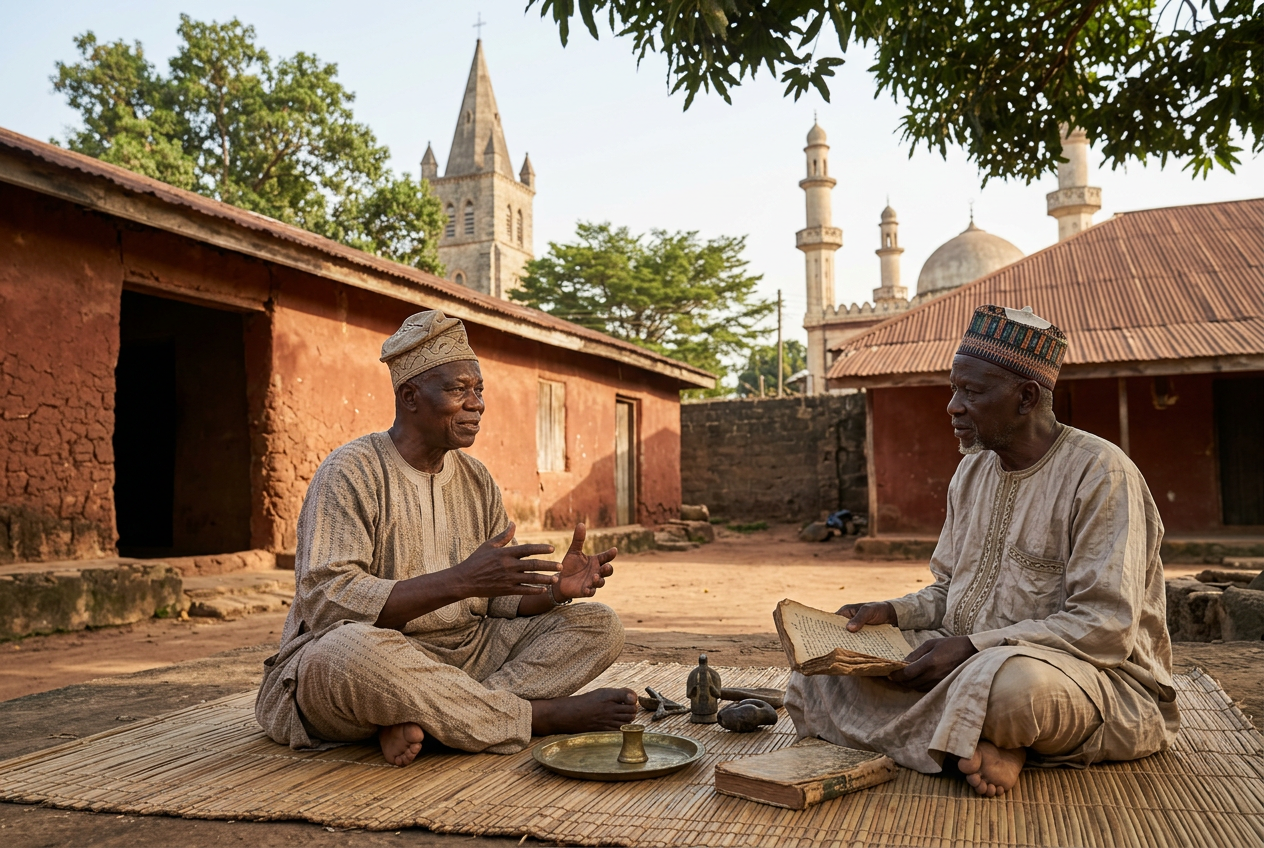
Welcome, and thank you for landing here. If you have ever sat through a heated argument at a wedding reception in Ibadan or a family compound in Kaduna about which religion was first in Nigeria, you already know the question rarely ends peacefully. This article is the conclusion of months of research and years of experience writing about Nigerian history, faith and identity, and I want to give you something better than the usual shouting match. The honest answer is older than the caravan routes that crossed the Sahara, older than any mission ship, and it is sitting in the ground beneath us.
Here is the thing that surprised me most when I started pulling the sources together. Almost everybody who argues about this is arguing about the wrong two options.
The debate is nearly always framed as Islam versus Christianity, as though those were the only two contenders on the pitch. They are not. They are the two most recent arrivals, and one of them showed up while the other had already been settling in for four hundred years. Meanwhile the actual first religion of this territory had been here for something in the order of three thousand years, and it left evidence in fired clay that you can go and look at in a museum in Jos this afternoon.
So let us take the question seriously. Not as a scoreboard, but as history.
One framing note before we start, because this subject gets weaponised quickly. The Nigerian state takes no side here. Section 10 of the 1999 Constitution bars the federal government and every state government from adopting a state religion, and the Presidency has restated the point recently, describing the country as a democracy operating under constitutional guarantees of religious liberty. Whichever faith turns out to have arrived first, no legal privilege follows from it. This is a history question, not a claim of ownership.
Is Islam Older Than Christianity in Nigeria?
Yes. And it is not close.
Islam entered the territory we now call Nigeria in the late eleventh century, through the north east, carried along the trading routes that linked the Lake Chad basin to the Maghreb and beyond. The Kanem court, whose rulers governed the region that later became Borno, adopted the faith under Mai Umme Jilmi, whose reign is conventionally dated to the years between 1085 and 1097. The Kanem-Bornu record shows the shift clearly: traditional religion until roughly 1070, a brief Ibadi Islamic period, and Sunni Islam thereafter for the better part of eight centuries.
Think about what that means for a moment. When the Kanem court was already praying towards Mecca, the Normans had only recently taken England, and Europe had not yet worked out that West Africa existed.
The spread was not instant, and it was not uniform. Islam reached the Hausa city states considerably later, through a different channel. According to the Kano Chronicle, the palace record that tracked Kano’s rulers from the tenth century onwards, Islam was introduced to Kano by Wangara merchants and scholars from Mali during the reign of Yaji I, between 1349 and 1385. Yaji dissolved the cult of Tsumbubura, the patron deity of Kano, and declared Kano a sultanate. That is roughly two hundred and sixty years after Kanem.
And then it wobbled. Kano’s defeat by Zaria around 1400 was blamed on the new faith, and King Kanajeji reinstated the old cult in exchange for military support from the levies its priesthood controlled. Islam regained ground in the 1450s when fresh Malian teachers arrived. Religion in this part of the world has never travelled in a straight line, which is something the neat timeline charts online tend to hide.
Islam reached Yorubaland later still, and through the same Malian merchant networks. This is why Yoruba speakers call Islam Esin Imale, which translates roughly as the religion of Mali. Not the religion of Arabia. The religion of Mali. The name itself is a fossil of the trade route it travelled on, and I find that detail more revealing than any dated document.
By contrast, the first Christian presence anywhere in this territory dates to the early sixteenth century, and the first sustained one to 1842. So on a straight reading of arrival dates, Islam predates Christianity here by roughly four hundred years in its earliest form, and by more than seven hundred if you measure against the mission that actually stuck.
That gap is real, and it matters for understanding why the north and south of this country developed such different institutional textures. It does not, however, make Islam the first religion in Nigeria. Hold that thought.
Something worth noting on the practical side: the scale of Muslim religious life here is now enormous by any measure. The National Hajj Commission of Nigeria, the federal body that fixes the annual pilgrimage fare, set the 2026 cost at roughly ₦8.24m for pilgrims departing from most northern states and about ₦8.56m for southern states. That is a single religious obligation carrying a national logistics operation, an airlift schedule and a savings scheme attached to four banks. Nothing about that arrived in 1085. But the thread runs back there.
Which Church Came Into Nigeria First?
This one produces genuine confusion, because there are three defensible answers depending on what you mean by “first” and what you mean by “church”.
The first Christian mission on Nigerian soil was Portuguese and Catholic. European contact with Benin began around 1486, and by 1515 priests were operating a school inside the Oba’s palace in Benin City, teaching the Oba’s sons and the sons of his senior chiefs. A friar from São Tomé arrived in 1517 with three other priests, one of whom, named Jeanes, was himself a Benin man who had gone to São Tomé and come back ordained. So there was indigenous Nigerian clergy in the sixteenth century. That fact alone should be better known than it is.
The Portuguese had more success in Warri than in Benin. Augustinian friars arrived around 1555 under Bishop Gaspar Cão, and one of them baptised the son of the Olu of Warri, who took the name Sebastian. When Sebastian succeeded his father he backed the mission, and sent his own son Domingos to Portugal, where he was educated between 1600 and 1611 and returned with a Portuguese wife. Two consecutive Christian Olus, three centuries before the British.
And then it withered.
The reasons are almost mundane. There were never enough priests. The climate killed the European ones. Ordinary Itsekiri families refused to present their children for baptism because they believed the rite would kill them. Polygamy and the ancestral cults were not going anywhere. By the time a Franciscan mission arrived in 1538 the Benin situation had already deteriorated badly, and the last Capuchin attempt to enter Benin City, in 1748, failed before it began. What survived was a residue at the Warri court, not a church.
So the first mission is Portuguese Catholic, from 1515. The first church that actually held is a different story entirely.
On the evening of 23 September 1842, the Reverend Thomas Birch Freeman, a Methodist missionary from the Gold Coast, arrived off Badagry with William and Mrs De Graft. They came ashore the following afternoon and preached under an enormous Agia tree near what is now the Badagry town hall. That tree, roughly forty nine metres tall with a girth of about nine metres, stood for more than three centuries before a storm brought it down on 20 June 1959. A monument marks the spot today. Within weeks the congregation had outgrown the travelling tents, and a chapel of bamboo and palm leaf went up at Boekoh quarters in November 1842. That is the first church building in Nigeria in the plain sense of the phrase.
The Anglican Church Missionary Society arrived in the same year and the same town, with Henry Townsend, and later Samuel Ajayi Crowther, the recaptured Yoruba boy who became the first African Anglican bishop and translated the Bible into Yoruba. The oldest surviving stone church, the Cathedral Church of Saint Peter at Ake in Abeokuta, was completed in 1898 and is frequently called Nigeria’s first church on that basis. The Presbyterians reached Calabar in 1846.
Which is the true answer? If you want the first mission, it is Benin in 1515. If you want the first church building, it is the bamboo chapel at Boekoh in 1842. If you want the oldest church still standing as a building, it is Ake. I would tell you plainly that the 1842 Badagry answer is the one most Nigerian historians reach for, because it marks the start of the unbroken line.
Here is where it gets uncomfortable, and I think we should say it out loud. That mission arrived at Badagry, a town whose previous claim to fame was its role in the Atlantic slave trade. The first primary school in the country, Saint Thomas Anglican Primary School, followed in 1845, a stone’s throw away. Education and evangelism came bundled together, deliberately, and the schools became the instrument of mass conversion because literacy was the entry ticket to colonial administration. You can see the same argument playing out in Guardian’s own pages, where one contributor has challenged the place of religious knowledge subjects in public basic schools on exactly these grounds. Nearly two centuries later, the classroom is still the contested ground.
Which Religion Was First in Nigeria: The Direct Answer
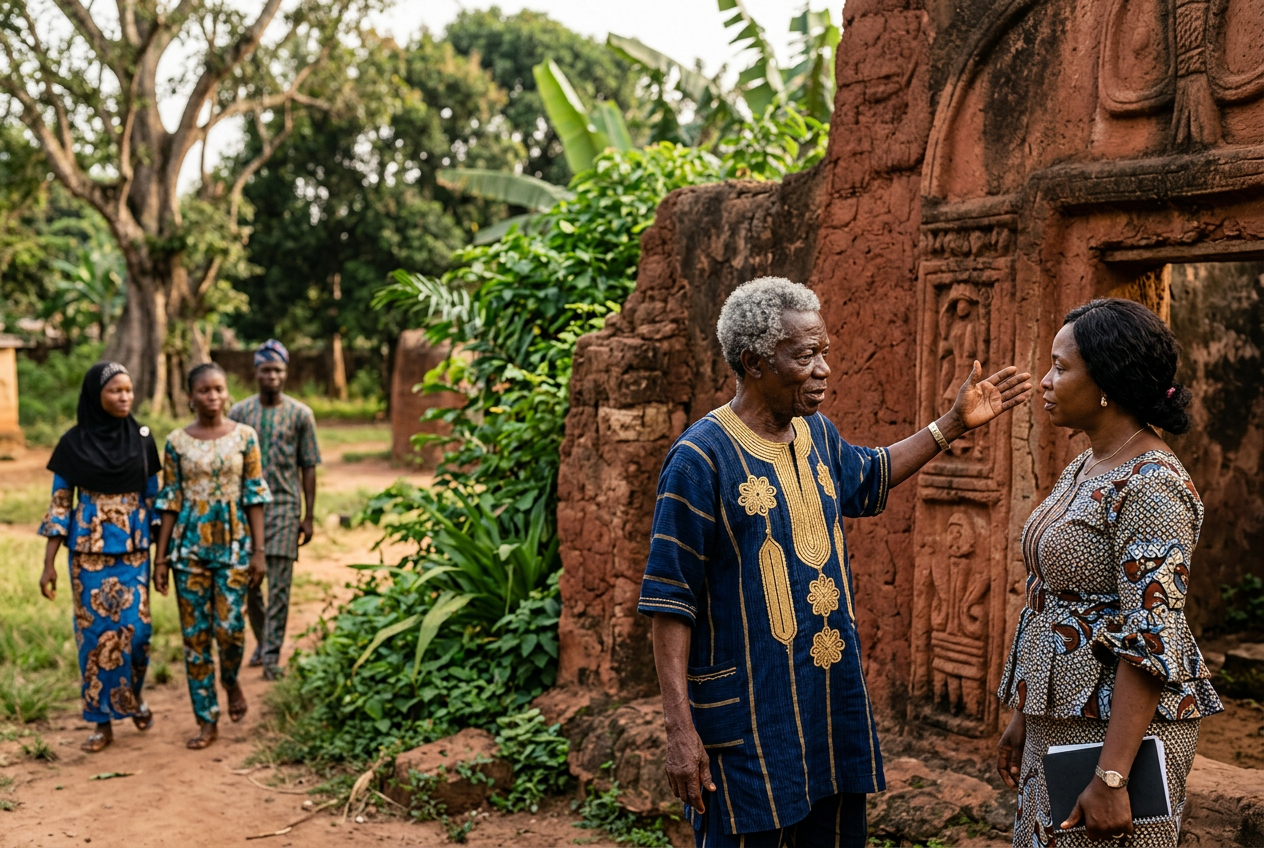
Indigenous religion. Traditional worship. The orisa, the alusi, the iskoki, the ancestors, the earth deities, the diviners and the shrines. Whatever name your grandmother’s people used for it, that is what was here first, and it was here first by something in the order of two and a half to three thousand years before Islam and rather more before Christianity.
That is not a sentimental answer. It is an evidential one, and it rests on things you can weigh in your hand.
The Nok culture flourished on and around the Jos Plateau from roughly 1500 BCE to about 300 CE. Its people smelted iron by the ninth to sixth centuries BCE, farmed pearl millet and sorghum, and produced hollow, coil built terracotta figures of humans and animals with elaborate hairstyles, modelled jewellery and pierced pupils. Excluding ancient Egypt, these are the earliest large figurative sculptures known anywhere on the continent. The National Commission for Museums and Monuments, the federal agency that holds the country’s antiquities, curates a great deal of this material across its museum network, and its former director general has described Nok as one of the oldest cultures south of the Sahara.
Now, we should be careful about what terracotta can and cannot prove. Because so many Nok pieces were looted rather than excavated, their original context is lost, and archaeologists are honest that the precise ritual function of most figures is unknown. Guardian’s arts desk has covered both the Nok collections rehoused in Kaduna and the illicit trade that stripped the sites in the first place. What survives still tells us that organised symbolic behaviour, deliberate deposit, and specialised craft production existed here more than three millennia ago.
Then there is Igbo-Ukwu. In 1938, a man named Isaiah Anozie was digging a cistern in his compound in what is now Anambra State when his shovel hit metal. Thurstan Shaw’s later excavations in 1959 and 1964 recovered more than seven hundred objects in copper, bronze and iron, along with roughly one hundred and sixty five thousand beads. The dating came back as ninth century CE, and specialists initially refused to believe it. The pieces are ritual vessels, pendants, crowns, breastplates and staff ornaments. Not domestic ware. Ceremonial equipment, cast to a standard that European foundries of the period could not match, two centuries before Kanem heard of Islam.
And Ile-Ife, between roughly the eleventh and fifteenth centuries, produced naturalistic portrait heads in copper, brass and terracotta while Europe was building Chartres.
Put those three together and the picture is unambiguous. Long before a single trader crossed the Sahara with a Qur’an, and long before a Portuguese caravel felt its way into the Benin River, the people of this territory had temples, priesthoods, divination systems, ritual metallurgy and a settled cosmology. If you would like the fuller ancestry behind this, my earlier piece asking who Nigerians are descended from traces the deeper archaeological and genetic record.
Arrival Dates of Nigeria’s Three Faith Streams
| Faith tradition | Earliest firm evidence in Nigerian territory | First area of strength | Approximate share of population today |
|---|---|---|---|
| Indigenous traditional religion | Ritual terracotta from roughly 1500 BCE; ceremonial bronzes from the ninth century CE | Jos Plateau, later Igbo-Ukwu and Ile-Ife | Roughly 1 to 6 per cent by survey, almost certainly undercounted |
| Islam | Kanem court conversion, roughly 1085 to 1097 | Kanem-Bornu, then Hausa states from about 1350 | Roughly 50 to 56 per cent |
| Catholic Christianity, first wave | Palace school at Benin City, about 1515 | Benin and Warri kingdoms | Absorbed into the wider Christian total |
| Protestant and modern Christianity | Badagry landing, September 1842 | Badagry, Abeokuta, Calabar from 1846 | Roughly 43 to 46 per cent |
Two conclusions jump off that table. The first is the sheer size of the gap: indigenous religion has a head start measured in millennia, not centuries. The second is the inversion at the far right, where the oldest tradition now records the smallest share, which tells you that longevity and dominance are entirely different things.
How Many Religions Did Nigeria Have Before Islam and Christianity?
The honest answer is hundreds, and the number depends entirely on how you count.
Modern survey forms give you three boxes: Christian, Muslim, Other. That third box, usually labelled African Traditional Religion, is doing an amount of work that would make a Lagos danfo conductor blush. It is being asked to contain Yoruba orisa worship with its four hundred and one deities and its Ifa corpus of two hundred and fifty six Odu; Igbo veneration of Chukwu, Ala and the alusi; Hausa Maguzawa practice with its iskoki spirits numbering into the thousands; Ijaw water deities; Tiv ancestral cults; Kanuri pre-Islamic ritual; Efik Ekpe society observance. These are not denominations of one religion. They are separate religious systems, with different cosmologies, different professional priesthoods and different ritual calendars, spread across a country that recognises hundreds of ethnic groups.
Calling all of that “one religion” is a bit like calling Christianity, Judaism and Islam “one religion” because they all descend from Abraham. Technically you can draw the circle. Practically you have erased everything interesting.
I would put it this way, from years of asking people about their own towns. Before the eleventh century, Nigeria did not have a religion. It had as many religions as it had communities, each locally grounded, each tied to a specific landscape, lineage and set of obligations, and most of them perfectly comfortable borrowing from a neighbour when the neighbour’s deity appeared to be delivering results.
That flexibility is the reason the two incoming faiths spread as fast as they did. Traditional practice was never exclusive. A Kano king could take Islam and reinstate the Tsumbubura cult a generation later without anyone regarding it as apostasy in the modern sense. A Warri court could accept baptism and keep its ancestral rites running quietly in parallel. Exclusivity is the imported idea, not the indigenous one.
What survives today is genuinely hard to measure, and the numbers are almost certainly too low. Pew research has found that around seven in ten Nigerian adults believe spells or curses can shape a person’s life, which sits oddly beside a reported traditional religion share of about one per cent. People who tick “Christian” on a form still pour libation at a burial. The forms are not lying, exactly. They are just asking the wrong question.
Guardian ran a thoughtful piece some years back on a documentary event in Abuja that examined what it costs to practise traditional belief openly in Nigeria today, including the steady destruction of the few surviving shrine artefacts and the way Nollywood has trained a generation to read those traditions as automatically sinister. It is worth your time if this section interests you.
Is Yoruba Religion Older Than Christianity in Nigeria?
Comfortably, yes, on any reading.
Ile-Ife is dated by recent archaeological work to somewhere between the tenth and sixth centuries BCE, making it the oldest of the classical Yoruba city states. Its artistic and ritual peak runs from roughly the eleventh century CE. Ifa divination, the system attributed to Orunmila, took recognisable structured form somewhere between the tenth and fourteenth centuries according to the scholarship of Wande Abimbola and William Bascom, though the Yoruba themselves date Orunmila’s life to around 500 BCE and treat the tradition as considerably older.
Even taking the most conservative academic dating, Ifa was a functioning divination system with a formal corpus, trained practitioners and a transmission structure some five hundred years before Thomas Birch Freeman stepped off a boat at Badagry. Take the traditional dating and you are looking at more than two thousand years.
The Ifa corpus is worth pausing on, because it embarrasses the lazy assumption that indigenous religion means simple religion. Two hundred and fifty six Odu, each subdivided into hundreds of verses called ese, held and transmitted orally by babalawo who spend decades in training. UNESCO inscribed it on the Representative List of the Intangible Cultural Heritage of Humanity, originally proclaimed in 2005 and formally inscribed in 2008. The same inscription flagged that the tradition is under real pressure from religious intolerance and declining youth engagement, which is a polite way of saying it is being actively suppressed in the country of its birth.
Rather like a family that sells the ancestral compound to fund a shiny new house, and then finds it has no address to give when asked where it comes from.
Seven Steps to Tracing the Religious History of Your Own Community
If this article has made you curious about your own town rather than the national picture, here is the method I use. It takes a weekend or two and costs very little.
- Start with the place name itself and any oriki, praise poetry or town chant attached to it, because deity names, sacred groves and founding shrines are frequently embedded in the language of these texts and survive long after the practice has stopped.
- Ask the three oldest people in the family what the annual festival calendar looked like when they were children, and write down the month, not the name, because festival timing anchored to the farming year is one of the most reliably preserved fragments.
- Identify the sacred grove, stream, rock or tree that everyone in the town knows about but nobody explains, then find out who is responsible for it and whether that responsibility is hereditary.
- Check whether the traditional ruler’s title and installation rites include any priestly function, since chieftaincy and priesthood were frequently the same office before either mosque or church arrived.
- Look up your local government area in the National Commission for Museums and Monuments records to see whether any excavated material, monument or listed site sits within about fifty kilometres of you.
- Find the founding date of the oldest mosque and the oldest church in the town, which local congregations usually keep, and subtract, because the gap between those dates and the town’s own founding tells you how long it managed without either.
- Write it down properly and give a copy to someone under twenty, because oral transmission fails within two generations once the practitioners stop practising, and you will be the last person in your family who had access to step two.
I have run this exercise for three different towns now, and in each case the surprise was the same. The imported faith arrived far more recently than anyone in the family assumed, usually within the lifetime of a great grandparent.
What This Means for Nigeria Today
Nigeria has not asked a religion question in a national census since 1963. That is more than six decades of silence, and it is a deliberate policy choice rather than an administrative oversight, because successive governments judged the topic too combustible to touch. The consequence is that every percentage you have ever seen is an estimate.
The estimates disagree, and not slightly. Pew put Muslims at 56.1 per cent and Christians at 43.4 per cent as of 2020. The Association of Religion Data Archives has estimated Muslims at 46.3 per cent and Christians at 45.8 per cent. Statista has published 53.5 per cent Muslim and 45.9 per cent Christian. Andrew McKinnon’s analysis of eleven nationally representative surveys conducted between 1990 and 2018 found that Christian identification was probably the adult majority through most of that window, peaking near 69 per cent in the early 1990s before declining proportionally as Muslim identification rose, driven by fertility differences rather than conversion.
Anyone quoting you a precise figure with confidence is selling something. That is not cynicism, it is arithmetic.
Constitutionally, the position is clearer than the demographics. Beyond the Section 10 bar on any state religion that I mentioned at the outset, Section 38 guarantees freedom of thought, conscience and religion, including the freedom to change one’s belief and to propagate it in worship, teaching, practice and observance. The Presidency has leaned on both provisions in rejecting recent characterisations of Nigeria as a religiously intolerant country.
Whether lived reality matches the constitutional text is a separate conversation, and a longer one than this article can hold. What I will say is that the tradition with the oldest claim to this soil is the one whose adherents most rarely feel able to say so out loud, and that seems to me the single most striking fact in the whole story.
Practical measurements, since I promised some. A Hajj place costs a Nigerian pilgrim somewhere north of ₦8m as of 2026. A modest church harvest thanksgiving in a Lagos suburb will typically ask ₦20,000 to ₦50,000 per family. A full Ifa consultation with a trained babalawo, in the towns where one can still be found, commonly runs between ₦5,000 and ₦20,000, though the ritual materials prescribed afterwards can multiply that many times over. Those three numbers, side by side, tell you a good deal about which traditions have institutional money behind them and which do not.
Final Thoughts on Which Religion Was First in Nigeria
So, which religion was first in Nigeria? Indigenous traditional religion, by a margin of roughly two and a half to three thousand years, evidenced in Nok terracotta from around 1500 BCE and ceremonial Igbo-Ukwu bronzes from the ninth century CE. Islam came second, entering through the Kanem court between 1085 and 1097 and reaching Hausaland around 1350. Christianity came third, arriving as a Portuguese Catholic mission at Benin around 1515, collapsing, and restarting durably at Badagry in September 1842.
If you take one thing away, let it be this: the argument you keep hearing at weddings is a contest for second place.
What should you actually do with that? Be precise when the subject comes up, because precision is a form of respect. Say “the first of the two Abrahamic faiths” when that is what you mean, rather than “the first religion”. Visit the Jos museum or the Badagry monuments if you can, because standing in front of the material does something no article can. And ask your oldest surviving relative the festival calendar question this month rather than next year, because that window closes without warning.
Nigeria’s religious story is not a two horse race with a long empty track behind it. It is a three layer sediment, and the deepest layer is the one holding everything else up.
- The first religion in Nigeria was indigenous, not imported, and the archaeological evidence for it predates both Islam and Christianity by millennia.
- Islam preceded Christianity here by roughly four centuries in its earliest form, arriving through trade in the north east rather than through conquest.
- No official religious census has been conducted since 1963, so treat every population percentage you encounter as an estimate with a wide margin.
Related Articles
If the demographic side of this question interests you more than the historical one, I looked closely at the competing survey figures, the absent census, and why the numbers are so fiercely contested in my examination of which faith actually has the larger following today. It picks up exactly where this article’s discussion of the estimates leaves off.
And for readers wondering how the newest of the three traditions is organised now that it has been here nearly two centuries, my piece on how Christian authority is structured across Nigeria’s denominations maps the leadership of a faith that arrived at Badagry with one Methodist minister and a bamboo chapel.
Key Takeaways
- Indigenous religion holds the earliest claim in Nigeria, with ritual terracotta from roughly 1500 BCE and ceremonial bronzes from the ninth century CE, thousands of years before either Abrahamic faith arrived.
- Islam entered through the Kanem court between 1085 and 1097 and Hausaland around 1350, while the first Christian mission reached Benin around 1515 and the first lasting one landed at Badagry in September 1842.
- Nigeria never had a single pre-colonial religion but hundreds of distinct systems, and the modern survey category that lumps them together conceals both their variety and their continuing influence.
Frequently Asked Questions About Which Religion Was First in Nigeria
Which religion was first in Nigeria?
Indigenous traditional religion was first in Nigeria by a margin of several thousand years. Ritual terracotta from the Nok culture dates to roughly 1500 BCE, while Islam arrived in the late eleventh century and Christianity in the sixteenth.
Is Islam older than Christianity in Nigeria?
Yes, Islam is older than Christianity in Nigeria by roughly four centuries. The Kanem court adopted Islam under Mai Umme Jilmi between 1085 and 1097, whereas the first Portuguese Catholic mission was operating at Benin around 1515.
Is Yoruba religion older than Christianity?
Yoruba religion is far older than Christianity, both in Nigeria and anywhere else. Ile-Ife was a functioning ritual centre centuries before Portuguese ships reached the Benin River, and orisa worship was already an organised system with trained priesthoods when the first missionaries arrived.
Which church came into Nigeria first?
The first Christian mission was Portuguese and Catholic, running a palace school at Benin City from about 1515 and working at Warri from the 1550s. That wave faded, so the oldest continuously surviving mission is the Methodist and Anglican work that began at Badagry in September 1842.
How many religions did Nigeria have before Islam and Christianity?
Nigeria had hundreds rather than one, because almost every ethnic group carried its own ritual system, calendar and pantheon. Modern surveys compress all of them into a single category called African Traditional Religion, which flattens an enormous amount of variation.
Where was the first church building in Nigeria?
A bamboo and palm leaf chapel went up at Boekoh in Badagry in November 1842, and it is widely described as the first church building erected in the country. The Cathedral Church of Saint Peter at Ake in Abeokuta is also called Nigeria’s first church, because its stone structure was completed in 1898 and still stands.
Why is there no official religious census in Nigeria?
Nigeria has not asked a religion question in a national census since 1963, because successive governments judged the topic too politically combustible. Every percentage you see today comes from sample surveys or international estimates rather than an official count.
Did Christianity reach Nigeria before colonial rule?
Yes, Portuguese priests were baptising members of the Benin and Warri royal households more than three centuries before the British protectorates were declared. Those early missions collapsed for want of clergy and local conviction, so nineteenth century Christianity effectively started again from nothing.
How did Islam spread from northern Nigeria to Yorubaland?
Islam travelled south through the same Wangara merchant networks from Mali that had carried it into Hausaland in the fourteenth century. That is why Yoruba speakers call it Esin Imale, which translates roughly as the religion of Mali.
What does the Nok culture tell us about early Nigerian religion?
The Nok terracotta figures show organised symbolic practice and specialised craft production on the Jos Plateau from around 1500 BCE. They do not tell us what the Nok believed, because most were looted rather than excavated, but they confirm that structured ritual behaviour existed here long before any imported faith.
Is Nigeria legally a secular state?
Section 10 of the 1999 Constitution bars the federal government and any state from adopting a state religion, and Section 38 guarantees freedom of thought, conscience and religion. In practice Nigeria functions as a multi religious state rather than a strictly secular one, since public life is saturated with both Christian and Muslim observance.
Does traditional religion still have adherents in Nigeria?
Yes, though the survey figures are almost certainly too low, because many people who identify as Christian or Muslim also consult diviners and observe traditional rites. Ifa divination remains active enough that UNESCO placed it on the Representative List of the Intangible Cultural Heritage of Humanity.

