 Follow Us on Google News


 Follow Us on Google Discover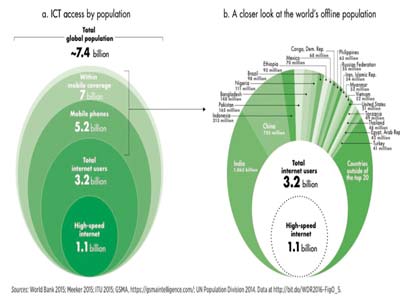
 FOR the global community to realise the attendant benefits, which Internet access brings, the need to explore the immense opportunities inherent in offline turf has been stressed.
Though, today, more people around the world have access to mobile phones than to electricity or water, according to the World Bank, digital revolution is yet to berth.
Indeed, in its 2016 World Development Report on the Internet, ‘Digital Dividends’, World Bank agreed that the spread of digital technologies over the last two decades has been rapid and generated a lot of excitement about the possibilities of the digital age, but the hope for benefits; greater productivity; more opportunities for the poor and middle class, more accountable governments and companies have not spread far and wide as anticipated.
World Bank Economist and one of the co-director of the report, Deepak Mihra, said clearly that Internet potential remains massive, “we share the optimism of Silicon Valley when it comes to the transformative potential of digital technologies. But not the expedient view that the benefits are both assured and automatic and we think translating digital investments into dividends is much more difficult than many experts have reported before.”
The study, which claimed that about 119 million Nigerians are off the Internet radius, it noted that greater efforts must be made to connect more people to the Internet and to create an environment that unleashes the benefits of digital technologies for everyone.
While Internet users have tripled in a decade to an estimated 3.2 billion, nearly 60 per cent of people globally — some four billion people — are still offline, the report revealed.

It stressed that despite the rapid adoption of mobile phones; nearly two billion people do not use one and that almost half a billion people live outside areas without a mobile signal.
World Bank warned that people without access to digital technology, education and skills to adapt will be increasingly left behind as the rest of the world advances.
Commenting, Co-Director, Digital Dividends, Uwe Deichman, said connecting everyone is a priority.
However, Deichman said digital technologies, are not a shortcut to development, though they can accelerate it if used in the right way. “We see a lot of disappointment and wasted investments. It’s actually quite shocking how many e-government projects fail.
“While technology can be extremely helpful in many ways, it’s not going to help us circumvent the failures of development over the last couple of decades. You still have to get the basics right: education, business climate, and accountability in government.
“We must ensure that the benefits of new technologies are shared widely, particularly for the poor”
The report covered the Internet’s role in promoting development, including growth, jobs, and delivering services.
It also examined the risks of the digital age — the growing concentration of the industry, increasing inequality as some types of jobs get automated and disappear, and the threat that the Internet will be used to control information instead of sharing it.
World Bank stressed that “analog,” or non-digital, factors such as policies and regulations are needed to ensure the digital market is competitive and the Internet expands access to information, lowers the cost of information, and promotes more inclusive, efficient, and innovative societies.
Digital technologies amplify the impact of good and bad policies, so any failure to reform means falling farther behind those who do reform, said the report.
“If regulations don’t promote competition, markets will become concentrated, and you’ll have digital monopolies, and divergence of fortunes across countries,” said Mishra.
Likewise, “If people have the right skills, digital technology will help them become more efficient and productive, but if the right skills are lacking, you’ll end up with a polarized labor market and more inequality.”
Deichmann added that in developed countries and several large middle-income countries, technology is automating routine jobs, such as factory work, and some white-collar jobs. While some workers benefit, “a large share” of workers get pushed down to lower-paying jobs that cannot be automated.
“What we’re seeing is not so much a destruction of jobs but a reshuffling of jobs, what economists have been calling a hollowing out of the labor market. You see the share of mid-level jobs shrinking and lower-end jobs increasing,” he said.
The report further noted that improving and rethinking education will be critical to prepare people for future job markets.
The report said it is important to keep in mind that job displacement from technological change was part of economic progress and that fears of “technological unemployment” go back to the industrial revolution.

