Head of Office and Representative at United Nations Educational, Scientific and Cultural Organisation (UNESCO) Office, Abuja, Jean-Paul Ngome Abiaga has stressed the need to build capacities among journalists, civil society organisations, community leaders, youth groups and religious leaders to address misinformation on climate change.
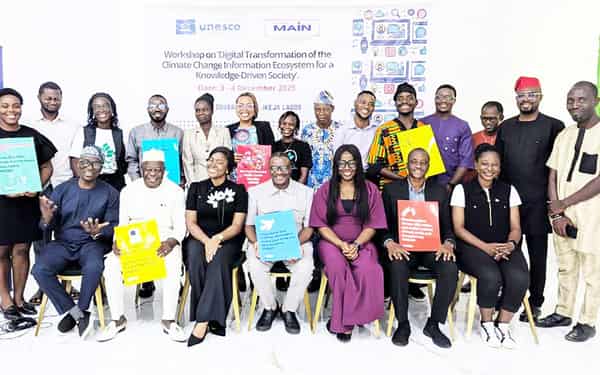
Abiaga spoke at a two-day workshop on, ‘Digital transformation of the climate change information ecosystem for a knowledge-driven Society’ held in Lagos. He was represented by the officer in charge of communication and information sector, UNESCO Office, Abuja, Yachat Nuhu.
The workshop was organised by UNESCO in collaboration with Media Awareness and Information for All Network (MAIN).
Some of the topics discussed include, ‘Understanding the role of UNESCO in promoting climate action for sustainable development’; ‘The intersectionality of climate change and public health, and the imperative of ethical communication’; ‘Understanding climate change and its impact on people and society’; ‘Interrogating climate change myths and misinformation and the pathways to ensuring behavioural change’.
Other topics are, ‘Role of social platforms in environmental advocacy’; ‘Strengthening climate change education for a resilient and sustainable future and AI for climate action’.
To Abiaga, “the world faces growing threat of climate change and the parallel crisis of misinformation surrounding it. Digital platforms connect us in unprecedented ways, allowing knowledge to travel across borders and communities in seconds. Yet this same digital space has also become fertile ground for confusion, conspiracy theories, manipulated content, and myths that undermine public understanding of climate change.
“These harmful narratives weaken our collective ability to respond to one of the most urgent challenges of our time.Across the continent, we have witnessed how climate-related misinformation fuels denial, delays policy action, erodes trust in scientific evidence, and deepens community vulnerabilities. In many cases, misinformation spreads faster than corrective facts.”
In conclusion, he noted, “we must equip our stakeholders with the tools to verify information, communicate scientific knowledge effectively, counter harmful narratives, and leverage digital technologies in ways that advance inclusion, resilience, and sustainable development. Digital transformation offers immense opportunity.
It can support climate education, strengthen early warning systems, expand community engagement, and democratize access to life-saving information. But without strong competencies in media and information literacy, these opportunities risk being overshadowed by the growing influence of misinformation and digital manipulation.
“UNESCO remains committed to bridging this gap — by empowering citizens and institutions to navigate the digital information landscape confidently and responsibly.”
We believe that Media and Information Literacy is not just a skillset; it is a cornerstone of democratic participation, community resilience, and sustainable development.”
On his part, Rector DS Adegbenro ICT Polytechnic Ogun State, Goke Rauf, observed the current realities call for better understanding and deliberate commitment to the basics of climate resilience.
To the don, leveraging digital technologies like AI, IoT, and big data to accelerate climate action through improved efficiency, emissions reduction, and enhanced adaptation thus becomes very critical to global survival.
The Chairman of MAIN, Prof. Jide Jimoh, explained that the workshop was hinged on Media and Information Literacy principles to bridge the gap between scientific understanding of climate change and community perceptions shaped by cultural beliefs and myths.
According to him, in many communities, deeply rooted cultural beliefs and local myths often shape perceptions of environmental change, leading to skepticism or outright denial of climate change. Some attribute extreme weather events or shifting agricultural patterns to spiritual forces, ancestral displeasure, or cyclical natural phenomena rather than human-induced climate disruption.
This disconnect between scientific evidence and traditional worldviews, Prof Jimoh explained, has fostered misgivings about climate change claims, with many not recognising its tangible impacts on their health, food security, and livelihoods.
As a result, efforts to promote climate resilience and adaptation based on scientific facts are facing resistance by conspiracy theorists, the effect of which has trickled down to the general population.
“By fostering dialogue between stakeholders, the workshop seeks to build trust, dispel misinformation, and promote culturally grounded climate literacy that empowers communities to recognize and respond to climate-related health and livelihood impacts,” he noted.
In his presentation titled, ‘Interrogating Climate Change Myths and Misinformation and the Pathways to Ensuring Behavioural Change’, the National Information Officer of the UN Information Centre (UNIC), Oluseyi Soremekun, noted that climate change myths and misinformation have become significant barriers to global efforts aimed at mitigating environmental challenges.
Saying myths undermine public trust in scientific consensus and create confusion among policymakers and citizens, he added understanding these myths is crucial because they influence attitudes, behaviors, and policy decisions.
To Soremekun, “when individuals believe inaccurate information, they are less likely to support climate-friendly initiatives or adopt sustainable practices.”
He also advocated clear communication of scientific facts, contextualising data to avoid misinterpretation, and highlighting the overwhelming consensus among climate scientists.
“By debunking these myths, we can restore trust in science and encourage proactive engagement in climate solutions,” he added.
Speaking on ‘Strengthening Climate Change Education for a Resilient and Sustainable Future’, the Executive Director, SBZ Development Ltd, USA, Samuel Babatunde, acknowledged that escalation climate change impact globally, and noted the importance of climate education as a veritable foundation for community resilience.
“As education increases, climate change resilience gets stronger. Climate literacy leads to climate action which will lead to resilient outcomes such as stronger food systems, reduced emissions, lower displacement, and green economic growth,” he said.
A Consultant on Public Health, Dr Olumayomikun Soremekun, underscored the impact of climate change on health.
He explained that climate change could increase heat-related illnesses, worsen air quality (asthma, lung issues), alter infectious disease patterns (malaria fever and dengue fever), threaten food/water security (cholera) and impact mental health.
He identified extreme weather like storms, heatwaves, floods, and wildfires as capable of disrupting basic needs like clean air, safe water, and food, creating new health challenges and exacerbating existing ones globally.