

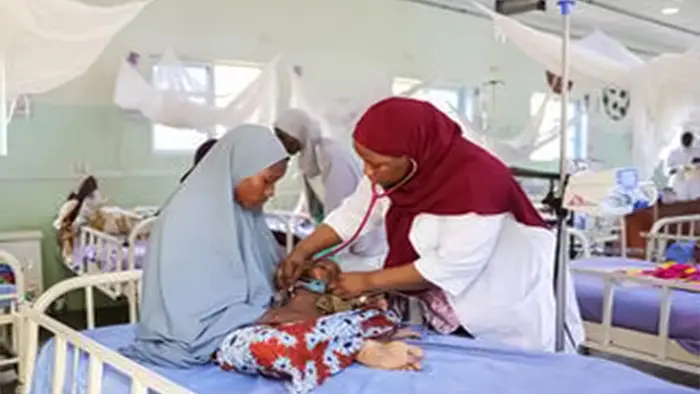
For caregivers of children battling severe acute malnutrition, the worry does not end at the hospital. At Médecins Sans Frontières’ (MSF) Nilefa Kiji nutrition facility in Maiduguri, Borno State, children receive treatment while their caregivers deal with their own fears and worries. Some spend days or weeks by their children’s beds, hoping to see them get better while thinking about the families they have left at home.
Treatment can last from one week to a month, depending on the child’s condition. Because severe malnutrition weakens the body’s immunity, some children also arrive with illnesses such as malaria, measles and diphtheria.
For many caregivers, particularly mothers, the fear of losing a child comes with another concern: who is looking after the children at home?
Fatima Ibrahim spent three weeks at the Nilefa Kiji facility with her 23-month-old daughter, Aisha, who was admitted after battling meningitis and repeated convulsions. Although Aisha began to improve, Fatima could not stop thinking about her eight other children at home.
“I am worried about my children,” she said. “There is no one to take care of my children. Their father is away and they do not have anything to eat or drink.”
Her worry grew when she learnt that one of her children had developed a fever. With no money to pay for treatment, Fatima said she became overwhelmed.

“I cried and could not eat,” she said. “Even this morning, I could not eat until the afternoon.”
For caregivers like Fatima, staying in hospital with one sick child can mean being away from the other children who also depend on them.
Halima Mohammed knows this struggle. She spent 45 days moving between hospitals with two sick children, a period she said began to take a toll on her own health.
“I was having good sleep before my children fell ill,” she said. “Now I barely sleep.”
Halima said she had also started feeling unwell. When she noticed that her daughter was improving, she asked for her discharge. She assured the medical workers that she was not trying to stop the treatment, but her daughter was not yet well enough to leave.
For Latifat Abdulkareem, the reality of what was happening at home became clear when her eldest son visited her at the hospital during her daughter’s admission.
“He asked me when I was coming home,” she said. “He said they were hungry since I wasn’t around.”
Kethurah John, an MSF counsellor educator, said situations like these can leave caregivers caught between the child receiving treatment and the children waiting at home.
She recalled the case of a woman with six children whose husband eventually left the children with neighbours after telling her he was tired of caring for them.
“She could not cope staying in the hospital,” John said. “She had six children. She had to leave, not because she wanted to, but because she feels this is just one child.”
John said the woman became distressed even when she was given food at the facility because she was thinking about her children and whether they had anything to eat.
The pressure on caregivers is not always obvious to the people around them. While medical workers monitor a child’s weight, symptoms and recovery, the fear, tiredness and worry carried by the caregiver can easily go unnoticed.
MSF has responded by including mental health and psychosocial support in its nutrition programmes.
Caregivers receive psychological first aid when they arrive at the facility. They can also have individual counselling and join group sessions where they talk about what they are going through, share their concerns and learn ways to cope.
The support is not limited to what happens inside the hospital. When caregivers lose contact with their families, counsellors help them make phone calls. In some cases, supervised home visits are arranged so they can check on their families before returning to complete their child’s treatment.
Children are also given time to play through structured activities during their recovery. For some, it provides a break from the hospital routine.
For Mariya Mukhtar, an MSF facility in Kano became a place of relief after she arrived with her severely ill daughter. She had taken the child to several other health facilities without seeing much improvement.
Her daughter had a severe fever, vomiting and loose stool, and Mariya feared she would not survive.
Nine days later, she began to see a difference. Her daughter could sit up, play, recognise her mother and talk. These were things she could not do when they first arrived.
“I am in no rush to leave,” Mariya said.
The change gave her some relief after days of uncertainty.
John said some caregivers even return to the facilities after their children have been discharged to show staff how much healthier they have become.
“For us, those moments remind us that caring for the caregiver is also part of caring for the child,” she said.
The need for this support comes as acute malnutrition continues to put pressure on families across northern Nigeria. In 2025, MSF teams treated 425,634 children for acute malnutrition in the region, an increase of 41.8 per cent compared with 2024.
MSF supports the state Ministries of Health in Zamfara, Katsina, Kebbi, Borno, Bauchi, Sokoto and Kano to provide lifesaving care for children suffering from malnutrition.
But behind those numbers are families dealing with problems that do not appear in hospital records. For the caregiver sitting beside a sick child’s bed, the child’s recovery may not be the only thing on their mind. There could be hungry children at home, an absent partner or the worry that something might happen while they are away.
Treating malnutrition also means paying attention to the person sitting beside the child’s bed. When caregivers are given a chance to talk about what they are facing and receive the support they need, they are better able to remain present for the child depending on them.
