 Follow Us on Google News
 Follow Us on Google Discover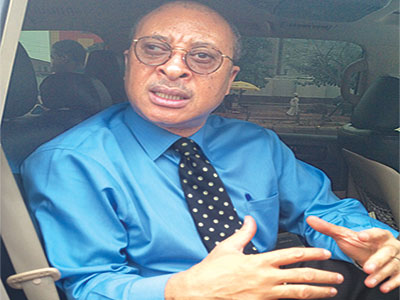
 Why, How He Missed Ministerial Appointments
Pat Utomi, a Professor of Political Economy and founder of the Centre for Values in Leadership (CVL), would clock 60 years next month. In this interview with MARCEL MBAMALU, he argues that Nigeria must grow a diversified entrepreneurial economy, which must shun the pettiness of clannishness and afford Nigerian youths opportunities to live as skilled, global citizens in their country.
Last year heralded premonitions of Nigeria’s breakup, collapse of oil prices and accelerated unemployment; how and where do you place these events in the country’s history?
The year brought with it home truths, great opportunities for renewal, and a sense of lost opportunities. Overall, it was okay. The Armageddon that was predicted with the elections did not manifest, thankfully.
Politically, we matured some more. The effort of years put in by some of us for opposition consolidation to deliver us from a frightening course we were travelling resulted in a giant leap for democracy, with power going, peacefully, from an incumbent group or party to another. Credit for this belongs to many.
The new order of government was slow off the ground, but goodwill was sustained, showing how much Nigerians desperately desired change. But life became tougher for most Nigerians as performance indicators headed South.
For me, 2015 was a year of huge choices. Like in the Scriptures, where life and death are set before us and we are enjoined to choose life that we may live, my gut feeling is that in 2015, we rejected death but did not quite embrace life with the vivaciousness possible. In a world of opening and closing windows, that may mean, in a broader sense of history, a huge opportunity squandered. As one diplomat told me some months ago, the world is excited and ready to reengage Nigeria and investors want to return, but people wonder if Nigeria would disappoint again. While I sounded optimistic, I knew that the signal that Nigeria could disappoint again was quite palpable. We still have difficulty discovering what it means to lead. But we cannot give up. The task belongs to all, not to All Progressives Congress (APC) or a few elected or appointed people.
Many wonder what keeps you going in the tenacious quest for what you call the “common good” when most would have given up, what drives you?
What I always hoped for from my life is that I could look back and the history I would see is a walking triumph of the human spirit and when I look forward, a hope-shaped vision of the dignity of the human person elevated. It is so easy to lose hope in a culture and retreat into your comfort zone and context, in which everything is used to make any one standing for truth seem tainted by some implied motive. This is probably why our best left town a long time ago. I have determined not to make up the numbers of the generation that left town, but it does not mean you do not wonder why things are the way they are; why they must be party, and why progress has been so slow around here, and the promise of Nigeria hovering, in this age.
I would be lying if I do not admit that, looking at the less than civilized nature of Nigeria’s public sphere, I have not considered either declaring victory, or accepting defeat, and thereafter retreating into the small joys of a very private life. After all, for a person of contentment, I have had more than a good life. Perhaps much more than I deserve, compared to many who make an honest effort.
What prospects do you see for 2016?
As JK Rowling reminds in one of those Harry Porter books, we are the choices we make. Oil prices, from all indications, will travel further South. Now, the diversification singsong is on. But it is not something that comes with a remote control, with which you flip channels like from CNN to Channels Television. It takes a decade or two to get the effort bear lasting fruit. This is why we have screamed ourselves hoarse on the matter these last 30 years, but an instant gratification culture and a lazy elite, have left us not far from the starting block in the race that has produced this recursive economy of two steps forward, four steps backward.
Still, I think 2016 is the best chance for new beginning in a long time. The problem is that I see little evidence that the leadership and political class have seen this chance, or seen the values, discipline and sacrifice this will require. When you hear of new SUV’s for senators you wonder. They seem to be waiting for this challenging patch to pass away so we can return to old ways, at best with a little less corruption than was the case. Unfortunately, we are at a TINA point.
There is no alternative to a diversified entrepreneurial economy of inclusive growth and leadership that rises beyond clannishness to a transforming one, which recognises that our children are already global citizens, looking to live in a globally competitive country. If the promise of Nigeria is not claimed in that direction, they will move and this place could descend into a flotsam of mediocrity where the coming anarchy Robert Kaplan predicted will descend, ensuring conditions that will make recolonisation of these parts a major act of mercy.
At a personal level, 2016 is another benchmark year during which I refocus on some activity areas. I hope for a surge of activity in wealth creation, mining, manufacturing and farming. I have spent the last few years working with youths, and the politics of change. It’s time for a new thrust.
My adult life has generally been lived in the nexus of ideas and action: theory and praxis. Obsession with bridging the knowing-doing gap and ensuring an execution premium has kept me making effort to walk my talk. This is why it is hard to see anything I have talked about that I have not tried to do something on. Playing business angel helped me get quite a few entrepreneurs started to significant levels of success. That allowed me room while the core entrepreneur was leading the charge to keep the watch through social enterprise and involvement in public life. In this time of crisis of unemployment, wealth creation and general economic wellbeing, it seems time to go out and lead some big-ticket wealth creation initiatives.
When my big concerns were social justice issues regarding widows 30 years ago, I wrote about them and then crossed the line and set up the Widow Support Centre. A quarter of a century later, with it still active, one of fulfilling experiences I have, come from running into children of the widows who tell me how that Centre shaped their future. When I began to preach save the Universities, I left industry and passed up the invitation to become an executive in banking, to teach. It’s my good fortune to see today’s Chief Executive Officers (CEOs) who say kind things about what happened to them in my classes and the Lagos Business School (LBS) experience in general. Ditto for entrepreneurship mantra. I pressured my colleagues at the LBS management team to go open up an entrepreneurship development window 21 years ago. Many of them argued for focus and affirming the General Management emphasis in the LBS strategy.
I persisted that the future of Nigeria depends on entrepreneurs. I then designed and began to teach the first entrepreneurship class in the school. What would follow is now Entrepreneurship Development Centre (EDC), a centre everyone at the LBS is enormously pleased about today. I supplemented in personal engagement with the business angel role. Some of the results are published in my book titled, Business Angel as a Missionary. The outcome is the founding of enterprises like BusinessDay, Platinum Bank, Linkserve, Socket Works, including Akin Ogunbiyi’s frequent reference to my role in recapitalising Mutual Benefit Assurance, and others. Gratitude for Graces that enabled this walking of the talk compels the imperative of 2016. Maybe new grounds will add some other enduring contribution of value.
In a few days time, you will turn 60, since age 19, when you burst into public consciousness, you have been unapologetically passionate about how to make Nigeria great; 40 years on, do you feel frustrated?
There are moments when I stop and ask myself if the choice of strategy I have deployed is the optimal one. But I never quite feel like the person who wrote an article more than 12 years ago wondering why Pat Utomi is still here arguing when all of similar endowments have already left town. I know that there is a tipping point and that one day the culmination of struggles like mine and many more favoured in endowment and concern for the motherland will move it to that point.
No doubt, the concern for things being done better means you travel a lonely road. I convinced myself long ago that few are they, who have altered the course of history than they that chose the crowded path. I decided that I would have to endure the consequences of a road less travelled but look on the mantra that my road may be lonely but that I would never travel alone. I saw the path down that track as working the path of forming a sensitive conscience, collaborating with Grace to develop the courage to stay that course no matter what the crowds are yelling, and to travel around by a philosophy of continuous accounting to the co-travelers.
The motely crowd that inspired me include the great teachers of my life, beginning with my hard working parents of blessed memory, the American Dominican Priests in Gusau in the early 1960s, when John Kennedy was President in the US, who gave me an overdose of ask not what your country can do for you but what you can do for your country, to the Pius Okigbos, and Ukpabi Asikas, who were my post-doctoral ‘finishing school’ teachers, and the Omolayoles and Kolades, who I modeled in industry.
I often travel a lonely road but I seldom travel alone. That helps me persevere. I chuckle when I think about this because it reminds me of a funny experience on one environmental sanitation Saturday. Many of the policemen, who manned checkpoints in Ikoyi and Victoria Island areas of Lagos know me well and I often joke with them. That morning I needed a book I had left in the office in VI and needed to make a quick dash to the office. As I came down the Falomo bridge, the policemen who had never seen me driving, excitedly shouted, ‘Prof. you are alone.’ ‘Me, kee,’ I replied, ‘I never walk alone.’ ‘But there is no one else in your car,’ one exclaimed. I assured him that if he had the right glasses he would see many angels, former teachers and patriots, enough for them to charge me with overloading. ‘OK Prof.,’ said one clever one, ‘as you have reported yourself on the offense of overloading, you will have to shake body. Happy weekend.’ I really never walk alone and reflecting on being accountable to the crowd in that car keeps me walking like Johnny walker.
There was wide spread expectation you would be in the present cabinet and the puzzle about why that did not happen persists; can you shed light on the matter?
I wish we could turn to other subjects. First, I do not see what qualifies me better than any of our 170 million other compatriots. But really, it is a subject that has recurred so many times in nearly 30 years I was hoping we would be tired of it by now. I think the speculation that I would be in the cabinet has preceded every one of several dozen cabinet compositions or reshuffles since the 1980s. I still recall one Easter Sunday in the 1980s when I was travelling to Delta and had an accident near Okada. As we were towed into Benin, someone spoke excitedly about an interview that morning in the Guardian. It was President Babangida offering Ndeayo Uko explanations for speculations that I would be in the cabinet.
I think it is important to serve one’s country where the aptitude to add value is there, but I am not sure a cabinet position is the only way, or necessarily the appropriate way in certain circumstances. It has for me always been an Approach-Avoidance conflict, particularly dependent on the team. I had fun listening to the views of many I respect during the season of speculations. For authenticity, I will mention names.
One reaction was from Dr. John Abaelu, former MD of Chase Bank. We met at Engineer Vincent Maduka’s 80th birthday. ‘Please, I beg you,’ he said, ‘do not let them use a cabinet appointment to distract you from the very important role you play in this country. You are the conscience of this nation and your independent voice is important.’ As if to be sure I heard him right when he got home, he sent me a text to reinforce the point.
Semi Williams was characteristically straight to the point. ‘Go in there and in 18 months make your contributions and get out,’ he said. He sounded like someone who had been reading my remarks about the people who come to Washington with US Presidents and are often gone in two years because of toll on anyone who does the job well and how I cannot understand people who hang around public office most of their life.
A law lecturer in Abuja who I had worked with a few years back, Jonathan Ehusani was actually upset by the speculations. ‘You are bigger than a minister and I wonder what this people are saying,’ he insisted. ‘I hope I am not offending the disposition towards these speculations but permit me to say that I would prefer you send a clear signal you do not need to be a minister.’ I told him that I agree with him that given the quality of some characters who have been appointed ministers in the past such a position could be a demotion but that my attitude was to pour out myself where the grace allows in roles not denominated in ranking or with titles for that matter, as I keep referring to Robin Sharma and the leader who had no title.
Then there is the Igwe from a Kingdom in Imo State from which my fore bearer trace ancestry. Igwe Dr. Achelonu thought it is a misuse of talent to have people like me in ministerial roles ‘chasing contractors’ and hope there would be enough wisdom to put ‘three or four like you’ together thinking for the country and pointing to what direction to go.
In all of the prolonged period of speculation which I thought was not the best way for such a process, I avoided any conversation with anybody in the power structure, except for a brief conversation with Atiku Abubakar on what would be the best thing to do after a friend flew from Kaduna to Lagos to engage me on the subject.
It also caused me to reflect on the more recent encounters on this subject in the 30 years of speculation. The one I thought most interesting being the one with late President Yar’Adua. When he invited me to the Villa one Friday, shortly before the reshuffle that brought in people like Dora Akunyuli into the cabinet, the last thing on my mind was that it would be about an invitation to the cabinet.
He took the afternoon off and we went to the Residence. After FCT Minister Aliyu Modibo and Attorney-General Michael Andoaka had left, he asked the big question about the trouble with Nigeria. I was surprised I kept his attention during the long lecture. Very calmly, he said it is this depth of understanding that makes people say we need you inside to help with these solutions. And calmly, I assured that I was a patriot and he could reach me anytime for input and ideas and said I had seen enough of the corporatist state in post-colonial Africa that brought in voices of dissent just to rubbish them.
When he asked what would make me change my mind, I said ‘if you appoint seven good people and assure me you will walk closely with the group I can come in.’ He pushed it back to me and said why don’t you propose the seven good people. I said I could try but need to sleep on it for the night. I did send seven names. But that would be my last contact with him. He had the reshuffle, but became gravely ill. I would assume he was uncomfortable with my list because somebody like Nasir El Rufai, who he had issues with, was on it. It was not until after his death and the Sultan was proposing me for a place in the Jonathan cabinet that I got a different perspective. I had said a blunt No to the Sultan’s suggestion, saying there was a fundamental value misalignment between that regime and me.
I then told him the Yar’Adua story and said I would have joined if seven good people had been found but that in the then extant order, I could see myself in the mix. The sultan then said, ‘do you know that the way the Villa operates, Yar’Adua may never have seen your list and could have gone to his grave thinking you snubbed him.’ I was pained much by that.
What I found most interesting in the whole matter especially with strong opinions about accepting or refusing a job not offered was that none asked what I would like.
You constantly lament the state of the public sphere and the shrinking marketplace of ideas; how do you think these can be remedied?
Democracy and, indeed, human progress has as key fuel the exchange of ideas that aid consensus for choice and the growth of capacity for social and private action. But many who can add value to public conversation are frightened of being insulted, have their ideas twisted or ridiculed for matters of conscience. Social media has made it worse because the gatekeeper’s function of traditional media is missing there. But the answer is not to abandon the market place. My experience is that ultimately truth and knowledge are like light, just a little of it can push back so much darkness and lies.
We do not need to legislate against freedom of expression, but to create more incentives for the light bearers. Knowing as we do that a candle loses nothing when it lights another candle, light bearers must be encouraged to challenge the marketplace of ideas space and push back badly brought up and poorly educated young people, who see abuse as their only tool of expression. Once an idea is put down and the idea is not criticized but the motives or muck on the source of the ideas is raked up people of decency must put down such intervention and state the person is less than worthy of that public sphere.
We can argue about whether an idea is utopian, not founded in strong logic or negates evidence available, but not what is this person looking for or how he begged for something 20 years ago. I have been much encouraged by the reflections of German philosopher, Jurgen Habermas, on the public sphere and wish our educational system will include more of material from such sources in General Studies readings.
What I find most telling about the Nigerian reality is that it has prevented the people from understanding the character of its elite that has exercised ‘capture’ of the post-colonial state. It is a capture that diminishes rather than elevate the dignity of the citizen so long as a few can be parasites to their fill, on the Nigerian state. Yet it is a character that manages to accommodate, even with admiration of sorts, iconoclasts, muckrakers and outliers like Fela Anikulapo Kuti, Bala Usman, Chidi Ubani and Gani Fawehinmi.
What the guardians of this elite and their agents have done well is to poison public conversations with unsavory views of motives of people, who question this order that has produced so little progress and left many decent Africans frustrated about the Nigerian essence, as you could see in Nelson Mandela’s anger in the interview with Dr Baba- Ahmed and the Thabo Mbeki address just a few week ago at the Manufacturers Association of Nigeria (MAN) Annual General Meeting (AGM) in Lagos. These guardians of the current dysfunctional order are quick to ask “what are they looking for ‘or they are “talking theory” or “they are frustrated”. What is wrong with theory? What is wrong with a Nigerian aspiring to shape policy? They are so clever they make it look as if these labels are illegitimate. They succeed in making naïve people think the “selfless” are the self-interested even as their own tracks as parasites on the Nigeria state is so evident. But they are clever and they have a naïve and corrupt media, now including social media to help advance their cause.
At the Goddy Jidenma Lecture you described Nigeria as the ultimate unjust society and said it was hard to sustain success in a society seen as pervasively unjust and lacking in the rule of law; why you say so?
I am not sure that anybody desired or desires it as a goal, but a number of development from the weakening of institutions that flowed from what I have always called the dangerous alchemy of the convergence of soldiers and oil, to the philosophy of a dominant state at the commanding heights of the economy of soldiers and oil, to a collapse of culture into money worship, and the sense of might is right, created patterns.
Impunity became the way, the rule of law receded and property rights came to be damaged at will by public officials. At that lecture, I offered several examples cited by the Director General (DG) of the Nigerian Institute of International Affairs (NIIA), Prof Bola Akinterinwa, on housing in which the state more or less 419ed citizens, and my own experience as an entrepreneur both at the state level with the current Ogun Governor and at the federal level. It is not a surprise that serious analysts around the world consider regulatory risk one of the biggest threats to doing business in Nigeria.
Something seems to have happened to Nigerian culture such that authority, often symbolized by a uniform, seems to be license to terrorize the citizen, individual or corporate. To liberate this land, change of policy cannot be enough, authority as a chance for service and advance of the common good and not the legitimate basis for bullying, is so critical. As the now Vice President, Prof Osinbajo, said, when I told him the story of how an investment of more than N200 million held up for no good reason since Amosun became Governor in Ogun State: ‘if they can do this to you, imagine what they are doing everyday to people who do not have your voice.’
But it gets worse. I am part of a prison ministry in church. Each time I go to the prisons as I did on the last Boxing day, December 26, I find young men wasting in their prime, in jail without trial for years because somebody of clout suspected they stole something worth a few hundred Naira or because a ten thousand Naira bail bond was requested and they had no one to put it up.
Corruption was a key issue for the APC campaign; how shocking have current revelations been to you?
If true source of excitement can be found in 2015 besides peaceful elections and transition from one party at the helms to another, it is that corruption began to get the attention it deserved. I have for 30 years been lamenting the damage of pervasive corruption. In times past, it sometimes got a bad wrap in some instances of which I recalled in the autobiographical reflections in the book titled To Serve is to Live.
I never felt better than when I challenged US news television great, Mike Wallace, about his characterization of Nigeria in the CBS 60 minutes interview of Louis Farrakhan in 1996. When I said to him ‘I am Nigerian, I have served at senior levels in Government, as an executive in industry and in academia and no human could point to my ever asking for or taking a bribe and that evidence would not be necessary to prove my point but just a naming of the transaction.’ The change in his tone which suggested error in tarring a whole people with one brush made my day, but it did not take away from the veracity of his point, especially after the Transparency International, which I was part of, published its first corruption perception index a few months later and Nigeria was ranked most corrupt of the countries in the pool.
But we need to go beyond arresting some offenders in this fight. We need stakeholders budget monitoring with goal achievement as measure of performance rather than spending. Structures of governance of public agencies that are deliberately kept secret must be made transparent with beneficiaries of the services of the such agencies and government departments as part of formal and informal governance and monitoring structures.
We need to hold in contempt all whose lifestyles do not reflect income or the value they have created in society as denominated in jobs created and improved quality of life in society.

