 Follow Us on Google News
 Follow Us on Google Discover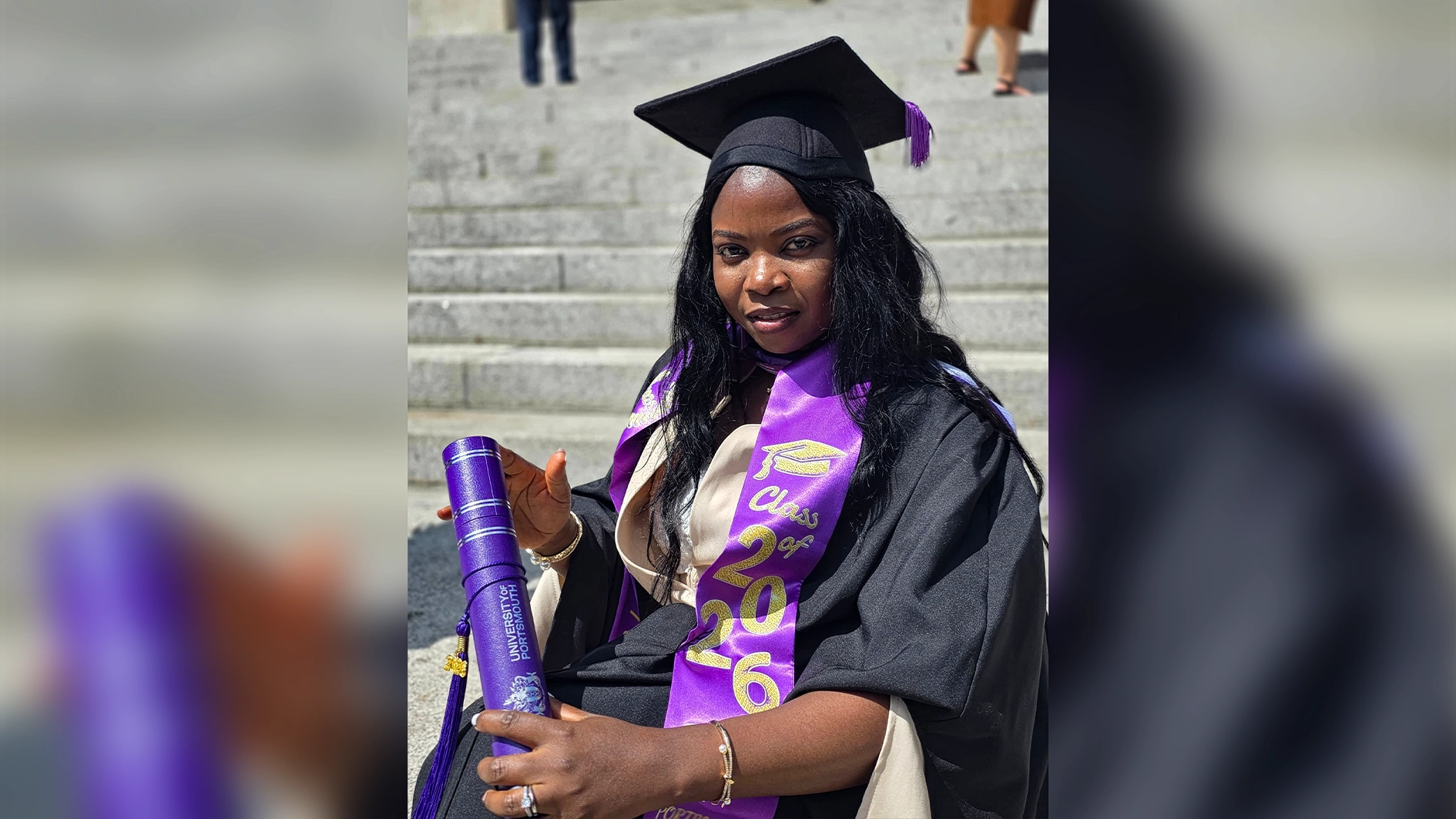
Education remains one of the most powerful tools for transforming lives. For many Nigerian students, studying abroad begins as a dream fuelled by determination, sacrifice and the hope of creating better opportunities.
Across Nigeria, interest in international education continues to rise as families invest heavily in giving their children global exposure, quality education and skills that can compete in today’s increasingly interconnected world.
For Blessing Okoye, an Anambra-born wife and mother, that dream became reality. At the University of Portsmouth, United Kingdom, she graduated with a Bachelor of Arts (BA) in Business and Management with First Class Honours, emerging as one of the outstanding graduates at the institution’s July 2026 graduation ceremony.
Originally from Nibo in Awka South Local Government Area of Anambra State and married to Ikechukwu Ekweli of Awka, Blessing’s journey is one of resilience, perseverance and unwavering faith. From walking barefoot to primary school and enduring painful words that she would one day become a pepper seller in Eke Awka Market, to balancing pregnancy, motherhood, work and academics abroad, her story reflects the triumph of determination over adversity.
In this interview with The Guardian, she shares her inspiring journey, the realities of studying in the United Kingdom, the challenges faced by Nigerian students overseas, and why she believes motherhood should never be seen as the end of a woman’s dreams.
Congratulations on graduating with First Class Honours in Business and Management from the University of Portsmouth. How does this achievement feel, and what does it mean to you personally?

Thank you so much. This achievement feels like God’s grace made visible, a testimony written through tears, hard work and unshakable hope.
Graduating with First Class Honours means far more to me than earning a degree. It represents every hardship I endured and proves that none of it was in vain.
I grew up knowing what it felt like to be looked down upon and to be told I did not deserve good things simply because my parents were poor. I walked barefoot to primary school. While studying for this degree, I worked two jobs to support my family. At eight months pregnant, I stood for nearly five hours completing an assignment because I could not sit comfortably. I did it through tears and eventually earned an ‘A’. I never wanted anyone to do my work because I wanted every grade to reflect my own effort.
This First Class is proof that your background does not determine your future. A woman, a wife and a mother can rise through faith, discipline and determination. This is more than a certificate; it is my victory over every voice that once said I would never amount to anything.
What inspired you to pursue your university education in the United Kingdom instead of Nigeria?
My decision was influenced by what I witnessed among friends who attended universities in Nigeria.
I watched them struggle endlessly for hostel accommodation. I heard stories of students being compelled to buy unnecessary handouts and textbooks. Even more disturbing were reports of harassment and exploitation by some lecturers. The recurring strikes also meant that students spent far longer in school than necessary.
I wanted an environment where I could focus solely on learning, where I would be assessed on merit, not on who I knew or what I could afford to pay. That is what attracted me to the United Kingdom.
My decision was never because I do not love Nigeria. I remain proud of my country. I simply wanted to acquire knowledge and experience in an environment that would allow me to thrive so that I can one day return home and contribute meaningfully to national development.
Having experienced higher education in the UK, how would you compare the learning environment, teaching methods and academic expectations with those in Nigeria?
From my experience, the learning systems are significantly different.
In the UK, everything is structured to support students. Every student has an online portal accessible on both computers and mobile phones, where lecture slides, course materials and library resources are available free of charge.
Teaching goes beyond theory. Lecturers use videos, illustrations, case studies and interactive learning methods to simplify complex concepts. Assignments are practical and designed to prepare students for the workplace rather than simply testing memorisation.
Each course consists of lectures and seminars. Lectures introduce concepts, while seminars provide smaller interactive classes where students receive practical guidance. Students who need additional academic support are offered extra tutorials until they understand the subject.
Academic calendars are clearly planned from the beginning of the semester, with assessment dates communicated in advance. Students typically study between two and four modules per semester, allowing greater focus.
The learning facilities are equally impressive. Computing students have access to desktop computers with free internet. Buildings are accessible to people living with disabilities, free drinking water is readily available, and nursing mothers and female students receive thoughtful support, including sanitary products.
Academic integrity is taken very seriously. My dissertation required original research, independent writing and strict plagiarism checks.
When I compare this with the experiences many of my friends had in Nigeria, I believe our educational institutions can still improve significantly in terms of infrastructure, student support and learning resources.
Many Nigerian students aspire to study abroad but are often unaware of the realities. From your experience, what are some of the biggest challenges they face?
One of the biggest challenges is adapting to an entirely different educational culture.
In the UK, attendance is monitored electronically using student identification cards, assignments must be completed independently and there are no shortcuts. Nobody reminds you to study or chases you to attend lectures. Success depends entirely on personal discipline.
Financial pressure is another major challenge. Tuition fees, accommodation and living expenses are substantial. Many students work long hours simply to survive, making it difficult to balance employment with academic responsibilities.
Studying abroad demands independence, discipline and resilience. It is challenging, but those same challenges also build character.
Studying abroad is financially demanding. How did you combine work with your academic responsibilities?
It required discipline and careful planning.
Before my son was born, I worked two jobs while studying. After his birth, I resigned from one job so I could devote more time to my family and education.
Organisation became my greatest tool. Every assignment deadline was saved in my Google Calendar, and I aimed to complete coursework at least three weeks before submission dates. During breaks between lectures, I went straight to the library instead of wasting time.
Education remained my priority, so I only accepted work shifts that would not interfere with my classes.
My husband also played an invaluable role by supporting our home and caring for our son whenever I needed to study. Above all, I relied on God’s strength throughout the journey.
Some Nigerian students abroad are unable to complete their studies. In your opinion, what causes this, and how can prospective students avoid such challenges?
Financial challenges remain the leading cause.
Many students underestimate the total cost of studying abroad. Exchange rate fluctuations, delayed sponsorship and family financial expectations often create enormous pressure. Some students work excessive hours and neglect their studies.
Another challenge is failing to adapt to the educational system. Everything is technology-driven, so basic computer literacy is essential. Students must also understand that attendance, coursework and deadlines are strictly monitored.
Some students mistakenly prioritise work over school, while others assume money or social status can influence academic outcomes. That simply does not happen.
Prospective students should prepare adequately before travelling. Learn computer skills, understand the academic culture, budget realistically and communicate honestly with family members about financial expectations.
Above all, remain humble, attend classes consistently and never hesitate to seek help whenever necessary.
Your story reflects remarkable resilience, particularly during pregnancy and motherhood. How did being a wife and mother shape your academic journey?
Motherhood strengthened rather than weakened my determination.
At eight months pregnant, I completed a demanding assignment by standing for almost five hours because sitting had become extremely uncomfortable. I stayed late in the library despite the physical discomfort because I wanted every mark to be earned honestly. That assignment eventually received an ‘A’.
I also carried with me memories from childhood. I still remember an aunt telling me that because my parents were poor, I would one day sell pepper at Eke Awka Market. Those painful words became my motivation.
My children became my greatest inspiration. Whenever I felt exhausted, I remembered that I was setting an example for them.
My husband stood firmly beside me throughout the journey. He supported our family, encouraged me constantly and believed in my dreams.
These responsibilities made me more disciplined, organised and determined. I was no longer studying only for myself but for my family’s future.
Beyond graduating with First Class Honours, what lessons has this journey taught you about perseverance, discipline and self-belief?
Perseverance means continuing even when everything seems difficult.
The painful words spoken over my childhood did not destroy me; they became the motivation that pushed me forward.
I also learned that discipline is more valuable than talent. It was discipline that made me complete assignments weeks before deadlines, spend long hours in the library and remain committed despite pregnancy and work.
Most importantly, I learned to believe in myself. Your background does not define your future. People’s opinions do not determine your destiny.
This First Class is proof that faith, discipline, planning and hard work can transform even the most painful experiences into remarkable success.
What are your future academic and career aspirations?
By God’s grace, I intend to continue my education up to the PhD level.
Beyond academics, my greatest dream is to establish a non-governmental organization (NGO) that will support widows and sponsor the education of underprivileged children.
Having experienced poverty myself, I understand what it means to lack shoes, uniforms and school materials. I want to ensure that children within my reach never experience those hardships.
I also hope to build international partnerships that will help provide housing, educational support and opportunities for vulnerable families.
My degree in Business and Management has equipped me with knowledge that I intend to use to create lasting social impact in Nigeria.
Finally, what message would you like to share with young mothers who believe marriage or motherhood has ended their dreams?
I want every young mother to know that motherhood is not the end of your dreams, it can become the beginning of your greatest purpose.
I balanced pregnancy, work, marriage and university education, and by God’s grace I graduated with First Class Honours from the University of Portsmouth.
The university also provided excellent support for nursing mothers, making it easier to combine parenting with academic life.
If someone who walked barefoot to primary school and was once told she would only become a pepper seller can achieve this, then others can too.
Choose a partner who believes in your dreams and supports your ambitions. Be kind to people because you know what it feels like to be overlooked.
Your children are not obstacles; they are powerful reasons to keep striving.
Plan carefully, trust God, remain disciplined and never abandon your dreams. You can be an outstanding mother, a supportive wife and a successful professional all at the same time.
Your dreams are still valid, and they are waiting for you.

