 Follow Us on Google News
 Follow Us on Google Discover
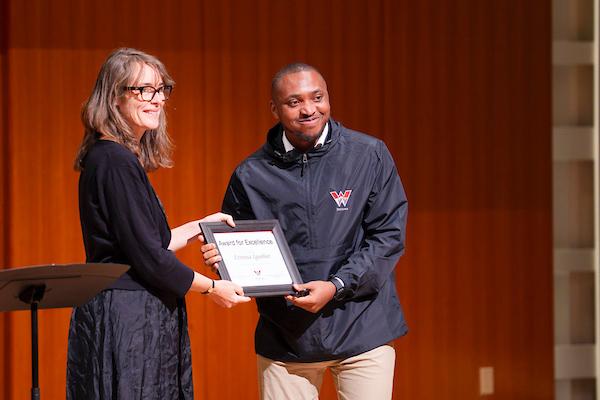 In the field of environmental conservation, few names command as much respect as Etinosa Igunbor. A distinguished climate scientist and researcher, Igunbor has made groundbreaking contributions to ecosystem management, carbon monitoring, and global sustainability. With more than 20 national and international awards and invitations to present his research on global platforms, his work continues to shape policy discussions and scientific advancements worldwide.
[ad]
At the core of Igunbor’s achievements is his development of an innovative carbon monitoring model that utilizes satellite imagery to track carbon sequestration. This cutting-edge approach offers a more precise, scalable, and cost-effective alternative to traditional field-based methods.
“Our model is transforming how we monitor ecosystem health, making conservation efforts more data-driven and impactful,” Igunbor explains. His research, which integrates remote sensing with field data, has been applied across diverse landscapes, including wet meadows and sagebrush ecosystems in the United States. “By leveraging geospatial technology, we provide accurate assessments of restoration efforts, empowering land managers to make informed decisions,” he adds.
But Igunbor’s influence extends far beyond research. A strong advocate for sustainable land management and conservation policies, he has served in various capacities both nationally and internationally. He was invited to join the board of the California Society for Ecological Restoration as an affiliate member, where he supports efforts to advance ecological restoration within and beyond the state. Previously, as a senior forest conservation officer with the Edo State Government, he led initiatives that reduced forest degradation while increasing revenue generation.
His commitment to environmental advocacy is also evident in his role as a Climate Lobbyist with the Citizens’ Climate Lobby in Washington, D.C., where he engages with U.S. policymakers on ecosystem restoration and sustainability. “For real change to happen, policy must align with science,” he emphasizes. “That’s why my work bridges the gap between research and implementation.”
On the international stage, Igunbor has represented the official youth mechanism group to the United Nations Environment Programme (UNEP), participating in bilateral meetings and consultations with member state representatives at major conferences such as the United Nations Environment Assembly (UNEA-6) in Nairobi and the Global Youth Environmental Assembly. His contributions to global climate policy have cemented his reputation as a key voice in international sustainability discussions.
His accolades include the prestigious Judith F. Taggart Mentor and Inclusion Award, the John Deere Award, and the HERD Fellowship Award. Reflecting on these honors, he notes, “Each award is a milestone, but more importantly, they highlight the collective impact of my research and advocacy.”

Beyond research and policy, Igunbor is deeply committed to mentorship and capacity building, ensuring that the next generation of environmental leaders is equipped to tackle climate challenges. Recognized by institutions worldwide, his work continues to shape conversations on carbon sequestration and climate resilience.
Looking ahead, Igunbor is focused on expanding his carbon monitoring model to tropical ecosystems, where deforestation is a growing concern. “The goal is to create a system that governments, researchers, and conservationists can use to track carbon levels accurately and implement targeted interventions,” he explains.
As the world faces the mounting challenges of climate change, Igunbor’s work serves as a beacon of innovation and dedication. “Sustainability is not just an idea—it’s an action,” he concludes. “And I am committed to being part of the solution every step of the way.”
[ad]

