 Follow Us on Google News


 Follow Us on Google Discover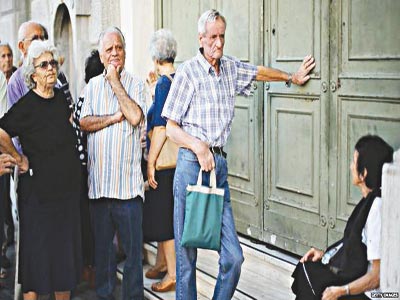

Papandreou, a proud Greek socialist who stood up to his country’s coup-mongering generals in the 1960s, won an election in October 1981 by fulminating against the European Economic Community (as it was then known) and vowing to lead Greece out of North Atlantic Treaty Organisation (NATO).
But in office he executed a graceful kolotoumba (somersault), discovering a taste for European subsidies that could be used to expand his crony state and turning himself into an engaged, if awkward, NATO partner. Greece’s interests, Papandreou determined, were best served by exploiting the rules of the clubs it belonged to, not by tearing them up.
Now Tsipras has come to the end of the road. He continued to seek a deal, even as Greece defaulted on an IMF payment and its bail-out expired. But at the same time he was denouncing his partners on television and urging Greeks to vote “no” to the agreement he sought. No one has been more infuriated than the Germans.
On July 1, Angela Merkel, the Chancellor, dismissed the latest Greek proposal with uncharacteristic haste. Her government now seems determined to see the back of Tsipras. What many saw as a poker game has turned out to be an unequal bout of Ultimate smackdown.
This is an extremely unhappy affair for the European Union (EU), which thought it had found an unusually effective way of resolving differences between democracies. Now that the rupture with the Greeks is clear, officials in Brussels do not know what to make of it all.

Perhaps the creditors deserve a share of the blame. Their own tactics could have been more sensitive: their response to a Greek proposal last week, which featured paragraphs struck out with red lines and entirely rewritten, infuriated Greeks who are no fans of Syriza. They could have offered some accommodating words on debt relief.
Yet that would have been a stretch for many creditor countries. Greece’s government, despite Tsipras’s protestations, is not the only one to enjoy a democratic mandate.
A better argument is that the creditors should have had the foresight to know what the austerity they brought upon Greece might wreak.
Few democracies could withstand a 25% contraction in GDP over five years, a calamitous growth in unemployment and the humiliation of having endless budgets written by unelected outsiders. Greece’s pre-2008 boom may have been unsustainable and its politicians venal, but that is of no comfort to retirees whose pensions have been slashed or graduates forced abroad to find work. Syriza appealed to voters who had lost all hope. It offered a false prospectus, perhaps a deceitful one. But it was, in part, the creation of the euro zone’s failed policies.
One still hears European officials lament that Syriza began its reign of calamity just as Greece was starting to recover, as if voters should have merely exercised more patience. Tsipras’s amateurishness has, lamentably, given Europeans an excuse not to examine their own culpability. If Greece does fall out of the euro, its leaders must bear the blame. But Europeans might consider what they can do to ensure a return to the glorious days of fudge.
Bar a few lonely Greeks who warned that Syriza was not a party Europe could do business with, almost everyone thought the mysterious forces that keep Europe together would drive Tsipras to accept a cash-for-reforms deal. Early signs of trouble, such as the preening lectures on macroeconomics delivered by Yanis Varoufakis, Greece’s former finance minister, to his euro-zone peers in the Eurogroup, were written off first as amusing, and then irritating.
The moment of truth came on June 26, when Tsipras called a shock referendum on the creditors’ latest bail-out offer. Officials had thought a deal was close; the negotiations were ongoing when Tsipras made his announcement.
Whatever its outcome, the Greek crisis will change the EU forever. The EU has never seen the like of the past eight days in Greece: barred banks, capital controls, the first IMF default by a developed country, the collapse of a multi-billion-euro bail-out, plans for a referendum that may hasten Greece’s ejection from the single currency, and the beggary of the people. Were the stakes not so high, all those emergency summits and last-minute demands would count as farce.
For the rest of Europe, too, “Grexit” has well-rehearsed risks, notably that of a failing state on the continent’s south-eastern flank. But as the drama has become more desperate, so Europeans seem less worried. They take comfort from the fact that Greece is uniquely dysfunctional. Game-playing and repeated miscalculation have poisoned the negotiations. Without Greece, many now conclude, the euro zone might actually be more stable.
Sadly, that is wrong. Look beyond Greece, and the threat of further conflict within the euro is all but inevitable. Although Greece’s departure would prove the euro is not irrevocable, nobody would know what rule-breaking would lead to expulsion. Nor would it resolve the inevitable polarisation of debtor and creditor governments in bail-outs. If the single currency does not face up to the need for reform, then this crisis or the next will witness more Greeces, more blunders and more dismal weeks. In time, that will wreck the euro and the EU itself.
To protect against downturns, euro-zone members must create automatic mechanisms, such as collective unemployment insurance, that channel extra funds to countries in recession. Instead of bail-outs, the single-currency area needs more joint pooling of risk and responsibility—some form of “Eurobonds” or jointly guaranteed sovereign debt—governed by fiscal rules more binding than today’s.
The moral of Greece’s disaster is that Europeans must face up to the euro’s contradictions now—or suffer the consequences in more ruinous circumstances.
Eurozone finance ministers say they expect to hear new proposals from Greece after the country voted to reject the terms of a bailout.
A spokesman for German Chancellor Angela Merkel said there was currently “no basis” for talks on a new bailout and the ball was in Greece’s court.
Merkel is to meet French President Francois Hollande in Paris.
Germany’s economy minister has warned that any unconditional debt write-off would destroy the single currency.
“I really hope that the Greek government – if it wants to enter negotiations again – will accept that the other 18 member states of the euro can’t just go along with an unconditional haircut (debt write-off),” said Sigmar Gabriel, who is also Germany’s vice-chancellor.
“How could we then refuse it to other member states? And what would it mean for the eurozone if we’d do it? It would blow the eurozone apart, for sure,” he added.
Greece may push for a debt cut or restructuring – especially after the International Monetary Fund (IMF) said that is exactly what the country needs – but it simply won’t wash in Berlin. Angela Merkel ruled out that approach earlier this year, and yesterday her vice chancellor echoed her.
Greece must successfully institute reform first, said Sigmar Gabriel. To offer debt relief now, he said, would destroy the eurozone.
Eurozone finance ministers are to meet today followed by a full summit of eurozone leaders. According to a Greek government official, Prime Minister Tsipras is expected to present fresh proposals at the summit.
In another development, Greek officials named Euclid Tsakalotos to replace outspoken Finance Minister Varoufakis, who resigned.
Meanwhile, the European Central Bank (ECB) is discussing whether to raise its emergency cash support for Greek banks, which are running out of funds and on the verge of collapse.
Last week, Greece ordered banks to close after the ECB froze its financial lifeline following the breakdown of bailout talks in Brussels.
Capital controls have been imposed and people are queuing to withdraw their limit of 60 euros a day.
Greece’s Economy Minister, Georgios Stathakis, said the ECB had to keep Greek banks alive for seven to 10 days so that negotiations could take place.
Global financial markets have fallen over fears that Greece is heading for an exit from the euro.

