 Follow Us on Google News
 Follow Us on Google Discover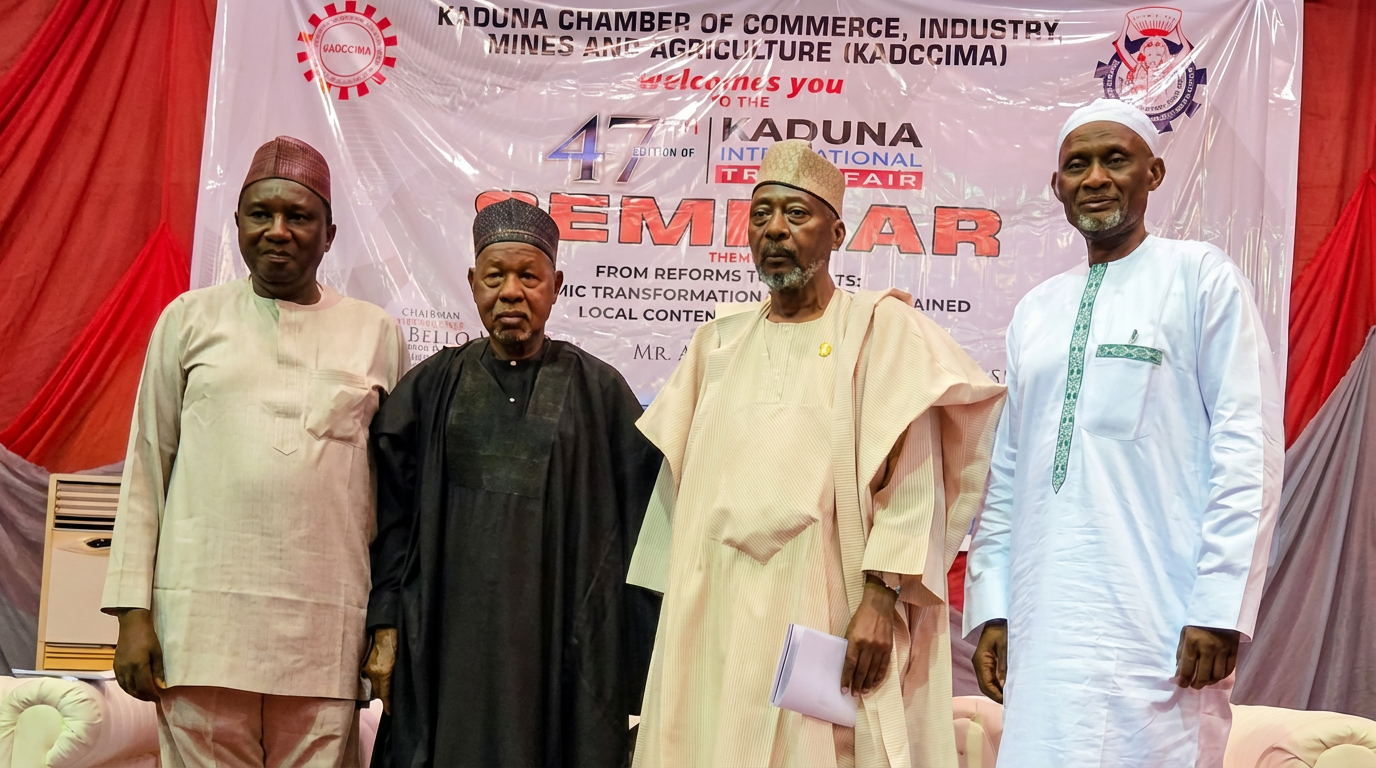
Nigeria’s long quest for industrialisation found renewed urgency and direction as the 47th Kaduna International Trade Fair opened at the Kaduna International Trade and Investment Centre, drawing together policy makers, industrial leaders, investors and trade experts around a shared conviction that the nation’s economic transformation must be rooted in strong local content development.
The week long fair, which runs until February 15, 2026, is themed“From Reforms to Results: Economic Transformation through Sustained Local Content Development.” Yet beyond its theme, the gathering signals a deeper shift in national thinking. Stakeholders insist that policy reforms, while necessary, are not sufficient. What Nigeria now requires is measurable output: factories that produce, young people who are skilled, enterprises that thrive and goods that compete both at home and abroad.
Across the expansive fair grounds, exhibitors displayed products spanning agriculture, manufacturing, technology and services. But the most compelling message was not found in the exhibition stalls alone. It came from the speakers who used the platform to call for a decisive move from rhetoric to production.
Ambassador Ahmed Nuhu Bamalli, the Emir of Zazzau and Grand Patron of the Kaduna Chamber of Commerce, Industry, Mines and Agriculture, set the tone. Represented by the Madaki Goma Zazzau, Hon. Musa Bamalli, the royal father observed that Nigeria has never lacked policies or grand programmes. What has often been missing, he said, is steady implementation.
He identified youth unemployment as one of the most pressing challenges facing the country, describing it as both a barrier to development and a contributor to insecurity. For him, skills acquisition must sit at the centre of any serious diversification agenda. He urged the chamber to ensure that the trade fair complex does not remain a venue used once a year, but becomes a constant hub for economic activity, culture and tourism.
That challenge aligns closely with the vision of Alhaji Farouk Suleiman, who assumed office as President of KADCCIMA two months ago. In his welcome address, he declared that Nigeria has entered a season of necessary reforms, but warned that reforms on their own do not create prosperity.

“Only production creates prosperity. Only skills create jobs. Only enterprise creates wealth,” he said, insisting that chambers of commerce must take the lead in translating reform into tangible results.
Under his leadership, the chamber is repositioning itself beyond its traditional role as an event organiser. It aims to function as a policy advocate, business accelerator, platform for skills development and year-round driver of economic growth. Suleiman outlined a detailed roadmap that includes vocational and technical training, digital and information communication technology programmes, agro processing initiatives, enterprise incubation, mentorship schemes and light manufacturing training.
The emphasis, he explained, is on empowering young people and women to become job creators rather than job seekers. He stressed the multiplier effect of such an approach, noting that training a single young person reduces unemployment, while empowering a woman strengthens an entire household.
Central to this strategy is the transformation of the trade fair complex itself. Suleiman unveiled plans to convert the site into a 365-day hub for trade, learning, innovation and investment. The vision includes modern exhibition facilities, incubation spaces for small and medium enterprises, training centres and structured business support services.
He called on investors, corporate organisations and development institutions to partner with the chamber through structured collaborations and sponsorships. According to him, the complex must evolve into a permanent economic ecosystem that nurtures enterprise throughout the year.
As part of efforts to broaden its economic impact, the chamber has also established a culture and tourism committee. Plans are under way to host a traditional boxing championship known as the Dambe Championship, reflecting a strategy to harness indigenous cultural assets as economic drivers.
At the state level, Governor Uba Sani reaffirmed Kaduna State’s commitment to building a predictable and investor friendly environment. Represented by the Commissioner for Business Innovation and Technology, Patience Fakai, the governor highlighted Kaduna’s first place ranking in the Subnational Fiscal Transparency Index for two consecutive years.
He noted that investors are drawn to environments where governance is clear, rules are predictable and public finance is credible. Higher fiscal transparency, he said, reduces uncertainty and encourages private capital inflow.
Governor Sani emphasised that the state’s focus on local content is deliberate. Industrial growth, he maintained, must be anchored in local enterprise, local skills and resilient value chains. From agriculture and solid minerals to manufacturing, technology and services, the state government is committed to policies that support indigenous businesses while remaining open to global capital and expertise.
The federal government echoed similar sentiments. Nura Abba Rimi, Permanent Secretary at the Federal Ministry of Industry, Trade and Investment, disclosed that the Nigeria Trade Policy has moved into its execution phase.
He explained that success would be measured not by policy documents but by the number of new factories established and the volume of exports leaving Nigerian ports.
He observed that the concept of local content has evolved beyond its traditional association with the oil sector. It is now becoming central to broader industrial growth and wealth creation. By prioritising goods made in Nigeria, he said, the country retains wealth within its borders and strengthens its internal economic cycle.
Rimi outlined measures aimed at improving trade efficiency, including digital platforms for monitoring trade flows, incentives to encourage local sourcing by major investors and simplified procedures to reduce bureaucratic delays. He also noted ongoing efforts to address infrastructure gaps and improve access to finance for businesses that source locally. Exhibitors were urged to prioritise Nigerian suppliers as a practical contribution to national growth.
The National President of the Nigerian Association of Chambers of Commerce, Industry, Mines and Agriculture, Engr. Dr Jani Ibrahim, praised Kaduna State’s fiscal direction. He cited allocations of one hundred million naira each to health, education, agriculture and social sectors in the 2026 appropriation bill as evidence of a government attentive to inclusive development.
He described the allocations as a sign that the state recognises the central role of the private sector in achieving sustainable transformation. He assured participants that the national chamber body would continue to advocate policies that strengthen private enterprise and encourage collaboration between government and business.
The positions expressed at the trade fair reflect a growing national consensus. Nigeria must move decisively from consumption to production, from dependence on imports to indigenous manufacturing, and from a culture of job seeking to one of enterprise creation.

