
GDN SIDEBAR
In recent times, Nollywood has been steadily expanding beyond its traditional storytelling boundaries. Son of the Soil comes through with the drive of a full-scale action spectacle. Directed by Chee Keong Cheung and written by and starring Razaaq Adoti, the film attempts to fuse the famous Western revenge cinema with the harsh realities of Lagos. The result is a film that is often thrilling in all physical senses, even if its storytelling occasionally struggles to keep pace with its own strength.
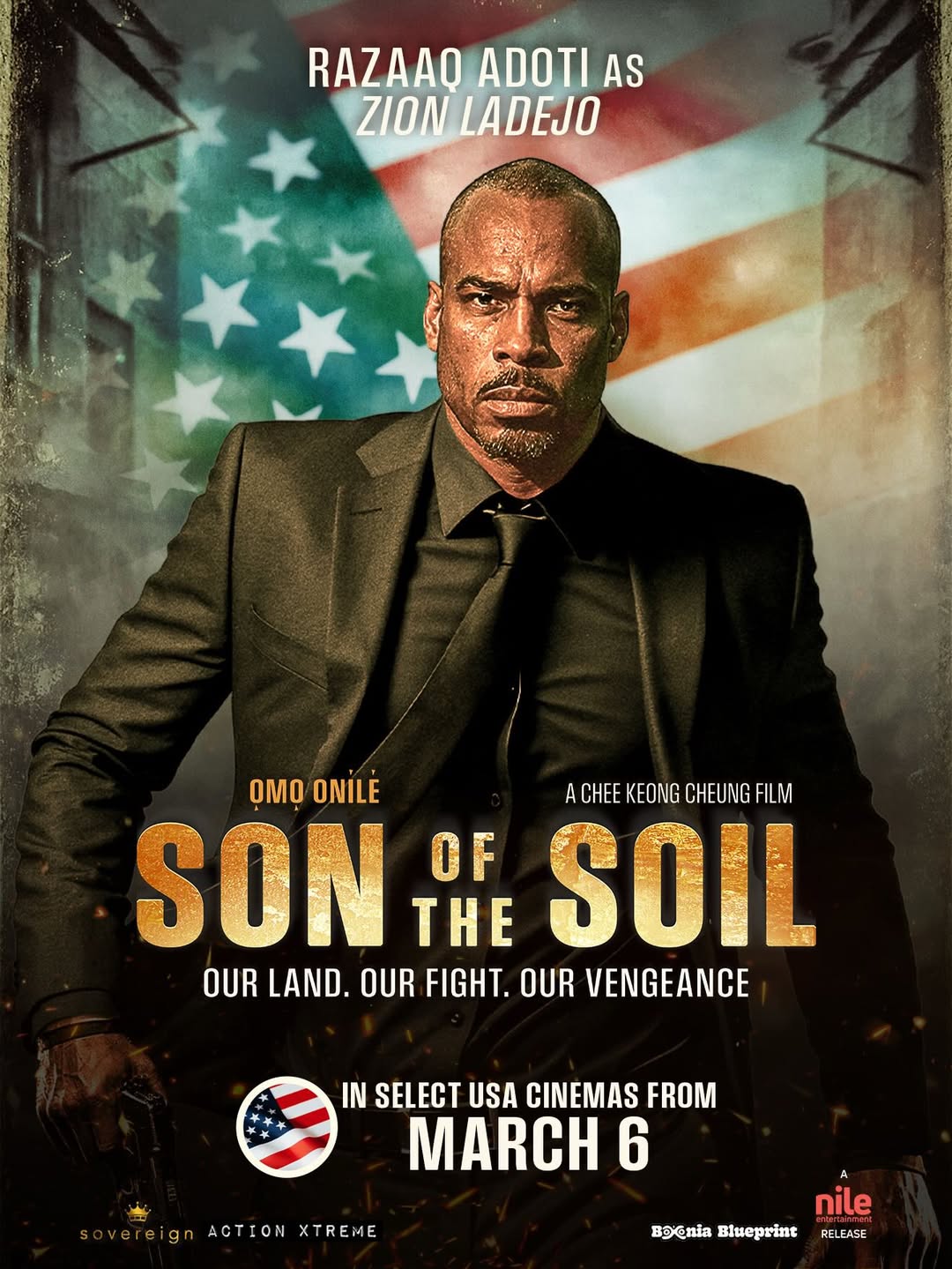
While not without flaws, the movie represents a bold step in Nollywood’s ongoing expansion into this genre. The story centers on Zion Ladejo, a former Nigerian special forces operative whose life is upended when his sister is brutally murdered. What initially appears to be a senseless crime soon reveals deeper corruption: her death is tied to a powerful criminal drug network operating within Lagos. Fueled by grief and a fierce sense of justice, Zion embarks on a one-man campaign to dismantle the syndicate responsible, setting the stage for a series of violent confrontations and high-stakes encounters, one that drags him deeper into a world of traffickers, corrupt operators, and shadowy power brokers.
At its core, Son of the Soil adheres to the familiar turn of the revenge thriller: loss triggers vengeance, and vengeance begets escalating conflict. Revenge thrillers are rarely concerned with narrative subtlety, and Son of the Soil follows that tradition closely. The film moves with a blunt sense of purpose: Zion hunts, confronts and dismantles his enemies one by one, driven by grief.
What distinguishes Son of the Soil from many other entries in the genre is its setting. The setting of Lagos itself acts almost like a character in the film. The crowded streets, bustling markets, and everyday hustle lend texture to the narrative and emphasize the stakes of Zion’s mission. The filmmakers avoid glossing over the city’s rough edges; instead, the camera frequently plunges into the chaos of the city, capturing the sense that danger could emerge from any corner. Lagos’s energy and unpredictability are woven into the film’s atmosphere and Lagos is not merely a backdrop but an active presence throughout the film.
Visually, Cheung known for directing and producing high-octane action, handheld camerawork relies heavily on tilted camera angles which is a stylistic technique that is intended to heighten tension and unease. Initially, this visual flourish adds urgency to the action, though the continuous use of tilted camera eventually becomes distracting, drawing attention to the camera rather than the drama unfolding within the frame.
The film’s greatest strength lies in its action choreography. The fight scenes are raw, fast and unapologetically brutal. Rather than relying solely on polished stunt spectacle, many of the confrontations feel improvised and physical, with punches landing heavily and the things in the environment becoming weapons. One particularly memorable sequence involves a chaotic pursuit through Lagos traffic. Rather than the familiar Hollywood car chase we see Lagos’s distinctive tricycles which adds a welcoming sense of local flavour to the genre.

Adoti’s performance as Zion carries the film’s emotional core, though the script offers him limited space to explore the character’s inner life. His portrayal is stoic and controlled, presenting Zion as a man hardened by both military training and personal loss. Yet the film rarely pauses long enough to explore the psychological cost of his mission. As a result, Zion sometimes feels less like a fully realised character and more like a vessel for the film’s relentless action.
The supporting cast helps anchor the story in moments of quiet credibility. Ireti Doyle brings a measured authority to her role, while Patience Ozokwor lends emotional weight to the narrative whenever she appears. Their performances offer brief but welcome reminders that the story’s violence has consequences beyond the immediate spectacle.
Where the film falters is in its narrative logic. Several plot developments rely on coincidence, and certain story threads appear only to disappear without meaningful resolution. At times, it feels as though the screenplay is racing to the next confrontation rather than allowing its characters or themes to breathe.
Despite these shortcomings, Son of the Soil marks a promising evolution for Nollywood’s action ambitions. It is not a flawless film, but it is a bold one willing to prioritise physical storytelling and genre energy while rooting its narrative in a recognisable socio-cultural setting.
In the end, Son of the Soil is best appreciated as an action piece. Its power lies in its movement: the relentless drive of a man wronged, the chaotic force of Lagos, and the power of its fight scenes. For fans of action thrillers looking for something that blends local texture with genre intensity, this is a film worth experiencing.