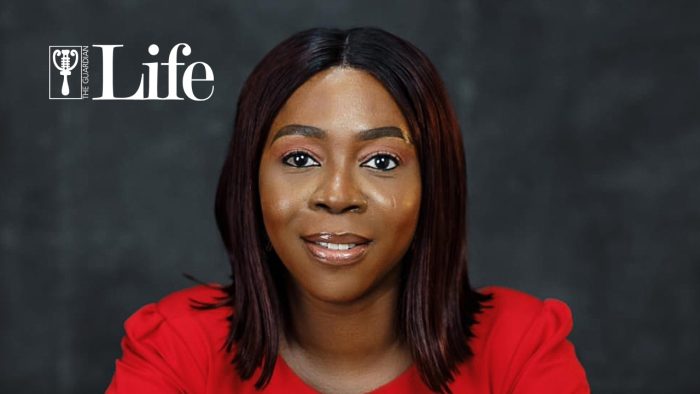
Sharon Rotimi did not walk into Nollywood by accident. Long before viewers saw her in The Wives, The Yard, Finding Me, The Architect, Son of the Soil, and Wura, she already knew she wanted a life in film.
Her journey, however, did not follow a straight line. At 18, she became a registered nurse, later worked in marketing and community management, before finally choosing the path that gave her the most joy.
Speaking exclusively with Guardian Life, Rotimi opens up on leaving nursing, dealing with rejection, managing pressure, finding balance, and why every closed door pushes her to pursue excellence.
Tell us something about yourself that people may not already know.
I wanted to be an actress and work in film. I’m the first of three children. I have a sister and a brother, and I love them so much.
You have grown in Nollywood. What has rejection taught you about yourself?
For me in Nollywood, rejection is not exactly something I see as personal. If anything, it has shown me how tenacious I can be. First off, I consider it an honour to be considered for roles and to be invited to audition for stuff. But with the way it goes in film, especially the auditioning process or casting process, the decisions are hardly ever personal.
It is usually a question of, “Is this person a good fit?” It is hardly ever an indictment of your talent or your skill as an actor. So many times, decisions are mostly beyond you or beyond your skill. It could be, “Does this person physically look like a character?” or “Is there chemistry with certain members of the cast or as an ensemble?” Do these people look good together?
So, there are so many things that go into decision-making during casting. Over time, when you go into the audition room, you know that it is barely personal. If anything, it fuels my tenacity to continue to do more, continue to audition, and continue to pursue excellence. So, yes, it does not stop me. I can be very, very tenacious, especially if it is something that I want to do.
As people start to recognise you more now, do you feel pressure to live up to a certain image?
As I get more recognisable, there is a limit to the kind of things I can do very freely. For example, I can’t just go about doing the regular things that I used to do. It sort of comes with responsibilities as to what I portray publicly.
So, there is that side for me. But there is the other end where it feels like people expect that, as you become recognisable, there is a certain way you should look and a certain way you should talk that might differentiate you from a regular person. I do not particularly follow that school of thought.
I’ve never been one to do things because they are popular or because other people are doing them. I have always liked being my own person and being comfortable in my own skin.
So, yeah, it is just those two things for me. As I get more recognised, I feel more responsible about the kind of things I say publicly or the kind of things I want to do. For example, I want to portray people, especially because I’m a believer.
But also, I do not necessarily feel the pressure to look or act a certain way or be seen with particular sets of people. For me, pressure comes with a feeling of inadequacy in certain areas. I do feel like if you are comfortable in the person that you are, and if the people around you, the people whose opinions matter to you the most, think you are a good person, I think you should be fine.
Have there been moments when you doubted yourself despite your recent growth in the industry?
For me, I have confidence in my ability, but I am also very open to growing and learning. I want to be better. So, there is that.
There are also moments where I have looked back on my journey, and I’m not going to deny a bit of the privilege that I’ve had, especially in my career. I’ve hit certain milestones that many people who have been here longer have not achieved.
So, I do have to manage my privilege sometimes. I do not see it from a point of pride, like, “Oh yes, I am here.” It is almost always that I acknowledge the grace it has taken to be here. It obviously is not just a function of whether or not I am good.
So, I recognise that God has placed me here for certain reasons. Even when I begin to self-doubt, if anything, it makes me more aware of God’s grace and God’s hand, and I will never deny that.
You left nursing to fully become an actor. Why did you leave that path for acting?
At the age of 18, I took my council exam to become registered, and I became one at 18. Between that year, in 2014 and 2022, I did a couple of other jobs. So, it wasn’t straight from nursing into acting. I had done other stuff.
Nursing is a noble profession. I do believe that people who are there, I would have to call them things. It is the kind of profession that you should do if you are somebody who cares about people and you are a very nurturing person.
I’m not saying I can’t be that person, but I do feel like it takes a lot of passion to be in the medical sciences generally, not just nursing, and I just wasn’t that person. Nursing was something that was supposed to be a journey. I was supposed to end up being a medical doctor.
But for me, I just feel like I did not exactly have the passion that it takes to work in the medical sciences. I just wanted to explore other things. Even though I always wanted to be an actor, I also wanted to work in entertainment and media. I explored some of those things in my journey to becoming an actor.
I also worked in marketing. I had a job as a community manager for a fintech. So, I just dabbled in a lot of things. After doing all of those things, I finally arrived at acting. It was just me wanting to shift.
I came to a point where I knew that I wasn’t living to my highest potential. I wasn’t doing the things that brought joy to my heart. So, I said, “You know what? I do not have an excuse not to pursue these things. What do I need to do? Get training.”
Yes, I enrolled in a creative academy. I finished that, and then I thought, if I’m not training, what more? And here I am.
What are the challenges you have encountered in your career?
Just like every other person in this kind of work, there has always been a level of, I don’t want to call it struggle, but it takes a lot of work to try to get yourself seen, recognised, and appreciated for the work that you do.
I don’t think I’m special in that regard. Everyone who wants to grow into being a household name goes through that same journey. It does not, in any way, reduce the fact that it can feel really difficult. It can be a lot to deal with.
But I guess it is much easier to bear when you realise that you are not alone. So many people are on that journey. It is even easier because of the kind of supportive community that I have, and I am forever grateful for that.
Everybody sees the glitz, the glamour, the excitement of the industry, but the kind of work that goes into it should never be taken for granted. It is a lot of work. You deal with rejection, you deal with assessing yourself, especially with the economic requirements. There is a lot to deal with, but all of that is easier if you have a supportive community. I do have that, and I am grateful for it.
Walk us through your support system?
I have had friends over a number of years, from my time in nursing school to my time in the university, and from my church community, growing up in church, my family, my mother, my brother, my sister, my management, and friends in the industry.
When I think about that, I’m overwhelmed because I’m not entirely out there yet. There are not many people who know me like that, but it is crazy how many people show up for me. I do not take it for granted.
It is beautiful to have people who see you, think you are talented, and want to see you do well. It is a blessing, and I do not take it for granted.