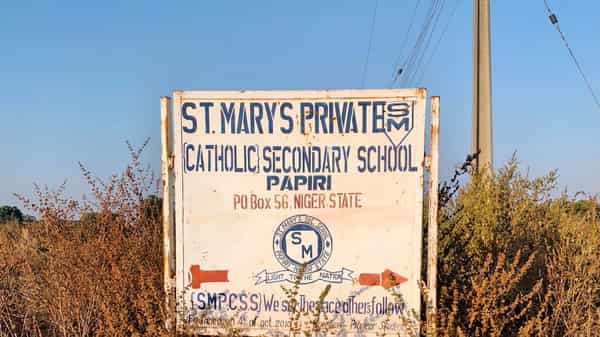
Fifty of the more than 300 children snatched by gunmen from a Catholic school in Nigeria have escaped their captors, a Christian group said in a statement Sunday.
“We have received some good news as fifty pupils escaped and have reunited with their parents,” said the Christian Association of Nigeria in a statement, adding they escaped between Friday and Saturday. Gunmen on Friday raided St Mary’s co-education school in Niger state, taking 303 children and 12 teachers in one of the largest mass kidnappings in Nigeria.The abduction came after gunmen had on Monday stormed a secondary school in neighbouring Kebbi state, abducting 25 girls, as security fears mount in Africa’s most populous nation, sparking a wave of school closures across other parts of the country.The number of boys and girls – aged between eight and 18 years – kidnapped from St Mary’s is almost half of the school’s student population of 629.
The Nigerian government has yet to comment on the number of students and teachers abducted.
“As much as we receive the return of these 50 children that escaped with some sigh of relief, I urge you all to continue in your prayers for the rescue and safe return of the remaining victims,” CAN chairman in Niger State, Reverend Bulus Dauwa Yohanna, said in the statement.
Police reported that the attackers arrived around 02:00 local time (01:00 GMT) and took students who were staying in the boarding facilities. Security forces are reportedly combing nearby forests in an effort to rescue the remaining abductees.
Authorities in Niger State ordered the closure of all schools in the state on Saturday in response to the attack. Officials said the school had ignored prior instructions to suspend boarding operations following intelligence warnings, exposing students and staff to “avoidable risk.” The school has yet to comment on this statement.
Friday’s mass abduction is the third in Nigeria in the past week. On Monday, more than 20 schoolgirls were kidnapped from a boarding school in neighbouring Kebbi State, while a church attack in Kwara State left two people dead and 38 others abducted.
President Bola Tinubu has postponed foreign trips, including attendance at the G20 summit in South Africa, to address the country’s escalating security challenges.
The incident has intensified public concern over the rising threat posed by armed gangs, commonly referred to as bandits. Ransom payments have been outlawed in an effort to reduce kidnappings, but attacks continue.
Some international observers have framed recent abductions as part of a wider pattern of attacks against Christians, a claim disputed by the Nigerian government. An official statement emphasised that “terrorists attack all who reject their murderous ideology—Muslims, Christians and those of no faith alike.” Analysts note that in northern and central Nigeria, violence often arises from conflicts over resources, rather than religious identity.
In 2014, Boko Haram abducted 276 girls from Chibok, an event that drew global attention and prompted international campaigns for their release. Many were eventually freed or escaped, though an estimated 100 remain missing
– ‘Deep sorrow’ –
Pope Leo XIV on Sunday made “a heartfelt appeal for the immediate release of the hostages”.
He expressed his “deep sorrow, especially for the many young boys and girls kidnapped and for their anguished families,” at the end of the Angelus prayer.
The two abduction operations and an attack on a church in the west of the country, in which two people were killed and dozens abducted, came as US President Donald Trump threatened military action over what he called the persecution of Christians by radical Islamists in Nigeria.
When asked about the recent attacks and kidnappings on Fox News Radio, Trump said “what’s happening in Nigeria is a disgrace”.
Nigeria is also dealing with a deadly Islamist insurgency in the northeast of the country, where the violence has killed more than 40,000 people and displaced around two million since it erupted in 2019.
Ayesha Yesufu, co-founder of the #BringBackOurGirls group movement, which led the campaign for the release of the Chibok schoolgirls kidnapped by Boko Haram 11 years ago, said kidnappings continue because “authorities are doing nothing” to curb the crisis.
“They’re more interested in the propaganda of…not looking inept and incompetent, rather than actually being interested in the protection of rights and properties,” she told AFP.
Ngozi Okonjo-Iweala, the Nigerian chief of the World Trade Organisation, posted on X that “As a mother, I am greatly saddened by the kidnappings in our country, particularly of our children and teachers from places of learning.”