• Not much will change with U.S. exports, even with extension, says Yusuf
• Trump slams 25% tariffs on Nigeria, S’Africa, Kenya, others doing business with Iran
The African Union (AU) has called on the United States Senate to approve a three-year extension of the African Growth and Opportunity Act (AGOA), following overwhelming bipartisan passage of the bill in the House of Representatives.
Also, the U.S. has issued a sweeping new tariff warning that could reshape Africa’s trade relationships, targeting countries that continue doing business with Iran at a time when Tehran is rapidly expanding its economic footprint across the continent.
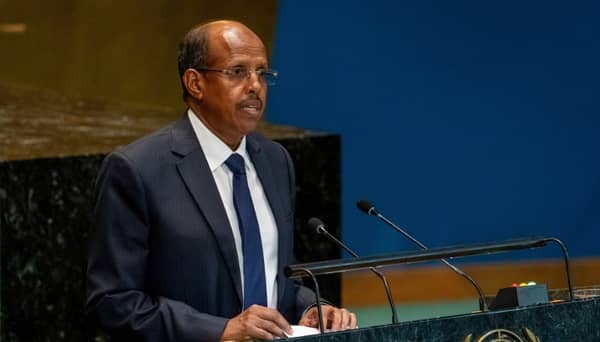
In a statement issued yesterday, AU Commission Chairman, Mahmoud Youssouf, described the preferential trade initiative as a cornerstone of U.S.–Africa economic relations and welcomed the House’s approval.
Praising the bi-partisan support, which he said reflects the U.S. enduring commitment to boosting trade, investment and shared prosperity with African economies, he highlighted AGOA’s role in fostering mutually beneficial economic ties and reinforcing Africa’s position as a reliable partner in global trade.
The U.S. House of Representatives recently passed the three-year extension, offering a potential lifeline for the U.S. flagship trade initiative with the continent. The Act, which provides African manufacturers and businesses in eligible countries, including Nigeria, with tariff-free access to the U.S. market, expired on September 30, 2025.
However, a proposed extension until December 31, 2028, sponsored by Republican Congressman Jason Smith, will now head to the Senate for approval after the House voted 340-54 in favour. The vote suggests strong bipartisan support in the lower chamber for AGOA, which was first approved by Congress in 2000.
The extension, if approved, will bring a renewed level of certainty to African exporters to the U.S. market. The International Trade Centre had estimated that AGOA’s expiry would reduce projected exports of its beneficiaries by $189 million by 2029, with $138 million of that accounted for by reductions in exports of apparel and textile products to the U.S., which were expected to register a decline of 9.7 per cent by 2029.
Reacting, Chief Executive Officer (CEO), Centre for the Promotion of Private Enterprise (CPPE), Dr Muda Yusuf, expressed scepticism, noting that he does not expect much to change regarding the country’s export to the U.S., even with the extension.
He pointed out that other African countries, such as South Africa and Mauritius, that took advantage of the programme flourished with manufactured goods export as well as export of textiles and apparel, sectors in which he said Nigeria lags.
U.S. total goods trade (exports plus imports) with South Africa was about $20.5 billion in 2024, while Nigeria recorded less than half of that figure at $10 billion.
The 25 per cent tariff warning threatens higher export costs, currency pressure and potential loss of preferential access to the U.S. market for many African economies.
For countries that continue trading with Iran, including South Africa, Nigeria, Ghana, Kenya, Tanzania and Somalia, the new measure would add a 25 per cent levy on all U.S.-bound exports, sharply reducing competitiveness.
Iran has been gripped by widespread unrest triggered by a collapsing Rial and inflation nearing 40 per cent.
Protests demanding the fall of the country’s theocratic government have spread across major cities, while authorities have imposed near-total Internet blackouts, limiting independent reporting.
Against this backdrop, U.S. President Donald Trump threatened on Tuesday that any country doing business with Iran would face a 25 per cent tariff on all trade with the U.S.
South Africa faces tariffs of up to 30 per cent on select goods, Nigeria 14 to 15 per cent, Ghana 10 to 15 per cent, while Kenya and Tanzania are subject to around 10 per cent. Other African countries face a baseline 10 per cent tariff.