 Follow Us on Google News
 Follow Us on Google Discover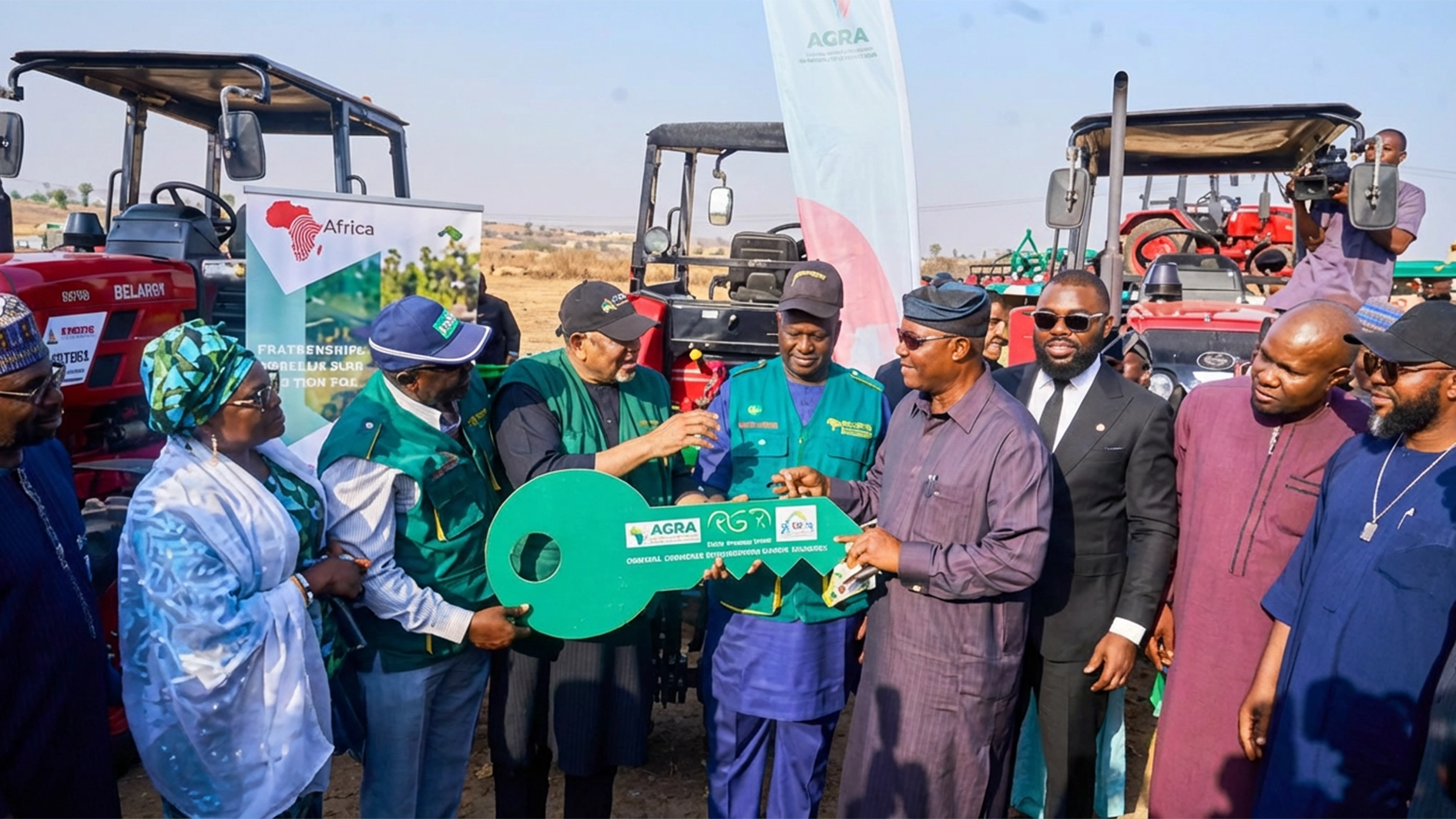
The Federal Government, through the Bank of Agriculture (BOA), has moved to address Nigeria’s deepening food crisis by distributing 2,000 tractors in phases under the Renewed Hope National Agricultural Mechanisation Programme (NAM).
Speaking at the ceremony on Tuesday, Managing Director and Chief Executive Officer of the Bank of Agriculture (BOA), Ayo Sotinrin, described the initiative as a historic milestone for the country’s agricultural transformation.
He explained that the program reflects President Bola Tinubu’s recognition of agriculture as a national priority and is designed for bold and deliberate action.
Sotinrin highlighted Nigeria’s mechanisation deficit, noting that the country currently has approximately 13 tractors per 100 square kilometres of arable land, compared with a global average of 200.
He said, “Nigeria stands at a critical juncture, with over 230 million people and a population projected to double by 2050. We face an urgent imperative to dramatically increase our food production capacity.”

“While we have over 70 million hectares of arable land, only 34 million hectares are under cultivation. And 95 per cent of our farmers, who produce almost 90 per cent of our food, still rely primarily on manual labour.
“This mechanisation deficit is not just a number; it translates directly into low productivity, post-harvest losses, missed planting windows, and ultimately food insecurity for millions of Nigerians.”
He emphasised that the NAM is not just about distributing tractors but creating a sustainable mechanisation ecosystem.
“For too long, tractor programs have followed a predictable pattern. Tractors are procured, distributed, and within a few years, they sit idle, broken down, and underutilised. Capital is expended in hundreds of millions of dollars, but not recovered. Assets depreciate without generating returns. The Renewed Hope National Agricultural Mechanisation Program is built on a different foundation.”
The MD explained that the program operates through a revolving system, where every naira invested is recovered, reinvested, and multiplied to expand access to mechanisation services.
“To achieve sustainability, we have established very rigorous qualification criteria—not to disenfranchise mechanisation service providers, but to safeguard public investment and ensure participant success.
“Every applicant must demonstrate the ability to service a minimum of 600 hectares per year, covering operational costs, loan repayments, and generating sustainable income.”
Sotinrin outlined the three financial models under the program. The first, according to him, targets agribusinesses and commercial farmers, representing 10 per cent of the fleet, allowing for immediate recovery and reinvestment of funds.
The second, the largest, is a partnership with state and local governments to empower youth and women entrepreneurs through mechanisation, deploying 1,200 tractors via qualified partners, with repayment tied to service-generated revenue.
The third model engages established mechanisation service providers with proven track records to deliver services at scale.
“Each tractor under the program must be productive and integrated into a functioning service ecosystem. A tractor is only as good as the ecosystem it supports,” Sotinrin said.
He noted the establishment of 40 mobile service stations and seven large-scale mechanisation service centres across the six geopolitical zones, providing workshops, spare parts, training, and digital monitoring systems to ensure sustainability.
According to him, every tractor is equipped with IoT tracking devices for real-time monitoring, ensuring assets remain productive.
“Heifer International, through AFI Nigeria, is providing a $7 million catalytic partnership during the first two years. This is not a grant—it is a recoverable investment. By year five, the NAM program will operate on internally generated capital, demonstrating that public investment in mechanisation can be impactful and sustainable,” Sotinrin added.
Minister of Agriculture and Food Security, Abubakar Kyari, said strict monitoring would ensure proper utilization of the tractors.
Also, he explained that, through the Renewable National Agricultural Mechanisation Programme, the government had deployed heavy-capacity tractors and over 9,000 precision implements under a national framework.
The Director General of the National Agricultural Seeds Council, Fatuhu Mohammed Buhari, said his Council has received additional 2,000 applications.
“I have more than 2,000 applications in my office, thinking that seed council is responsible for this mechanisation.
“So, today I am very happy that this programme has come to light, and Nigerians can have hope, and we are going to see a lot of progress in food security,” he said.

