• ‘Our Target Is To Become World’s Largest Refinery By 2028’
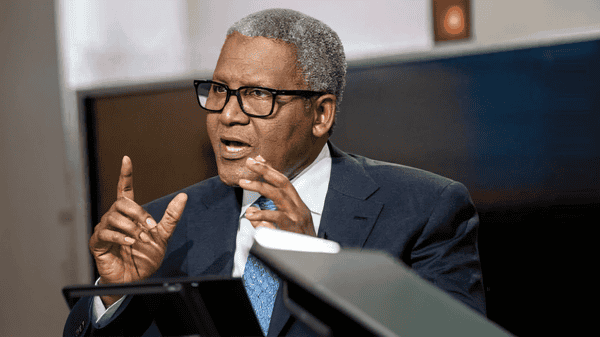
President of the Dangote Group, Alhaji Aliko Dangote, on Friday, declared that the era of fuel queues in Nigeria “is gone forever,” assuring that petrol supply will remain stable throughout the Christmas season and beyond.
Speaking with journalists after meeting President Bola Tinubu at the State House, Abuja, Dangote said the company has already notified the Nigerian Midstream and Downstream Petroleum Regulatory Authority (NMDPRA) of its ability to supply 50 million litres of Premium Motor Spirit (PMS) daily, well above the country’s consumption needs.
“Historically, Nigeria has battled fuel queues since 1972. For the first time, we are eliminating those queues, not through imports but by producing locally,” he said.
“Even when we were servicing the refinery, there were no queues. I can assure you that queues are now history.” Dangote added that neighbouring countries will also benefit, noting that by February, the refinery will be able to supply 15 to 20 million litres more than Nigeria consumes.
“So, we must export. Even our neighbours won’t experience queues because they can buy from us,” he said. He explained that domestic manufacturers, particularly in the plastics sector, which previously spent up to $400 million annually on imports, will now receive full local supply of their feedstock.
On the refinery’s long-term plans, Dangote unveiled an ambitious expansion drive to raise capacity to 1.4 million barrels per day by 2028, overtaking India’s Reliance refinery, currently the world’s largest at 1.25 million barrels per day.
“We have already signed the necessary agreements. Construction piling begins before the end of January, and we will deliver on schedule,” he assured. He also disclosed plans to scale up urea output to 12 million tonnes yearly, positioning Nigeria as the world’s largest producer ahead of Russia and Qatar.
“Our goal is to use our fertilizer company to supply the entire African continent,” he said. Responding to questions on the recent drop in petrol and diesel prices, Dangote attributed it to increased competition and reduced smuggling.
“Prices are going down because we must compete with imports. Luckily, smuggling has dropped significantly, though not completely,” he said. He stressed that the refinery is not driven by short-term profit.
“We’re not here to recover $20 billion overnight; this is a long-term investment. The legacy I want to leave is that whatever Nigerians need, fuel, fertilizer, power, we will be part of delivering it.” Dangote also highlighted structural challenges facing Nigeria’s solid minerals sector, particularly limited port capacity.
“Apapa is full. Tin Can is full. Lekki is mainly for containers. You cannot export coal or copper if you have nowhere to ship from,” he noted.
To address this, he said the Dangote Group is developing what will be the largest deep-sea port in West Africa at Olokola, slated for completion within two-and-a-half years.
Dangote expressed strong support for the Tinubu administration’s naira-for-crude initiative, describing it as a patriotic policy to strengthen the local economy, though he acknowledged initial resistance from international oil companies who prefer offshore premiums.
“It’s a teething problem, but it will be resolved, either through legislation or administrative action,” he said.