 Follow Us on Google News
 Follow Us on Google Discover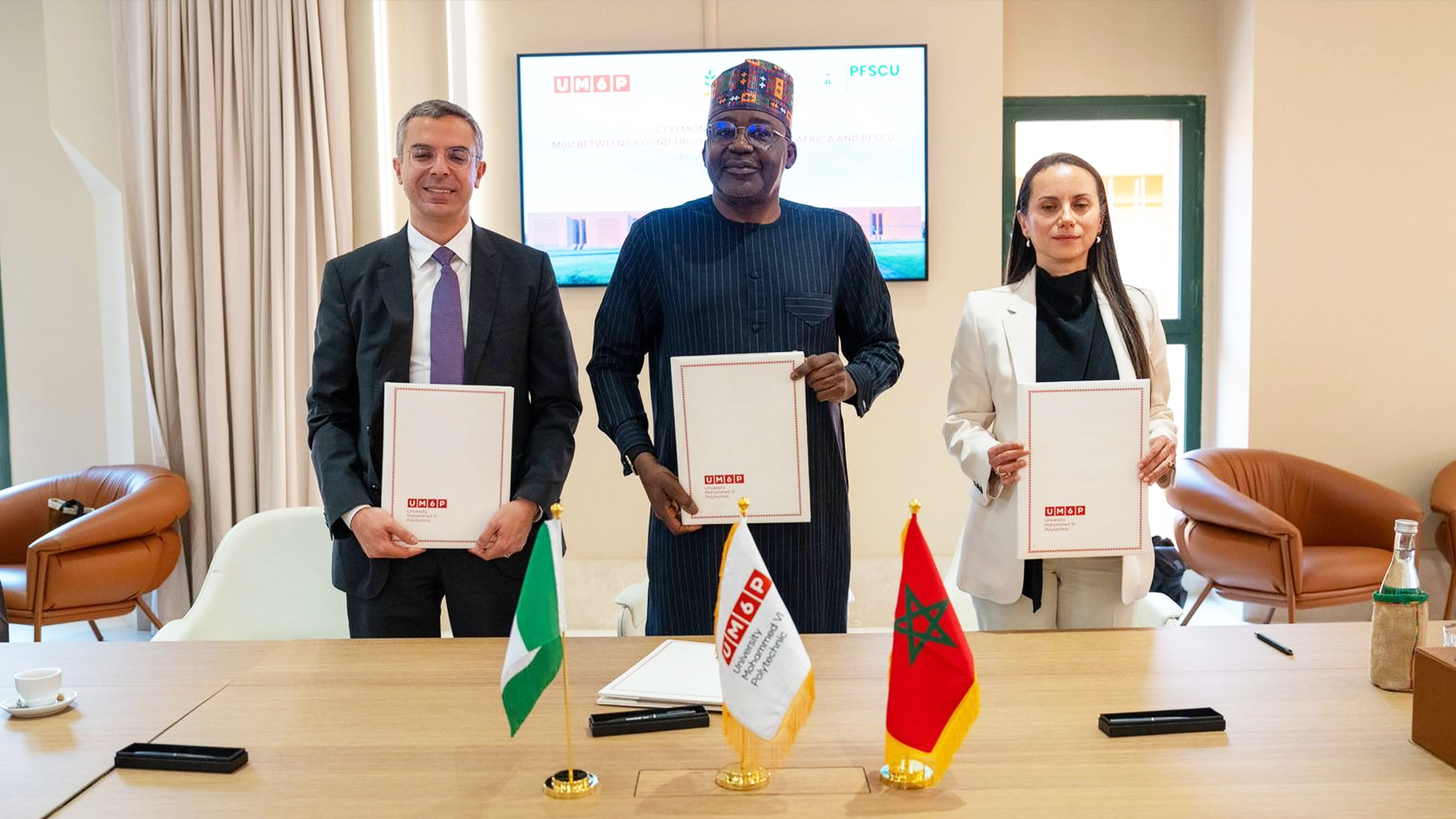
…Signs Morocco partnership to roll out real-time agricultural intelligence platform across 15 priority states
…Presidency says Nigeria must develop homegrown capacity in AI-driven agriculture
The Federal Government has taken a major step towards modernising Nigeria’s agricultural sector by signing a strategic partnership with Moroccan institutions to deploy an artificial intelligence (AI)- and satellite-powered crop monitoring system aimed at strengthening food security planning and agricultural decision-making across the country.
The initiative, which will initially cover 15 priority states, is expected to provide federal and state governments with real-time intelligence on crop cultivation, land use, production performance and emerging food security threats, enabling policymakers to respond more swiftly to shortages and improve agricultural planning.
The Memorandum of Understanding (MoU) was signed on Friday at the Mohammed VI Polytechnic University (UM6P) in Ben Guerir, Morocco, by the Deputy Chief of Staff to the President, Senator Ibrahim Hassan Hadejia, on behalf of the Federal Government, alongside Morocco’s OCP Africa and geospatial technology company, Ground Truth Analytics.
According to a statement issued on Saturday by the Technical Assistant to the President on Agriculture (Office of the Vice President), Marion Moon, Hadejia represented Vice President Kashim Shettima, who chairs the Presidential Food Systems Coordinating Unit (PFSCU), at the signing ceremony.

The agreement formally launched Nigeria’s National Agro-Productivity System (NAPS), the country’s first national crop monitoring platform powered by satellite imagery and artificial intelligence.
The platform will generate real-time data on crop yields, land availability, planting patterns and food security risks, giving governments at all levels access to timely information for agricultural planning, investment and policy coordination.
Speaking at the ceremony, Hadejia said Nigeria must move beyond merely adopting emerging technologies to developing indigenous expertise capable of adapting and improving them to suit the country’s peculiar needs.
“The challenges we face should inspire us to build the technologies, institutions and capabilities required to overcome them,” he said.
He noted that agriculture is increasingly driven by data, precision farming, artificial intelligence and geospatial technologies, stressing that Nigeria must position itself to become not only a consumer but also a developer of such innovations.
According to him, the new system will strengthen seasonal planning, boost productivity monitoring and provide reliable agricultural intelligence to support evidence-based policy decisions.
“Our ambition goes beyond deploying technology. We want to build a Nigerian capability managed by our institutions, supported by local expertise and sustained through knowledge transfer, institutional capacity development and continuous learning,” Hadejia added.
Earlier, Moon explained that NAPS was designed to address a longstanding weakness in Nigeria’s agricultural planning—the absence of reliable, in-season information on what farmers actually cultivate compared to what was initially projected.
She said inaccurate production estimates have often resulted in poor policy decisions on food reserves, imports and exports.
“We need visibility throughout the farming season. Farmers may declare one crop at the beginning of the season but eventually cultivate something different, leaving government planning based on assumptions rather than facts,” she said.
Moon described the National Agribusiness Policy Mechanism, under which NAPS operates, as a four-pillar framework balancing domestic production, strategic reserves, imports and exports to ensure national food security.
She disclosed that the framework, approved by the National Council on Agriculture and Food Security in November 2024, has already been piloted in 13 states across three planting seasons.
According to her, the pilot covered more than 250,000 farmers, surveyed over 50,000 farmers in more than 2,000 communities, tracked five priority crops and generated over one million agricultural data points.
Chief Executive Officer of OCP Africa, Alafifi Laadel, described the partnership as a long-term investment in Nigeria’s agricultural future rather than a conventional procurement arrangement.
She said the collaboration would focus on knowledge transfer, institutional strengthening and local capacity development to ensure Nigeria builds sustainable expertise in digital agriculture.
Demonstrating the technology, Chief Executive Officer of Ground Truth Analytics, Driss Kitane, explained that AI algorithms analyse satellite images every five days to automatically identify individual farms, determine the crops planted and monitor crop growth throughout the season without manual intervention.
“Every agricultural parcel is identified by artificial intelligence. The technology can operate at state, national and continental levels while continuously monitoring crop development,” he said.
Kitane noted that similar technology currently predicts Morocco’s national wheat production up to three months before harvest with between 90 and 95 per cent accuracy.
He added that financial institutions already use the platform for farmer credit assessments, while agricultural cooperatives in Ghana employ it to verify that beneficiaries cultivate the acreage declared when accessing loans.
On data protection, he assured that all Nigerian agricultural data would remain under the country’s control.
“Everything developed under this partnership will be sovereign to Nigeria. The platform will be hosted on Nigerian servers, and access to sensitive data will remain entirely under Nigeria’s authority,” he said.
He outlined a three-phase rollout beginning with a pilot in one state before expanding to three states and ultimately providing full crop intelligence and land-cover analysis across 15 priority states.
President and Director-General of Mohammed VI Polytechnic University, Hicham El Habti, welcomed the Nigerian delegation, revealing that Nigerian students account for about 60 per cent of enrolment in the institution’s English-language medical programme.
The partnership comes three years after President Bola Tinubu declared a national emergency on food security following the economic reforms of July 2023, which triggered sharp increases in food prices.
Nigeria’s food inflation climbed above 40 per cent in early 2025, while insecurity, climate shocks and weak agricultural data systems compounded the country’s food supply challenges.
The Federal Government delegation included officials from the Office of the Vice President, the Federal Ministry of Agriculture and Food Security, the Federal Ministry of Justice, the National Space Research and Development Agency, the Nigeria Governors’ Forum and other institutions supporting implementation of the National Agro-Productivity System.

