 Follow Us on Google News


 Follow Us on Google Discover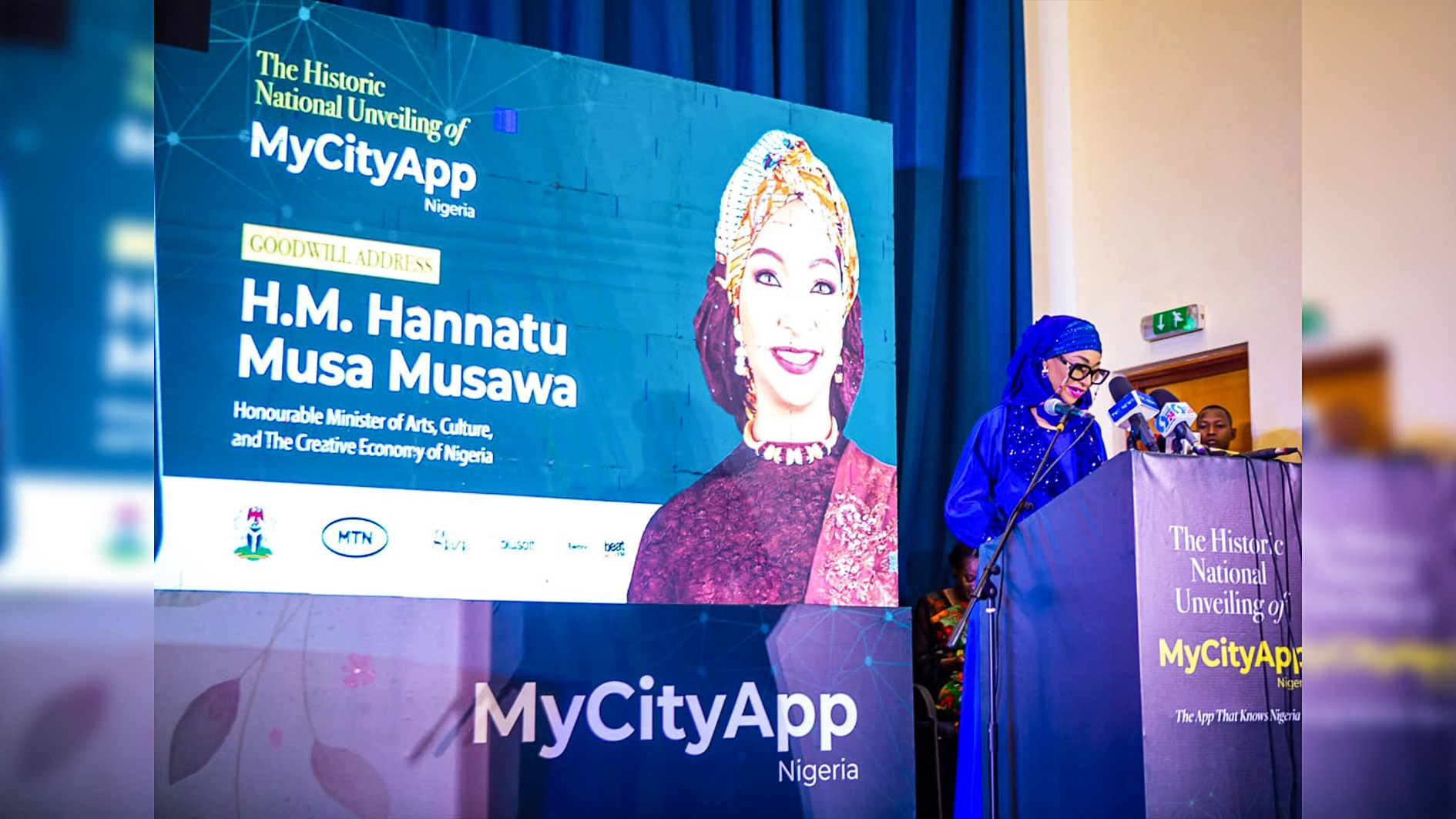
The Federal Government, in partnership with MTN Nigeria, has unveiled a nationwide digital platform, MyCity App, aimed at boosting tourism, deepening civic engagement and accelerating Nigeria’s transition to smart city governance.
Minister of Art, Culture and the Creative Economy, Hannatu Musa Musawa, who spoke at the national unveiling of the platform in Abuja on Thursday, described the initiative as a strategic tool to reposition Nigeria’s tourism sector and strengthen the interface between government, businesses and citizens.
Musawa said the platform aligns with the Renewed Hope Agenda of President Bola Tinubu, particularly the administration’s push to diversify the economy away from oil and unlock value in culture, tourism and the creative industry.
According to the minister, tourism in the digital era is no longer defined solely by destinations but by accessibility, safety, real-time information and seamless experiences.
She said: “We are not just unveiling an app; we are unveiling a vision where technology meets tourism, where government meets people, and where cities become smarter, safer and more connected.
“When a visitor lands in Nigeria, the first thing they reach for is their phone. If we are serious about positioning Nigeria as a global cultural hub, then information, services and experiences must be accessible at the touch of a button.”

She noted that Nigeria’s diversity from its cultural heritage to its varied landscapes across the North, South, East and West remains one of its strongest economic assets, stressing that technology can help package and present these assets to both domestic and international audiences.
Musawa linked tourism development to job creation and security, arguing that economically empowered communities are more likely to protect tourism assets within their environment.
She disclosed that the ministry is also advancing intellectual property reforms and copyright frameworks to strengthen Nigeria’s creative economy, projecting that the sector could significantly contribute to GDP growth and job creation by 2030.
“When you create tourism hubs and employ people within those environments, they take ownership. And when they take ownership, they protect it. Tourism can therefore play a role in addressing insecurity while expanding economic opportunities,” the minister added.
Managing Director/Chief Executive Officer of MTN Nigeria, Dr. Karl Toriola, described the platform as part of efforts to strengthen Nigeria’s digital economy.
Represented by the General Manager, Regional Operations, North West (Sales and Distribution), ThankGod Otorkpa, he said connectivity has evolved beyond voice and data services to become the infrastructure of opportunity.
Toriola added that integrating businesses and services on a single platform would drive inclusion, ensure transparency in payments and enhance civic trust.
“When we digitise a city, we democratise access. Whether you are in a boardroom in Abuja or in a market, government and economic services are now in your pocket.
“Telecommunications is the oxygen of a digital economy. Every real-time traffic update, verified business listing and service access depends on network robustness, and MTN is committed to providing that backbone,” he said.
He assured that the company would support nationwide deployment with enterprise-grade architecture capable of high reliability as user numbers grow.
Speaking on the technical architecture of the platform, General Manager, Architecture and Engineering, Information Technology at MTN Nigeria, Bukola Ajayi, said the application is designed for rollout across the 36 states and the Federal Capital Territory (FCT).
She explained that the core objective is to build a unified data layer for civic engagement, with a target of five million registered users and between 40 to 50 per cent daily active usage.
Among its key features, she listed traffic and mobility intelligence, government service payments, emergency and public safety access, business discovery, entertainment listings, jobs and housing information, as well as directories for government agencies and embassies.
Ajayi said the platform operates on a cloud-native, scalable architecture with a microservices framework to allow modular onboarding of states.
She said: “We have built in end-to-end data encryption, role-based access control and audit trails for government dashboards,” she said, adding that the system is mobile-first, adaptive to network conditions and capable of limited offline functionality for reporting purposes.
According to her, the platform will also provide governance intelligence through dashboards for policy decisions, revenue tracking tools, civic reporting e-maps, and urban mobility analytics.

