 Follow Us on Google News


 Follow Us on Google Discover
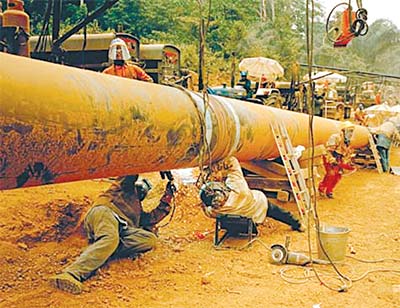 • As Niger Delta Rumbles Resume
THE crisis in the Niger Delta, which was held at bay since 2006 with the Amnesty programme of the late President Shehu Musa Yar’ Adua, seems to have resurfaced, as major pipelines carrying crude to Kaduna and Warri refineries were allegedly blown up by militants in the area last week. The two refineries recently went through Turn-Around Maintenance (TAM) and had just resumed production of refined petroleum products.
The activities of the insurgents attracted national attention because of its potential threat to the Nigerian state and the impact on its economy.
The Nigerian economy has a high level of dependence on oil. It is sustained majorly by the proceeds from exportation of oil and gas produced in the Niger Delta.
This, and the continued free fall of the price of crude at the international market are threatening the nation’s economy, and dashing the hope for the actualisation of the 2016 fiscal policy, especially if this development continues into midyear, because the country relies solely on proceeds of oil sale for survival
Although the Niger Delta problem has been around for many decades, the threat of outright rebellion against the Nigerian state became more obvious with the emergence of militant pressure groups protesting against perceived neglect of the region and environmental hazards imposed on local communities as a result of oil extraction activities by major oil companies.
Their agitation and subsequent destruction of the country’s economic wealth continued for many years, until Yar’ Adua’s amnesty programme, which made many of the militants surrender their arms to embrace peace that came with some sort of incentives, including foreign education for some of the beneficiaries.

Recent events indicate that the Niger Delta militants are back again in the trenches. Their return is said to have a link with arrest warrant issued against their erstwhile leader, Tompolo, by a Federal High court, where he is wanted to answer charges relating to corruption and illegal possession of Federal Government property.
The resurgence may spiral out of control with direct impact on oil production and the country’s economy, if not nipped in the bud.
Already, the recent attack on pipelines in the region has forced the Nigerian National Petroleum Corporation (NNPC) to shut down the Kaduna and Warri refineries, thus jeopardising efforts to refine 125, 000 and 110, 000 barrel per day respectively at the two refineries, which started operations last month.
The development may also frustrate the plan by government to reduce fuel importation due to the expected substitution with products from the refineries. They were expected to produce a total of 6.2 million litres of PMS monthly.
Already, the recent attack on pipelines in the region has forced the Nigerian National Petroleum Corporation (NNPC) to shut down the Kaduna and Warri refineries, thus jeopardising efforts to refine 125, 000 and 110, 000 barrel per day respectively at the two refineries, which started operations last month.
Specifically, oil and gas pipelines in the creeks of Gbaramatu Ugborodo and Egbema were damaged during the attacks.
According to reports, the gas pipeline, which run from Olero creeks in Escravos was destroyed, crude lines were sabotaged, while many others in other creeks were bombed.
The renewed insurgency in the region may dampen the hope and expectation of raising crude oil production capacity to three million barrels per day by the end of the year, according to NNPC projection, although the Federal Government in 2016 budget estimate reduced it to 2.3 million bpd. This may become unrealistic, if the renewed insurgency is not put under control now.
That alone would cause the total collapse of the economy, as the budget estimate of N6.5trn would become unachievable due to the monolithic nature of the Nigerian economy.
At the peak of insurgency in the region in 2001, the militants who love to be called freedom fighters almost succeeded in their threats to cripple the Nigerian oil industry, which holds the key to the economy.
As it was then, so it is today with the proliferation of militant groups and sophisticated nature of their attacks.
The Nigerian nation was taken aback in 2008, when the militants moved into the deep-sea operation area to attack Nigeria’s largest offshore oil platform, the Bonga oil platform.
Reports said the operation almost grounded oil business in Nigeria. That attack alone made the country to cede its position as the largest oil exporter in Africa to Angola. The Bonga oil platform produces 225,000 barrels of crude oil per day. The Atlas cove oil facility attack in Lagos by the same Niger Delta militants in 2009 demonstrated the capacity of the militants to wreak havoc on the Nigerian economy.
The spate of militancy in that region had made the Nigerian oil fields among the most dangerous in the world.
Various studies indicated that apart from the cost of military control on the insurgency, total as result of stolen crude (bunkering) and disrupted oil production between 2003 and 2008 was N14trn.
The Ledum Mitee-led Technical Committee on the Niger Delta estimated that Nigeria lost about N8.84 trn or $61.6b to oil theft. The report showed that in 2006 alone, a total cost of oil loss due to the activities of militants was N2.45 trn or $272b, while an additional N283b or $1.9b was lost to oil bunkering. In 2007, the country also lost N2.69trn or $18.8b to the debilitating Niger Delta crisis. Again, Nigeria lost an estimated revenue of about N2.97trn to attacks on oil installation resulting in shut downs and spillages in the first nine months of 2008.
Statistics reveal that from a peak production of an average of 2.1million barrels per day, achieved in March 2008, Nigeria’s oil production declined to 1.7m in June, same year. Due to the Nigerian Military onslaught in Gbaramatu kingdom in Delta State, oil production hovers between 800,000 barrels and 1.2m barrels per day till November 2009.
The degree of shut in production also varies among companies exploring and extracting oil in the region. Shell Petroleum Development Corporation (SPDC), which accounts for about 60 per cent of Nigeria’s production, suffered the most disruptions in its operations. From a previous production capacity of about one million barrels per day, Shell’s production delivery drastically reduced to an alarming 140,000 barrels per day as at June 2009 due to production shut ins, representing about 85.9 per cent drop in production output. Production output in Nigeria began to appreciate with the militants’ acceptance of the Presidential Amnesty.
The Nigerian Petroleum Development Company (NPDC), the upstream arm of the NNPC has, before now, increased its crude petroleum capacity by 70,000 barrels per day with its current production capacity of 220, 000 bpd, which it expected to increase to 350,000 bpd by the end of the year.
That target may be difficult to achieve with the renewed insurgency in the region, which if sustained and in addition to the continued free fall of the oil price at the international market, could push Nigeria into bankruptcy, a situation that could be worse than that of Greece.
Stakeholders in the oil and gas sector have reacted to the new wave of militancy in the Niger Delta region, saying it would definitely affect the country’s oil production projection and the 2016 budget.
Mr. Afe Mayowa, President of the Association of explorationists, says the resurgence and the subsequent destruction of oil pipeline could amount to double jeopardy for Nigeria that is grappling with dwindling fortunes from oil, due to free fall of the price at the international market.
In his view, the cost of production per barrel of crude oil in Nigeria has gone above the price of the commodity at the global market, adding that with the renewed activities by the Niger Delta militants, the oil firms may embrace the option of shutting down their facility.
“Nigeria is facing a lot of difficulties currently. The sanction on Iran has been lifted and the consequence is that it will soon flood the market with crude. That will be a precarious situation for Nigeria. A lot of companies will be forced to shut down their facilities, which will impact negatively on the 2016 fiscal policy. The target in the policy is 2.0m bpd and the militants, if not checked, could constitute a big disaster to that projection,” he said.
On the cost of production, Mayowa said, “The cost of production today in Nigeria is much higher than the selling price of the crude. We are producing in deep water, where you need a lot of facilities. Today, the total cost of production per barrel is $31 against the selling price of $28. That is a loss of $3 already and now their pipelines are being blown up. They will just shut down and vacate the country. Already, we have $10 less than what we projected in the budget. So, you can imagine if we are not producing at all because of this problem.”
He advised Niger Delta people to see the ongoing fight against corruption as a fight against the ills of the society and not against them, as many prominent personalities from other regions have since also been arrested by the anti-graft agency.
Besides the Niger Delta re-insurgency, another thorny issue constituting a menace to the country is the fallen oil price. It fell from its peak of $120 per barrel in 2014, to its lowest ever at $27 per barrel, and still falling. The naira is also compounding the problem, as many forces have combined to create its devaluation against international currencies, including the green back.
Inflation is at hyper level, as big time players are auctioning stocks, as a result of the declining value of the Nigerian currency.
The 2016 budget is at the receiving end because the benchmark of crude at $38 per barrel is no longer feasible. At that price, Nigeria is already in deficit budget of about $10 per barrel, even when the price is predicted to go as low as $15 per barrel.
Experts are beginning to see it as a threat to the Nigerian economy, because it will compound the problem, even as Nigeria has for three consecutive months been suffering from low sale of its crude commodity.
The Chief Executive Officer, RTC Advisory Services Ltd., Yemi Agbaje, said the situation not only threatens the actualisation of the 2016 fiscal policy, but the economy too, adding that the situation demands radical solutions.
“The fall in price of crude and the crash of the naira against foreign currencies is an existential threat that puts Nigeria in a radical situation, which calls for radical changes. In addition to these threats, Nigeria has a budget deficit of N2.2 trillion, and is till rising, and there is a level of uncertainty as to how to meet the deficit. Although it is good that there is no provision for subsidy in the 2016 budget, and exchange rate is at N197, but if oil prices sink lower, and the naira value plummets again, it will become an issue for the government, which may have to reconsider subsidy again.”
The Director General, Lagos Chamber of Commerce and Industry (LCCI), Muda Yusuf, took an insight into the benchmark and said, “evidently the $38 per barrel oil price benchmark assumption does not appear sustainable, given the continuous plunge in oil price.”
The Managing Director, Consolidated Management Consultants Ltd, Dele Oguntebi, who also observed that government, may have difficulty realising the budget said, “Actualisation of the 2016 budget is under threat with the free fall of the oil price.
“Details available indicate that the budget is a deficit one. The fall in the oil price also portends a poor flow of Foreign Direct Investment (FDI) into the country, since profitability projections of investors, who may want to invest in oil, are no longer realistic. The chances of losing investment are high. Many have applauded the budget only to realise, however, that it may have to be adjusted from time to time to meet current realities.”He advised government to explore internal revenue generation before borrowing to fund the budget.

