 Follow Us on Google News
 Follow Us on Google Discover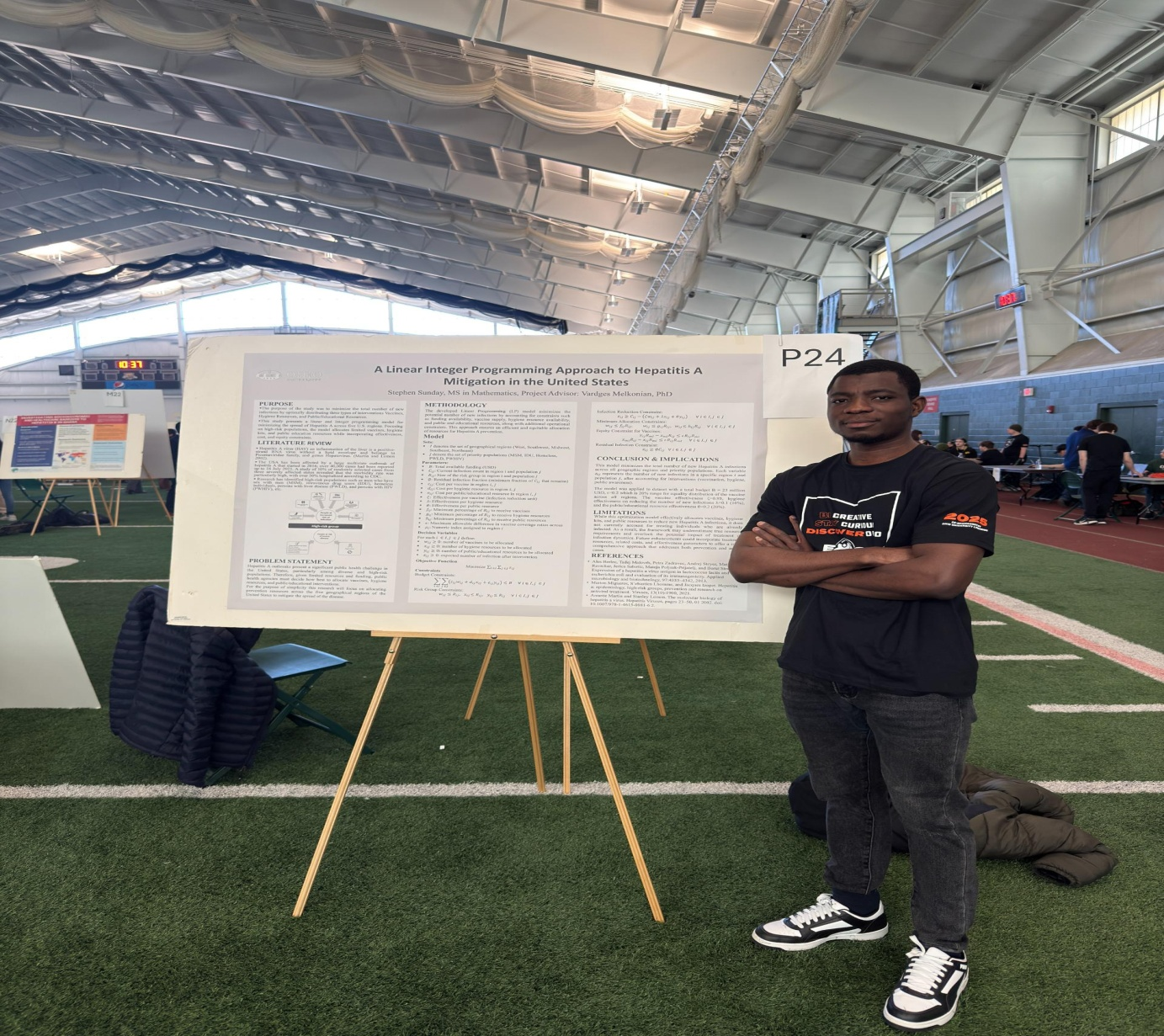
In a generation where global health outcomes increasingly depend on data-driven decisions, Stephen Adebowale Sunday is redefining the role of mathematics, not as a figurative academic pursuit, but as a practical tool for saving lives. As a mathematical scientist and public health innovator, Stephen is innovating using predictive modelling to improve how communities foresee and handle public health crises.
His journey is a remarkable mix of academic excellence, interdisciplinary impact, and international relevance. Having obtained a First-Class degree in Pure and Applied Mathematics from Ladoke Akintola University of Technology (Nigeria), and now pursuing a Master’s in Mathematics at Ohio University, Stephen is rising through the ranks at the intersection of epidemiological modelling, global development, and mathematical optimisation.
Stephen’s most groundbreaking work lies in applying mathematical models to real-world public health challenges. In one of his recent projects, he developed a linear integer programming framework to optimise Hepatitis A mitigation strategies in the U.S.A. His model provides fact-based guidance for efficient resource allocation and outbreak response planning, a feat that gained recognition at the Ohio University Student Expo.
His research also encompasses mental health modelling, where he co-developed a compartmental mathematical model to imitate the spread and management of psychological illnesses in the United States. Currently under peer review, this work identifies critical intervention points and demonstrates how mathematical simulation can reduce systemic strain in mental healthcare.
These are not casual academic exercises. Stephen’s models offer practical, walkable tools that public health systems—especially in resource-limited countries like Nigeria—can adopt to fight against infectious diseases such as cholera, Lassa fever, and malaria. By simulating outbreak trajectories and evaluating response strategies in advance, his predictive models equip governments with foresight, not just hindsight.
Stephen’s inputs are uniquely suited to Africa’s health infrastructure. In nations where health systems are fragmented and real-time data is sparse, his work presents a powerful opportunity which, when effectively harnessed, utilises low-cost mathematical models to predict disease spread, enhance surveillance, and optimise emergency response.
His vision extends even beyond that. He aims to establish a West African Public Health Modelling Hub—an interdisciplinary centre where mathematicians, epidemiologists, and data scientists will collaborate to generate locally custom-made solutions for global health threats. This initiative will focus on building capacity for real-time disease forecasting, health system resilience, and policy modelling, while ensuring the training of a new generation of scientists in the process.
Stephen’s dedication to social good and global equity is not confined to theoretical work alone. While interning at Save the Slum Initiative, his research led to securing a $10,000 UNICEF-backed grant to support vulnerable communities across Nigeria, Ghana, and Togo. He also served as Research Lead for Education at AFRINYPE, leading multi-country youth development and education programs that impacted over 1,500 students across West Africa.
He is also a consistent advocate of community-based impact. In Ohio, he has volunteered with Community Food Initiatives, served as a grant reviewer, science fair judge, and academic mentor, contributing to student empowerment and STEM development. His professional affiliations include the American Mathematical Society and the Mathematical Association of America, reflecting his standing within the U.S. and international academic communities.
Stephen’s skill set bridges theory and application. He is proficient in Python, R-Studio, AMPL, MATLAB, and SQL, applying these tools to machine learning, optimisation, and simulation of public health systems. His co-authored research on generalised Poisson distributions, alongside multiple applied modelling projects, speaks to his depth of scholarship and growing body of peer-reviewed work.
He has received several awards, including Best Undergraduate Thesis in Mathematics, a University Baptist Church Best Graduating Student Award, and multiple certificates of academic service and leadership, both in Nigeria and the U.S.
Stephen’s success is not just his own but rather a clear indicator of what Nigerian talent can accomplish when nurtured and supported. As nations around the world compete for intellectual capital, Nigeria must take deliberate steps to retain and invest in exceptional minds like Stephen’s. His story is a wake-up call: without structured support for research, innovation, and scientific infrastructure, Nigeria risks losing its brightest minds to the diaspora.
By providing robust funding, institutional support, and opportunities for collaborative research, the Nigerian government can not only prevent brain drain but also build a resilient, data-driven public health system that serves the nation from within. Stephen’s vision of a modelling hub in West Africa should not remain a dream, but rather a national priority.
Stephen believes that mathematics, when applied intentionally, can help societies predict, prevent, and prepare. His long-term goal includes partnering with international health organisations to adapt predictive models for early detection and timely response to emerging epidemics, especially across Africa.
For Stephen Adebowale Sunday, mathematics is not abstract; it is personal, actionable, and life-saving. His work is helping build a future where nations don’t merely react to health crises but anticipate them intelligently. Through innovation, leadership, and unwavering commitment to public health, he is proving that math isn’t just part of the solution—it can be central to global health resilience.

