 Follow Us on Google News
 Follow Us on Google Discover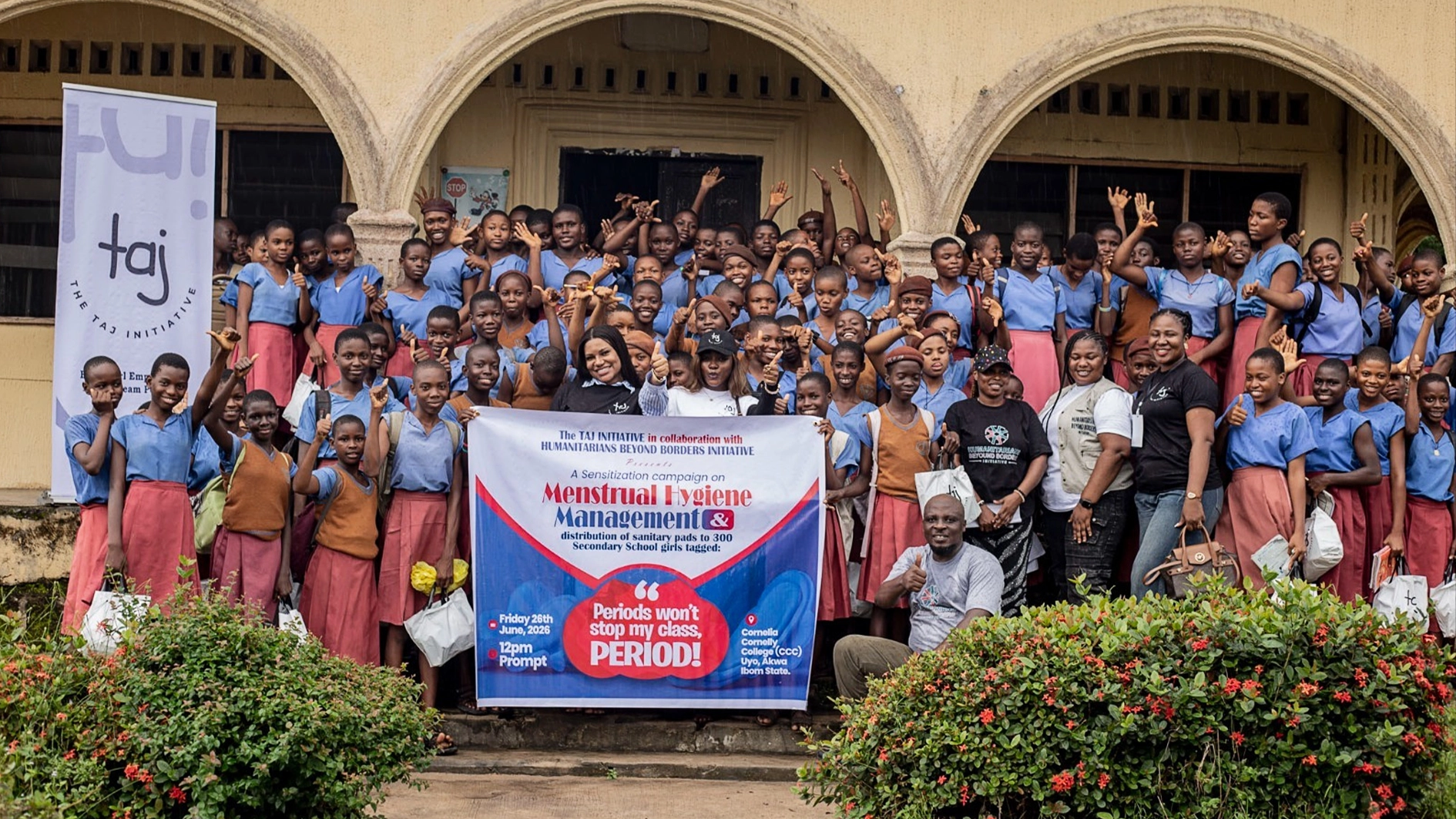
Humanitarians Beyond Borders Initiative (HUBBI), in partnership with the TaJ Initiative, has organised a menstrual hygiene management (MHM) sensitisation programme and distributed dignity kits to 300 secondary school girls under its Strengthening School Retention for Girls Project.
The campaign, tagged “Periods Won’t Stop My Class, Period!”, is designed to improve girls’ knowledge of Sexual and Reproductive Health and Rights (SRHR) while promoting confidence, dignity and uninterrupted school attendance during menstruation.
The campaign also conveys a clear message from the girls themselves—that menstruation, menstrual cramps or any other menstrual-related experience should never prevent them from pursuing their education.
The initiative, which will be replicated across several states, particularly in Nigeria’s North-East, commenced at Cornelia Connelly College, Uyo, Akwa Ibom State.
Ahead of the programme, the HUBBI team conducted a safeguarding risk assessment to ensure the intervention complied with the organisation’s safeguarding standards and the humanitarian ‘Do No Harm’ principle.
For many adolescent girls, menstruation remains a major cause of absenteeism, low self-confidence and reduced classroom participation. Limited access to menstrual hygiene information and sanitary products also continues to affect the education and well-being of girls across Nigeria.
Speaking at the event, the Chief Executive Officer of HUBBI, Gregory Okonofua, stressed the importance of menstrual hygiene education, describing menstruation as a natural biological process experienced by women over several decades.
He encouraged the students not to allow menstruation to become an obstacle to achieving their educational goals.
The sensitisation session was facilitated by HUBBI’s Sexual and Reproductive Health and Rights (SRHR) Specialist, Joy Essien, who engaged participants through interactive discussions, practical demonstrations and experience-sharing sessions that encouraged the girls to ask questions freely.
Topics covered included understanding menstruation, proper use and disposal of sanitary pads, personal hygiene during menstruation, breaking menstrual myths, building confidence, staying safe and seeking support.
One of the highlights of the programme was a practical demonstration on the correct use and disposal of sanitary pads, with several students volunteering to demonstrate the process.
Co-Chief Executive Officers of the TaJ Initiative, Tonia Anthony and Joy Bassey, also participated in the event.
Addressing the students, Anthonia, an alumna of Cornelia Connelly College, shared her personal journey and encouraged the girls to remain focused on their education and believe in their potential.
“I once sat in this same hall listening to speakers who inspired us. I told myself that one day I would also make a difference. Today, I stand before you to encourage you that one day you too will stand here and inspire other girls,” she said.
Bassey also shared her experience of her first menstrual period and offered practical advice on managing menstrual cramps and seeking support when necessary.
The interactive session gave many students the confidence to share their own experiences. While some revealed that severe menstrual cramps had caused them to miss classes, others expressed concern over the rising cost of sanitary pads, which sometimes forces girls to resort to unsafe alternatives.
Feedback from participants indicated that only about 30 per cent of the girls had previously received formal menstrual hygiene education, underscoring the need for more awareness programmes in schools.
One of the participants, Idongesit, a JSS3 student, said the programme had broadened her understanding of menstrual hygiene.
“This is my first time attending this kind of training. I am very happy because I learned many things about menstrual hygiene that I did not know before,” she said.
Another participant, Nyakdu, an SS1 student who took part in the practical demonstration, said she gained confidence and learned better ways to manage menstrual cramps while in school.
Following the sensitisation programme, the organisers distributed dignity kits containing sanitary pads, wipes, shaving sticks, antiseptic soap and other personal hygiene items to 300 carefully selected students.
Additional cartons of sanitary pads were donated to the school management to establish an emergency supply for girls who unexpectedly begin their menstrual periods while at school.
The Principal of Cornelia Connelly College, Mrs Caroline Udofia, thanked HUBBI and the TaJ Initiative for selecting the school for the intervention.
She described menstrual hygiene education as essential and disclosed that she personally donates sanitary pads to the school clinic to ensure emergency supplies are always available for students.
The organisers said the initiative reflects HUBBI’s commitment to improving girls’ health, dignity, protection and access to education through practical, evidence-based interventions.
As the campaign expands to more schools across Nigeria, the organisation said it remains committed to ensuring that no girl misses school or loses confidence because of menstruation.
HUBBI is a registered non-profit organisation with the Corporate Affairs Commission (CAC), with its country office in Damaturu, Yobe State. The organisation works across the humanitarian-development nexus, implementing programmes in education, child protection, water, sanitation and hygiene (WASH), livelihoods and youth development.
In 2024, with support from Pyxera Global, HUBBI developed the RAYUWA STEM Manual to strengthen teachers’ capacity to deliver science, technology, engineering and mathematics (STEM) education in schools.

