 Follow Us on Google News


 Follow Us on Google Discover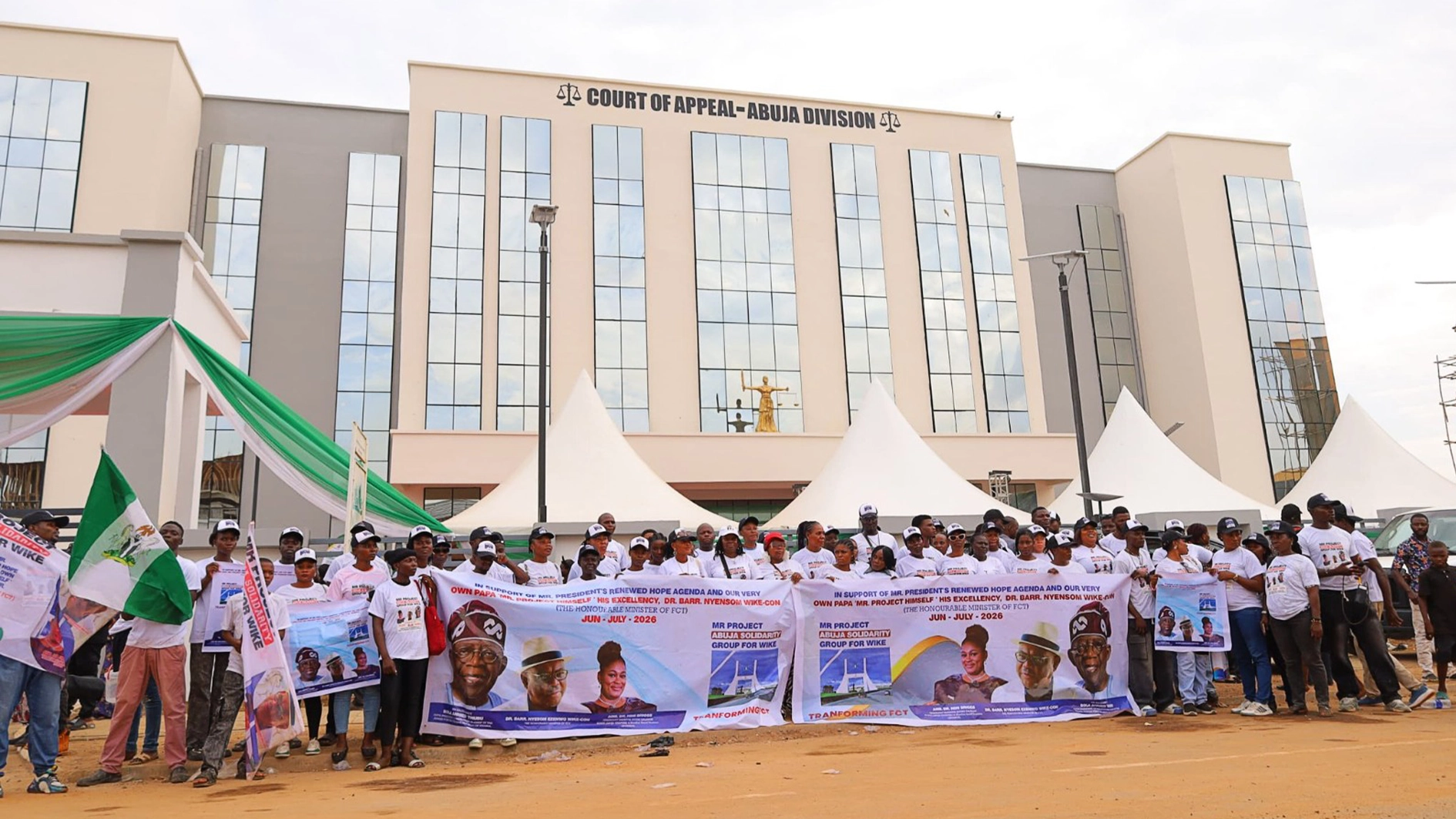
President Bola Ahmed Tinubu on Monday declared that meaningful judicial independence cannot be achieved without providing judges and judicial officers with adequate infrastructure and conducive working conditions.
He made the assertion as he commissioned the newly completed Court of Appeal Abuja Division Building Complex in Dakibiyu, Abuja.
The President, who was represented by Vice president Kashim Shettima, described the edifice as a symbol of his administration’s commitment to the rule of law and institutional renewal.
He said the project reflects the determination of the Federal Government to strengthen the judiciary under the Renewed Hope Agenda.
“It is with great pride that I stand here today in Dakibiyu to commission the Court of Appeal, Abuja Division Building Complex. This is not just a building. This is a statement. A statement that under the Renewed Hope Agenda, the rule of law will have a befitting home,” Tinubu said.
He recalled that the Abuja Division of the Court of Appeal had for years operated from a cramped and temporary facility, a situation he considered unacceptable for an institution entrusted with dispensing justice.

“A nation that seeks justice must respect the temple of justice. When I visited and saw the condition, I gave a simple instruction: fix it. Today, we have fixed it,” he stated.
The President commended the Minister of the Federal Capital Territory (FCT), Nyesom Wike, for delivering the project within the stipulated timeframe, describing him as “Mr. Project.”
According to Tinubu, the minister demonstrated exceptional commitment after receiving the assignment in May 2024, mobilising contractors to site within two months and ensuring completion of the project without variation in cost.
The President noted that the world-class facility, comprising two large courtrooms and eight smaller ones, would enhance the speedy dispensation of justice, reduce case backlogs, and improve access to justice for residents of the Federal Capital Territory.
He added that the project aligns with his administration’s agenda of improving governance through judicial reforms, increased funding, digitisation of court processes and provision of adequate accommodation for judicial officers.
Tinubu assured judicial officers that the government would continue investing in the sector to ensure that courts are equipped to meet the demands of modern justice administration.
“My Lords, you serve this nation under immense pressure. The Abuja Division carries a heavy docket. From election petitions to constitutional matters, the eyes of Nigeria are on you. You deserve an environment that matches the weight of your responsibility. This complex is not a favour. It is your right. And we will do more,” he said.
Earlier, the Attorney-General of the Federation and Minister of Justice, Lateef Fagbemi (SAN), described the commissioning as a historic milestone for the Nigerian judiciary and democracy.
He said the project, which coincides with the 50th anniversary of the Court of Appeal, represents one of several interventions by the Tinubu administration aimed at strengthening judicial independence and effectiveness.
Fagbemi argued that no administration in recent history had provided the level of support currently being enjoyed by the judiciary, citing the over 300 per cent increase in the remuneration and welfare package of judicial officers, expansion of judicial infrastructure and appointment of judicial officers to fill vacancies at the Supreme Court.
“This support has been comprehensive, deliberate and transformational, covering judicial welfare, infrastructure, institutional capacity and judicial manpower,” he said.
According to him, the interventions have enhanced the capacity of courts to manage caseloads, improved working conditions for judges and boosted public confidence in the justice system.
In his remarks, Wike stressed that judicial independence cannot be discussed in isolation from the quality of infrastructure available to judicial officers.
“You can’t talk about the independence of the judiciary when the judiciary does not have a fitting environment where they can carry out their functions. How do you talk about independence when somebody cannot comfortably carry out his or her duties?” he asked.
The minister disclosed that the FCT Administration had embarked on an ambitious programme to provide residential accommodation for judges and justices of various courts operating within the territory, including the Court of Appeal, Federal High Court, National Industrial Court and the FCT High Court.
He revealed that while residences for Court of Appeal justices and Federal High Court judges had been completed, additional housing projects for judges of the Industrial Court and members of the Code of Conduct Tribunal would soon commence.
Wike also highlighted the growing scale of infrastructure delivery under the Tinubu administration, noting that the FCT had expanded its project commissioning programme from nine days during the President’s first anniversary in office in 2024 to 31 days in the third year of the administration.
He commended the indigenous contractor, Visible Construction Limited, for delivering the project on schedule and urged residents of the FCT to fulfil their civic obligations, particularly the payment of ground rents and other statutory charges, to sustain infrastructure development.
The newly commissioned Court of Appeal Abuja Division Complex is expected to significantly improve judicial operations in the nation’s capital and further strengthen the administration of justice in Nigeria.

