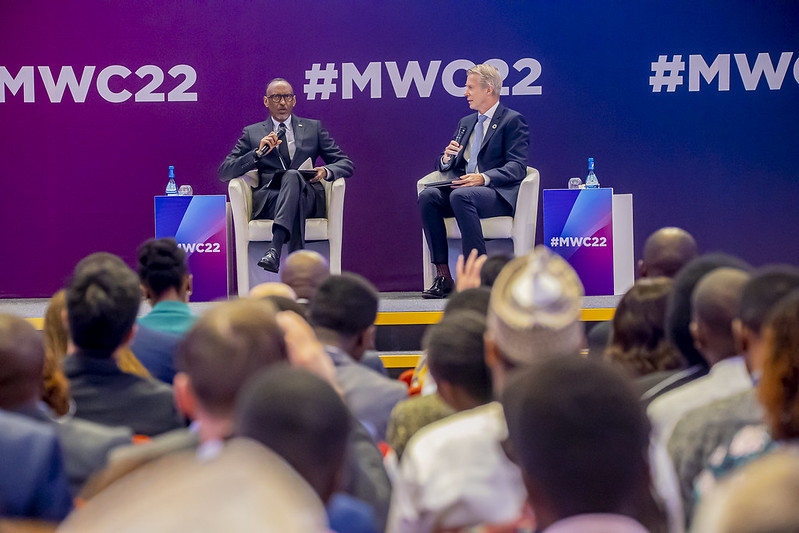
The Mobile World Congress MWC Africa took place in Kigali, the capital of Rwanda from Tuesday, October 25 to Wednesday, October 26, 2022. According to MWC Africa; “2022 saw the Shared Value Africa Initiative (SVAI) and the GSMA form a partnership to bring together the Africa Shared Value Leadership Summit and the Mobile World Congress Africa (MWC Africa).
Being a first for Africa and the global Shared Value community, this partnership gathered major players across sectors to explore and evolve innovation, technology, inclusion, opportunities and find solutions for the connectivity challenges that Africa faces. The collaboration also created the ideal chance to connect, network, explore partnerships and engage with clients and relevant stakeholders.”
The two-day summit was unique and distinct in its’ entirety and delivery as delegates I interacted with attested to. I sought the views of some delegates.
Muyiwa Matuluko, who is the Editor-in-Chief of Tech Point Nigeria stated that; “The inaugural MWC Africa, for me, reaffirmed that Africa indeed is a stakeholder in the global digital economy.”
On how the mobile and digital spheres impact his profession or industry; he stated that; “We are a digital-first media company with a primary focus on technology and how it affects business, culture, and lifestyle. And so, the mobile and digital spheres not only impact our work, but are also integral to what we do.”
On his takeaways from the MWC Africa 2022, The Editor-in-Chief of Tech Point opined that; “Africa is definitely a stakeholder in the global digital economy. Also, some of the best innovations in the coming decade will be of African origin.”
Uchechi Ibeku who is a senior associate at Advocaat Law Practice in Nigeria described the just concluded Mobile World Congress Africa 2022 “as an extremely well-organized conference with very insightful sessions.”
On how the mobile and digital spheres impact her legal profession, she posited that; “The world has moved to the technological era where it is impossible to carry on everyday activities without some sort of technology or the other. A lot of activities in the legal industry rely on technology, such as virtual meetings and conferences.”
Her takeaways from the MWC Africa 2022 were summed up in one sentence; “In short, Africa has to collaborate to free itself.”
Eche Emole, the CEO of Afropolitan described the event in his own word as; “the Mobile World Congress Africa 2022 brought together trailblazers and innovators in the digital and telecommunications space.”
On how the mobile and digital spheres impact Afropolitan, he stated that; “At Afropolitan, we are working on building the first-ever internet country. We have seen the creation of new companies and currencies on the internet, such as Google, Facebook, and Bitcoin. This has led us to wonder: is it possible to create a new digital country on the internet? The mobile and internet technology will play a central role in our work at Afropolitan.”
He started that his takeaways from the MWC Africa 2022 are; “On the role of governance in fostering a thriving ecosystem is also critical. I was glad to see the keynote by His Excellency Paul Kagame, as Rwanda serves as an inspiring example of what can be achieved when hardworking people come together to overcome challenges.”
Angela Wamola, Head of Sub-Saharan Africa, GSMA stated that; “MWC Africa was a great success with the support offered by the Government of Rwanda. We are honoured to have been graced by His Excellency President Paul Kagame, the President of the Republic of Rwanda; who was joined by Mr. Mats Granryd, the Director General for GSMA to kick off the event. Our first in-person edition of MWC Africa showcased the massive potential of the mobile economy for people across Africa through dialogue held by over 120 speakers, all in one accord, exploring the technology themes such as Leadership for Connectivity; One People – One Purpose; Accelerate Africa and Fintech to advance Africa to the digital economy. The event brought together a variety of industry sectors, business leaders and policymakers with the region’s mobile ecosystem to discuss the continent’s ambition to enhance the power of connectivity. Hosting the event in Rwanda was also a natural choice as the country has been an incredible leader in prioritising digital acceleration for all of its citizens; transforming the lives of its people through innovations like mobile money, pay-as-you-go systems and solutions, education apps and so much more.”
Wamola stated further that; “Hosting MWC in Africa has always been a priority for GSMA as Africa is one of the global hubs for mobile connectivity and growth. Africa is home to a creative and tech-savvy youth who are looking for the right platforms to contribute solutions and the continent stands at a unique moment in time. Over the past two decades, mobile growth across Sub-Saharan Africa has been phenomenal.
Today, forty-six percent of the population is connected and subscribed to mobile services, rising to fifty percent by 2025. In 2021, mobile technologies and services generated around eight percent of Gross Domestic Product across Sub-Saharan Africa, supporting 3.2 million jobs across the region. This will have a massive enablement effect on digital and socio-economic growth on the continent. To help continue this momentum and improve mobile adoption on the continent, the consensus from industry players and policymakers leaned towards focusing on encouraging investment in much-needed infrastructure, lowering the gender gap, literacy and training, increasing affordability and improving consumers’ ability to access digital services in their local languages.”
On how the mobile and digital spheres impact her profession and industry; Angela Wamola stated that; “As the GSMA, we are a global organisation that unifies the mobile ecosystem to discover, develop and deliver innovation foundational to positive business environments and societal change. We represent mobile operators and organisations across the mobile ecosystem and adjacent industries. We are the catalyst for bringing such crucial players together by providing the world’s largest platform to convene the mobile ecosystem at the MWC series of events, such as MWC Africa in Kigali and MWC Barcelona.
The work that we do addresses the collective interest of the mobile industry and of mobile operators in particular. We are driving change in the areas of spectrum allocations to help meet the fast-growing demand for mobile broadband and leading public policy discussions to help the mobile industry maximise development opportunities for mobile operators and long-term benefit for mobile users. For example, by driving GSMA Mobile For Development (M4D) initiatives to help underserved people in emerging markets. GSMA M4D is uniquely positioned at the intersection of the mobile ecosystem and the development sector. Our work has impacted 126 million lives to date and still counting. At MWC Africa, we hosted our first dedicated “Development Theatre”, where attendees learned how M4D stimulates digital innovation to deliver both sustainable business and large-scale socio-economic impact for the underserved.”
Angela Wamola had several takeaways from MWC Africa 2022; “As our Director General Mats Granryd said during his keynote at MWC Africa, Africa stands a unique moment in time. As the continent embarks on a journey to “digital everything”, it is important that we continue working on the basis that no sector can get there alone. Mobile connectivity and connected technologies are enablers, supporting countries as they build forward better in pursuit of economic recovery and resilience. During MWC Africa, I was inspired by the collaboration and urgency understood by key stakeholders to bridge the digital divide for building inclusive, sustainable societies across Africa. In fact, cooperation between the mobile industry players and the government is critical to make digital inclusion a genuine priority and a reality.
Removing barriers to mobile internet adoption will boost economic recovery, improve social mobility and gender equality and transform the lives of millions of people in Africa. Already, we are seeing that digital inclusion is a key priority for African governments and more industry players are putting up their hands to help digitally upskill people. In 2021, the mobile ecosystem supported more than 3.2 million jobs (directly and indirectly) and made a substantial contribution to the funding of the public sector, with $16 billion raised through taxes on the sector.”
Wamola further posited that; “By 2025, mobile’s contribution to the GDP of Sub-Sahara Africa will grow by $65 billion (to almost $155 billion), as the countries in the region increasingly benefit from increased take-up of mobile services. By 2025, 4G will account for a third of mobile connections in the region, compared to under a fifth of connections in 2021. Additionally, by the end of this decade, there will be more than 340 million 5G connections in Africa, to further improving connectivity for homes and enterprises, enabling the digital transformation of enterprises, boosting tech innovation and meeting the connectivity needs of young people.
Mobile connectivity has a greater reach in Africa than any other technology, making it an important enabler of social and economic progress in each region of the African Continent. However, more still needs to be done for the whole continent to be digitally included. Today, forty-six percent of the population in Sub-Saharan Africa is connected and subscribed to mobile services. This is set to rise to fifty percent by 2025.
This means there will still be fifty percent of the population not subscribed to mobile services. A lack of internet access holds people back from playing an active role in an increasingly online world; and prevents them from being able to access critical information and services such as healthcare, education, e-commerce, financial services and income-generating opportunities. That is why it is important for us to bring together people to meet, engage and inspire discussions on the future of the mobile industry. To support Africa’s digital gap, it will need cooperation and collaboration from the right people and a community of attendees from across sectors in the same room. An event such as MWC Africa gives us an unprecedented opportunity to truly push the boundaries of mobile innovation. We welcome you to attend next year at MWC Africa 2023, which would also take place at the Kigali Convention Centre in Rwanda from 17th to 19th October 2023.”
Dolapo Aina writes from Kigali, Rwanda.
[ad unit=2]