 Follow Us on Google News


 Follow Us on Google Discover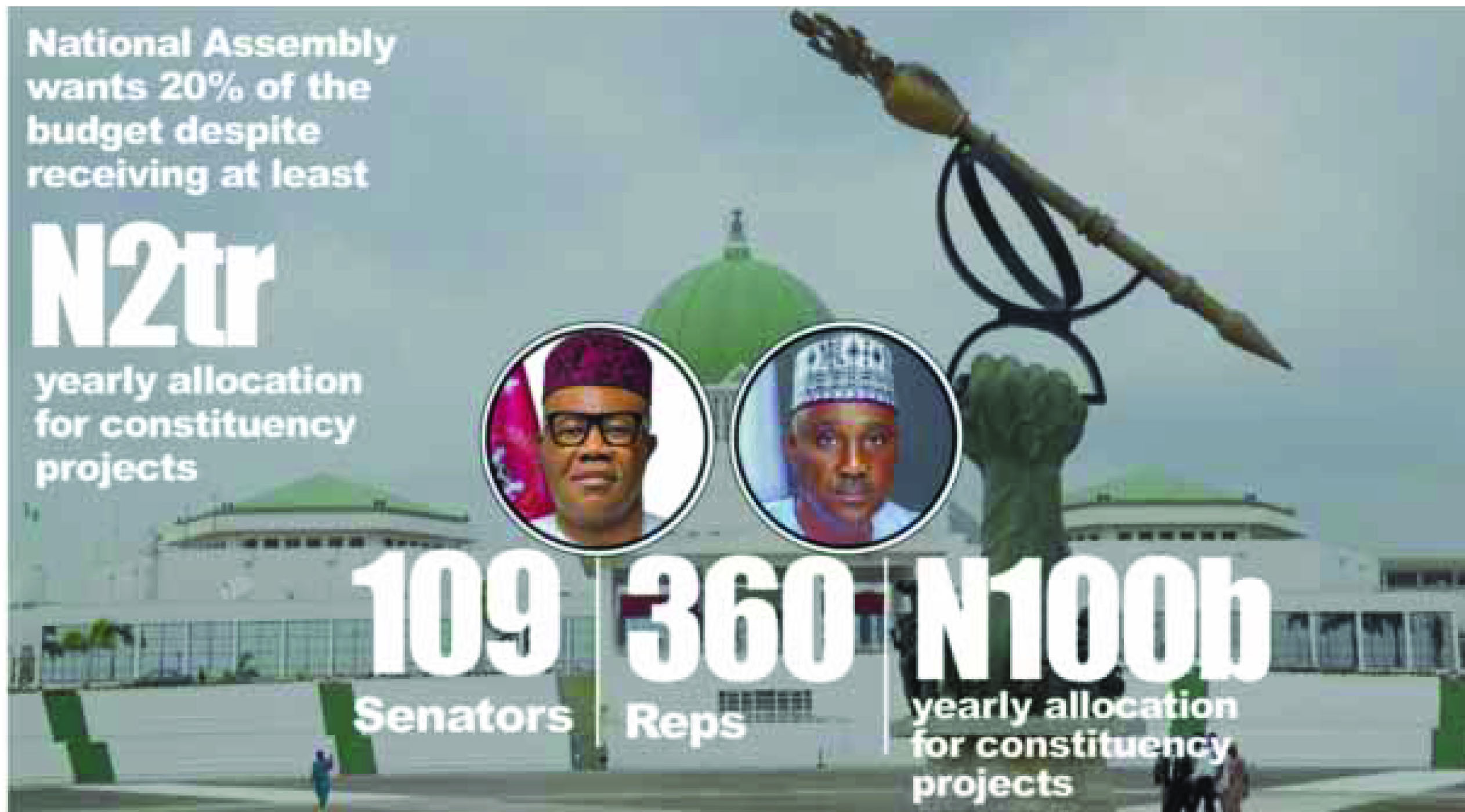

• Senators, Reps spent N2 trillion on projects in 21 years
• Constituency projects spread dividends of democracy, Senators insist
• For 20 years, I got only N100m – ex-Reps member Munguno
• Special intervention projects’ budgets illegal, opaque, should be scrapped – stakeholders
Twenty-one years after members of the National Assembly allegedly arm-twisted the executive to accommodate Special Intervention Projects (SIP), popularly known as constituency projects into the budget, fresh moves have begun to increase the vote currently pegged at N100 billion yearly.
[ad]
The Guardian investigation revealed that if their new proposal scales through, 20 per cent of the national budget will be appropriated for the constituency projects, to help “spread dividends of democracy to all the federal constituencies in Nigeria.”
Already, records show that at least N2 trillion has been spent on constituency projects since 2003 to date.
Checks revealed that between N95b and N100b had been allocated to the projects every year and shared among 109 senators and 360 members of the House of Representatives.
However, some federal lawmakers have criticised the N100 billion lump sum as “static” and insufficient to carry out meaningful projects within today’s realities.
[ad]
But quite challenging for past presidents and stakeholders is the value the constituency project and routine votes have brought to various constituencies, which are more united in squalor, infrastructural deficits, and abandonment.
The constituency project has an interesting past. Former President Muhammadu Buhari had in 2019 disclosed that there is little to show for over a trillion naira budgeted for constituency projects of the National Assembly in the last 10 years.

He said: “It is on record that in the past 10 years, N1 trillion has been appropriated for constituency projects, yet the impact of such huge spending on the lives and welfare of ordinary Nigerians can hardly be seen.”
Before him, former President Olusegun Obasanjo, who gave currency to the constituency projects for the lawmakers, also described it as corruption.
He earlier said, “You and I know what constituency projects mean. It is simply corruption.”
Senator Shehu Sani, who represented Kaduna Central Senatorial district during the Eighth National Assembly, said the implementation of constituency projects is an avenue “for theft and corruption employed by lawmakers.”
But the lawmakers want more of it. Speaking on the floor of the House, Senator Muhammed Tahir Munguno representing Borno North said, “The concept of constituency funding is a vehicle to reach the people at the grassroots level, to bring dividends of democracy to the doorsteps of our constituents”.
[ad]
He added that the major challenge over the years has been its implementation.
He recalled that when he was in the House of Reps, and throughout his five terms, he got only N100 million as constituency project fund; an amount he said was grossly inadequate.
He canvassed for a percentage of the budget to be set aside for constituency project funding, “because of the inflation trend in the country.”
Deputy Senate President, Jibrin Barau, said, as senators, they don’t need an Act to do what the Appropriation Bill intended to achieve, because “we have the authority to prescribe how money would be spent. Do you now need an Act to create any fund for the legislature?”
Senate President Godswill Akpabio lauded the new request for more votes for constituency projects, though urged that there be another gathering to take a second look at it in line with existing laws.
“The idea behind this bill is very laudable. We are making a law to have constituency projects appropriated. It is as if we don’t know our powers. Again, we have a separation of powers. Execution is the function of the executive, so any law you make that is inconsistent with any provision of the Constitution is null and void to the extent of that inconsistency.”
[ad]
Justifying the need for constituency projects, Senator Abdul Ningi, representing Bauchi Central, recalled that after the 2003 elections, the National Assembly had 82 per cent rate of non-return, which means only 18 per cent of the members came back.
He attributed the reason to legislators not having projects to lay claim to as their contribution to their constituencies.
Senator Wasiu Sanni Eshilokun, representing Lagos Central Senatorial District said constituency projects started in Lagos State in 1999.
He said: “Like what is happening here, every member will come with what is to be done in his constituency and move a motion. At the end of the day, you would find out that it was not provided for.
“At that time the leadership of the House said I should go and find a solution and we came up with the constituency project development.
“The President was the governor of Lagos State at that time. So, it will not be strange to him. Even if the government is doing very well, if you do not attract projects to your constituency, your people will term you a failure.”
Like past presidents, stakeholders also fault the lawmakers’ justification. Legal luminary, Prof. Itse Sagay (SAN), expressed aversion to constituency projects and said “the legislative arm of government has no business with such projects. It is unconstitutional and illegal.
[ad]
“I have always been opposed to constituency projects because first, the National Assembly should not be involved in projects at all. So, it is an invasion of the executive sphere. It is just how to lay their hands on more money. That is the whole idea,” he stated.
He said: “It is a Nigerian thing; it is unconstitutional, it is illegal, but we do it because they are blackmailing the executive that if you don’t give it to us, we will not approve any other thing you bring into the budget.”
Head of Tracka, Ayo Ladipo, said that while the constituency projects concept is not entirely bad, it has been abused and made legislators go beyond their mandate.
He said: “Legislators are seen to be interfering with the implementation process, meanwhile they are not supposed to, as MDAs are to implement them independently but they interfere right from procurement to award of contract.
“Meanwhile, their only mandate is to ensure there is proper oversight, whether the MDAs are executing according to plan but now they have spread their tentacles beyond oversight and now it is a total dictatorship.
“The major reason they are elected is to make laws and oversight the executive to enhance the county’s legislative system for the overall wellbeing. A lot of them have ignored that now to become project merchants, with which they can be more popular with their people, through the nomination of all the projects, as well as empowerment projects that will benefit a larger number of people.
“They nominate empowerment projects and use it to empower their party members alone, they use it to pay them back. We have seen cases where these events take place at the party secretariat when it is not supposed to be so because it is not a party project.
“It is a publicly funded project, which is supposed to be free and fair not for party patronage. Some take it to their family and friends. For people to access it, they will say he must be a card-carrying member of their party. By that, it is already an abused process. I think it should be scrapped entirely, the legislature should not have business with nominating projects and implementation.
[ad]
“I think anti-graft agencies should also take it up. They have to make somebody a scapegoat because we keep seeing a lot of these cases, but they think they are above the law. These cases will keep coming up until somebody is used as a scapegoat,” Ladipo said.
But a former senator, who represented Kogi East from 1999 to 2003, Alex Kadir saw it as the path to developing democracy.
He lamented that: “The way Nigeria is going, legislators have become part and parcel of the executive as they now want to do boreholes, construct roads, build schools and so on.”
He added: “That is the function of the executive. Legislators are supposed to make laws for the good governance of the country, and laws for the good governance of the state and local government.
“They are not expected to construct roads, sink boreholes, tar roads, or carry out other capital projects. I went to a place where the water tank had the inscription of the name of a particular senator, indicating that it was his constituency project.
“I don’t want to criticise my colleagues, but I think we are delving into the executive’s domain in the process. We will not have the moral courage to criticise the executive because we are going there to collect money for a project that they are supposed to be doing. This is the dilemma,” Kadir said.
[ad]

